
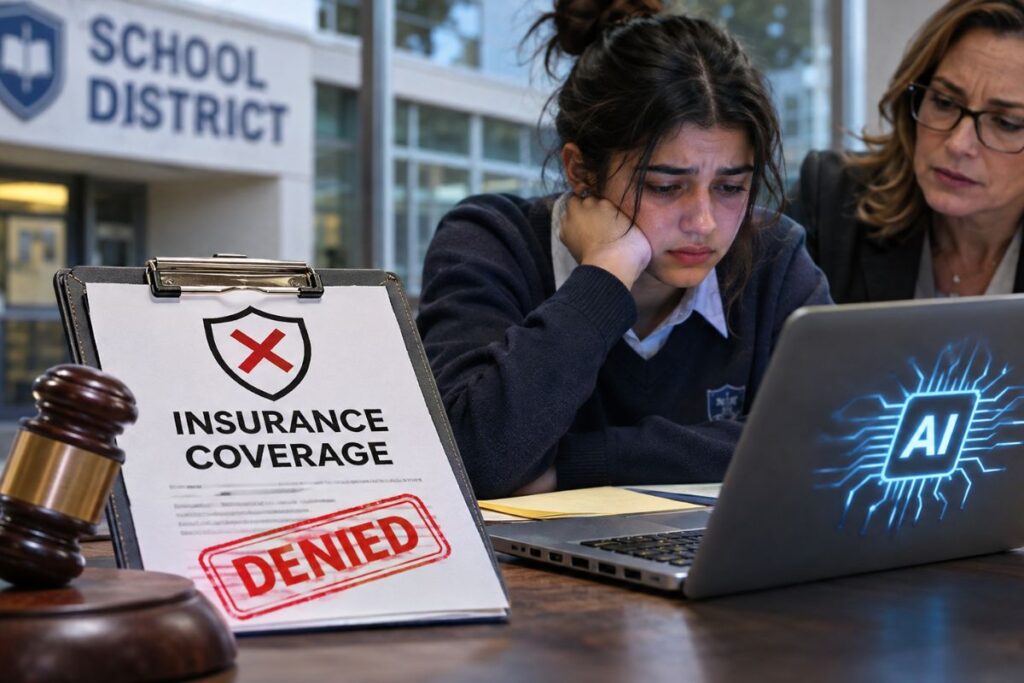
School district AI insurance liability policies will not cover lawsuits if a student is harmed by artificial intelligence on an assigned laptop. New policy exclusions eliminate coverage for bodily injury and emotional distress caused by generative models. Because procurement contracts shift liability onto local districts, taxpayers must fund seven-figure legal defense bills directly from operating budgets.
Why Do Student AI Injury Lawsuits Fall Between School Insurance Policies?
School liability insurance excludes generative model injuries because algorithmic self-harm claims allege physical and psychological injuries rather than network break-ins. Public schools buy Commercial General Liability to cover bodily injury and property damage, and Cyber Liability to cover electronic data breaches.
In 2026, the Insurance Services Office introduced standard exclusionary forms for commercial general liability policies, including endorsements such as ISO CG 40 47 Generative AI Exclusion. The Insurance Services Office is an advisory organization that drafts standardized policy language for the property and casualty insurance industry. These policy riders explicitly eliminate coverage for bodily injury, sickness, disease, and emotional distress arising out of generative artificial intelligence outputs. While related forms like CG 40 48 restrict exclusions to advertising and personal injury claims, broader market filings remove basic Coverage A protections when dynamic models are involved.
Cyber liability underwriters also reject these claims. Standard policy guidelines, as detailed in Cyber Liability Insurance Requirements, define an insurable event as an unauthorized system breach, malware deployment, or network security failure. When an enrolled student interacts with an integrated chatbot on an uncompromised browser session, no network breach has occurred.
Without coverage under general liability or cyber lines, school boards face these tort claims without an insurer paying defense fees.
How Do Cloud Vendor Contracts Shift Software Liability to Public School Districts?
Enterprise cloud software agreements systematically shift the duty of student supervision onto local districts while disclaiming third-party vendor fault. When school systems adopt Google Workspace for Education, the governing contract terms set clear boundaries regarding operational responsibility. Under the Google Workspace for Education Terms of Service, Google provides software infrastructure, while the institutional customer remains responsible for managing accounts, user access, and device oversight.
These enterprise agreements include unilateral liability limits and hold-harmless clauses. Platform vendors systematically disclaim responsibility for indirect, special, or consequential damages resulting from user interactions with consumer search integrations.
Public school risk retention pools, cooperative public trusts where member school districts pool tax funds to self-insure operational losses, warn their member boards about these gaps. Risk management programs and pooling associations have cautioned that school boards cannot transfer product liability back to hardware or software providers under standard cloud contracts.
School districts cannot negotiate bilateral revisions to these standard agreements. A rural or suburban district purchasing five thousand devices signs the same non-negotiable software terms as a multi-campus university.
Why Are Reinsurers Ending Silent AI Coverage for School Computing Fleets?
Insurers are abandoning “silent AI” coverage because non-deterministic conversational models produce unpredictable psychological responses that actuarial pricing models cannot evaluate. Silent AI refers to an underwriting condition where policies cover algorithmic losses simply because policy forms do not explicitly mention machine learning.
That silence has ended. Actuaries observed the civil complaint filed in California state court by North Carolina parents alleging that Google’s Gemini model fostered a fatal obsession in their 13-year-old daughter. Reinsurers recognized that unlike static software bugs, generative models generate non-deterministic outputs that cannot be evaluated using traditional actuarial tables.
Actuaries cannot calculate the likelihood that an integrated model will provide harmful instruction to an emotionally vulnerable minor. Because the risk cannot be priced, reinsurers refuse to back it.
Carriers have responded by issuing total exclusions across public entity renewals, mirroring the industry-wide removal of “silent cyber” coverage between 2018 and 2021. As commercial insurers restrict coverage terms, secondary reporting on Commercial Policy AI Exclusions confirms that brokers are warning public and corporate clients that algorithmic risks are being systematically stripped from baseline renewal towers.
What Administrative Mandates Must School Districts Meet to Retain Basic Umbrella Coverage?
Underwriters now require school technology directors to prove active technical blocking of search-layer generative tools before issuing annual renewal declarations. For the 2026–2027 renewal cycle, public school risk pools and commercial carriers are issuing supplemental underwriting questionnaires. To retain basic umbrella coverage, school districts must prove operational control over their device fleets.
These questionnaires require district superintendents and technology directors to certify several administrative safeguards:
- Verified deployment of administrative group policies that disable consumer search integrations across all minor-assigned profiles.
- Mandatory logging of third-party web filtering software that actively inspects client-side browser traffic on school-issued hardware.
- Formal board-approved acceptable-use policies signed by parents that disclaim institutional responsibility for unauthorized student prompts.
Meeting these conditions poses an operational challenge. School technology directors report that modern web filters intercept static uniform resource locators (URLs), not encrypted, dynamic model outputs generated inside standard search engines.
Districts that cannot confirm complete administrative blocking of search-layer generative tools receive non-negotiable coverage exclusions on their renewal declarations.
How Do Uninsured AI Tort Claims Directly Impact Local Property Taxpayers?
When an insurance carrier disclaims coverage under a generative model exclusion, the financial obligation falls entirely on the local school system’s operating budget.
Public school boards generally carry a Self-Insured Retention (SIR), the baseline dollar amount a public agency must pay out of pocket before excess coverage applies. For mid-sized suburban districts, retentions typically range from $100,000 to $500,000 per occurrence. When an exclusion applies, there is no excess policy. The district is responsible for the first dollar of legal defense and any ultimate settlement.
State tort claims acts provide limited protection. While sovereign immunity limits statutory damage payouts against public entities in states like North Carolina and Texas, capping recovery at set legislative thresholds, it does not cap the cost of retaining specialized outside trial counsel.
Defending a complex product liability and wrongful death lawsuit against technical discovery requires millions of dollars in legal fees, digital forensics, and expert witness retainers.
School districts do not maintain separate capital reserves for uninsured software litigation. Uninsured legal defense costs are drawn directly from unassigned general fund balances, the same operating ledger that pays for teacher salaries, classroom materials, and building maintenance. If a catastrophic verdict or protracted legal defense exhausts reserves, local school boards face two options: cut instructional budgets or introduce emergency tax levies to replenish public funds.
Related analysis: Read our investigation into Google’s classroom software bundling defense, enterprise risk exposure under banking AI sanctions and DORA rules, and how arbitration awards reshape commercial insurance policies.
Frequently Asked Questions
Does school district cyber insurance cover student injuries caused by generative AI?
No. Cyber liability insurance requires an unauthorized network breach, extortion demand, or system failure. Because student interactions with search-integrated models occur on authorized browser sessions without a digital intrusion, cyber policies deny coverage.
What is the ISO CG 40 47 endorsement on school liability policies?
The ISO CG 40 47 endorsement is a standardized general liability exclusion introduced in 2026 that removes Coverage A (bodily injury) and Coverage B (personal injury) arising from generative artificial intelligence. It strips policyholders of defense and indemnity payments if an algorithmic tool causes physical or mental injury.
Why can’t public schools force tech vendors to cover AI legal costs?
Under enterprise agreements like the Google Workspace for Education Terms of Service, vendors provide software infrastructure while assigning end-user supervision and device management to the school. These contracts include non-negotiable limitation-of-liability clauses that prevent school boards from transferring tort claims back to the platform.
What happens to school district finances when an AI claim is uninsured?
When an insurer denies coverage under an AI exclusion, the school district must pay all legal defense expenses from its own unassigned general fund balance. If litigation costs exceed existing contingency reserves, school boards must reallocate funds away from instructional classrooms or seek local tax millage increases.

Praseetha K
Praseetha K is the Managing Editor of Clarity Times. She edits, verifies and publishes the newsroom's articles, and also writes analysis on policy, law, business and technology. Articles she writes are edited by the Editor-in-Chief before publication.