Food companies still use DINCH in packaging because supermarket procurement scorecards forced them to spend millions retooling machinery for it a decade ago, and alternative plant-based materials fail under factory heat and line speeds. Contract packagers running on thin margins cannot afford another mechanical overhaul for an unproven substitute without risking severe seal failures.
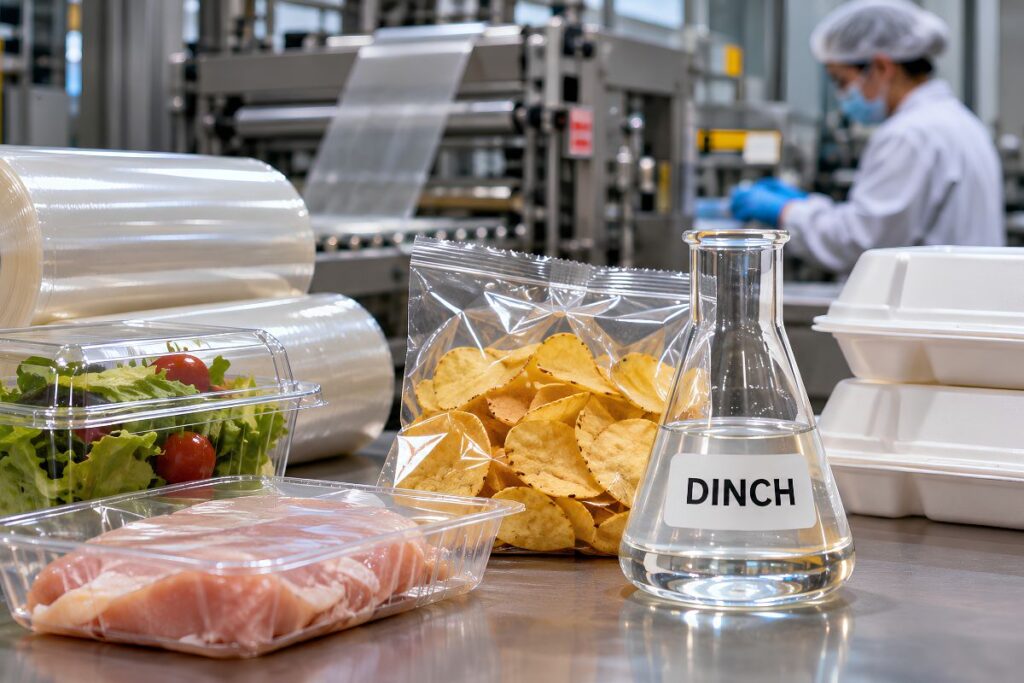
DINCH, technically known as 1,2-cyclohexane dicarboxylic acid diisononyl ester, is a synthetic chemical plasticizer used to make rigid plastics flexible, pliable, and resilient to mechanical cracking.
According to reporting by Clarity Times, contract food manufacturers are locked into DINCH not out of chemical preference, but because major grocery retail mandates forced plant conversions before viable, heat-resistant alternatives existed.
Why Did Food Packagers Retool Packaging Lines for DINCH?
Packagers switched to DINCH to meet private grocery chain rules that banned legacy ortho-phthalates across supply chains. Between 2014 and 2019, contract food manufacturers modified high-speed pouch-filling and bottling lines, absorbing significant capital debt to keep their supermarket retail accounts.
According to Mordor Intelligence’s conversion analysis of flexible line tooling, processors running automated lines face equipment payback horizons that exceed seven years. The capital went into recalibrating extruder temperature bands, cutting custom seal toolings, and installing chemical-resistant silicone gaskets suited to DINCH’s flow characteristics.
Because DINCH features higher fluid viscosity than the older phthalates it replaced, plant engineers had to overhaul mechanical feed pumps to maintain steady flow rates. Once installed, automated packaging machinery runs on standard depreciation cycles of seven to ten years. Scrapping functional lines early creates balance-sheet write-downs that contract converters cannot absorb.
How Did Supermarket Scorecards Replace Federal Regulation?
Supermarket sustainability scorecards acted as de facto private legislation, forcing processors to adopt DINCH while federal regulators took no formal action.
Beginning in the early 2010s, public interest advocacy groups organized under the Mind the Store Campaign graded national grocery chains on packaging additives. In response, grocery retailers updated their corporate purchasing requirements.
As documented in Walmart’s Chemical Footprint Project Disclosures, major retailers introduced strict chemical restrictions that required food suppliers to eliminate ortho-phthalates from product contact surfaces. Similar restricted substance lists across regional and national chains required co-packers to sign binding supplier declarations certifying that no legacy ortho-phthalates touched product packaging.
For corporate sustainability directors, the policy was a defensible public health step: legacy ortho-phthalates had documented scientific links to male reproductive abnormalities, and removing them eliminated an understood hazard.
Because the European Food Safety Authority had published a favorable safety evaluation cleared under EFSA Regulation (EU) No 10/2011 Annex I, and the U.S. Food and Drug Administration had accepted food contact notifications for the substance, retailers accepted DINCH as a cleared substitute. Contract packagers signed the warranties, financed the hardware conversions, and locked in the chemical.
Why Do Bio-Based Alternatives Fail on Industrial Packaging Lines?
Plant-based polymers and natural barrier coatings tear on automated packaging machinery and degrade during thermal food sterilization. Commercial manufacturing demands materials that survive continuous mechanical tension and high heat.
High-speed packaging equipment runs between 300 and 600 packages per minute. At that pace, sealing films require high tensile elongation, the physical capacity of a plastic film to stretch under stress without breaking. Unplasticized bio-based polyesters such as polylactic acid (PLA) and polyhydroxyalkanoates (PHA) exhibit low tensile elongation and brittle edges. During factory line tests, these materials suffer repeated web tears and puncture fractures at corner seals, halting operations.
Thermal preservation imposes an even stricter physical limit. Shelf-stable wet food, soups, and shelf-stable nutrition pouches require industrial retort sterilization: pressurized steam autoclaving at 121 degrees Celsius (250 degrees Fahrenheit) for up to 45 minutes to destroy spores of Clostridium botulinum.
Cellulose films and starch-derived barriers break down under continuous pressurized steam, causing package delamination and seal breaches. Flexible vinyl and polymer compounds plasticized with DINCH retain their tensile memory and airtight seal across the complete autoclave heating curve.
Without that physical stability, container seals fail during freight transit, creating immediate risks of bacterial food contamination.
What Did the NYU Grossman Pregnancy Study Reveal About DINCH?
A long-term epidemiological study found that maternal exposure to DINCH correlates with lower infant birth weights.
According to multi-cohort epidemiological research published by NYU Langone Health analyzing 6,617 mother-child pairs, every tenfold increase in maternal urinary concentration of DINCH breakdown products was associated with an average 27-gram reduction in infant birth weight.
The data upended the regulatory logic that drove the original packaging changeover. While DINCH avoids the androgen-blocking hormone disruptions caused by older ortho-phthalates, the epidemiological data revealed fetal growth deceleration.
This finding placed packaging facilities in an operational bind: the chemical they spent millions to adopt under retail pressure now carries scientific scrutiny, yet its commercial food contact clearances remain legally active.
Why Are Contract Packagers Unable to Pivot Away from DINCH?
Contract packagers operate on low profit margins that prevent them from financing a second line conversion without an approved, mass-manufactured chemical replacement.
Operating data published in the Contract Packaging Association State of the Industry Overview show contract packaging facilities routinely operate on net profit margins between 2% and 4%. With income constrained by rising labor and electricity costs, mid-tier packers cannot finance exploratory polymer research or scrap functioning equipment.
The commercial supply chain provides no drop-in chemical substitute. While chemical manufacturers formulate alternative non-phthalate plasticizers such as citrates and sebacates for medical tubes and cosmetics, few carry regulatory food contact clearances for high-temperature retort processing across flexible films. In addition, global production capacities for certified bio-based plasticizers remain a tiny fraction of industrial packaging demand.
For contract food manufacturers, the situation offers no quick exit. Dropping DINCH results in mechanical failure and ruptured packaging seals; retaining it exposes them to escalating public health criticism. Until industrial chemists invent a non-toxic plasticizer that withstands autoclave steam, commercial food packaging remains anchored to the machinery factories installed a decade ago.
Frequently Asked Questions
What is DINCH, and why is it used in food packaging?
DINCH is a non-ortho-phthalate chemical plasticizer added to flexible plastics and cap liners to keep them pliable, airtight, and resistant to cracking under pressure. Food processors adopted it after retail grocery chains banned older ortho-phthalates that disrupted male hormone development.
Can food companies immediately replace DINCH with plant-based plastics?
Current plant-based plastics such as PLA and cellulose break down during retort steam sterilization at 121 degrees Celsius and tear at standard factory packaging speeds of 300 to 600 units per minute. Abandoning flexible synthetic films without a functional replacement causes seal delamination and food spoilage.
Did government regulators force food companies to use DINCH?
Federal regulators did not mandate DINCH. Instead, major supermarket chains introduced private sustainability scorecards and restricted substance lists in the 2010s, requiring food processors to eliminate ortho-phthalates to keep their retail shelf placement.
What did the recent health study discover about DINCH?
A 2026 study of 6,617 mother-child pairs led by researchers at NYU Langone Health found that every tenfold increase in maternal urinary levels of DINCH metabolites was associated with an average 27-gram reduction in infant birth weight.

Praseetha K
Praseetha K is the Managing Editor of Clarity Times. She edits, verifies and publishes the newsroom's articles, and also writes analysis on policy, law, business and technology. Articles she writes are edited by the Editor-in-Chief before publication.