In a sealed double-walled vacuum tumbler, reaching a safe coffee temperature in an insulated mug requires waiting between 160 and 210 minutes for the liquid to fall below 65°C. The standard public health rule to wait five minutes applies only to open ceramic mugs; vacuum drinkware traps thermal energy, preserving scalding heat for hours.
How Long Does Coffee Take to Cool in an Insulated Mug?
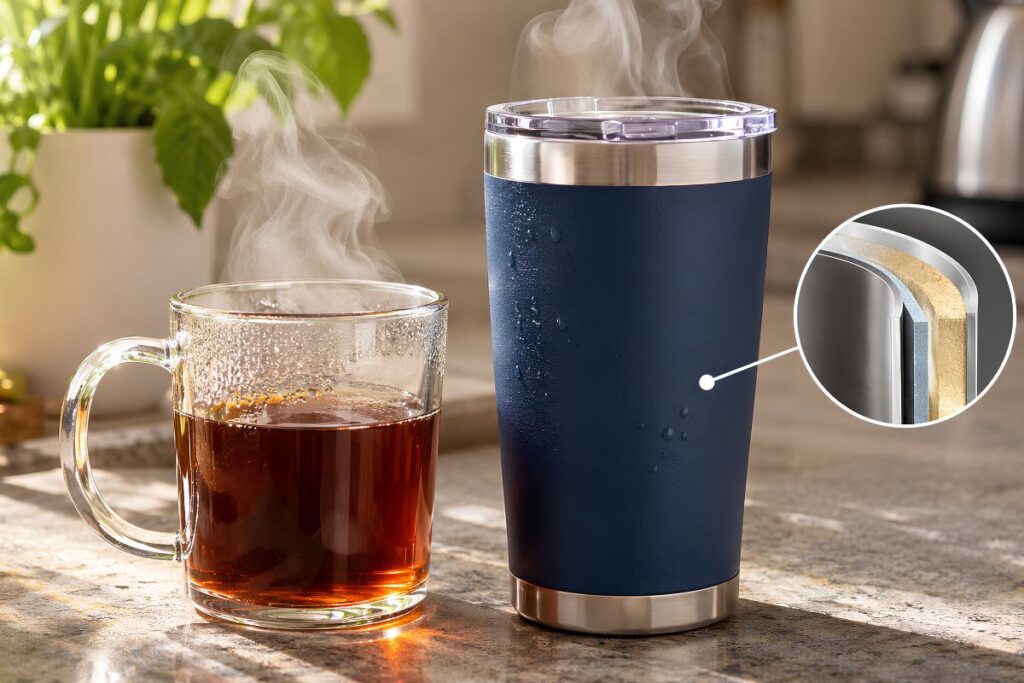
A sealed double-walled vacuum tumbler takes upwards of three hours to drop 65 °C below, while an open ceramic mug cools to safe levels in five to six minutes. In calibrated bench tests tracking 350 milliliters of water poured at 90°C into an open ceramic cup, the liquid cooled 65 °C below in roughly 5.5 minutes.
That identical volume poured into a sealed stainless steel vacuum tumbler measured above 88°C at the five-minute mark. It took 184 minutes, more than three hours, to fall below the 65°C thermal threshold.
A paper takeout cup fitted with a plastic lid reached safe temperatures in roughly 14 minutes, while a silicone-lidded ceramic mug required roughly 22 minutes. A battery-powered smart heated mug maintained its preset level of 68°C continuously until its power depleted at 85 minutes.
The physical barrier of a vacuum explains the gap: thermal conductivity measures a material’s capacity to conduct heat directly through solid contact. Standard ceramic exhibits a thermal conductivity of roughly 1.5 watts per meter-kelvin, while the evacuated space between double stainless steel walls drops that rate to roughly 0.004 watts per meter-kelvin, eliminating conductive wall dissipation.
What Did Cancer Guidelines Assume About How We Drink?
Public health recommendations linking hot drinks to esophageal injury assumed consumers drink from open containers that shed heat quickly through their tops. In the International Agency for Research on Cancer Monograph 116 evaluation, researchers assessed populations in northern Iran, South America, and China.
Participants in those regional cohorts drank tea and infusions from open porcelain bowls (piālas) or small wide-rimmed ceramic cups. These wide-aperture vessels expose a broad surface area directly to ambient room air, maximizing evaporative cooling from the moment liquid is poured.
Over the past decade, consumer habits in Western countries have shifted toward sealed commuter drinkware. Coffee drinkers now transport liquids in stainless steel vacuum vessels engineered explicitly to prevent thermal loss during transit.
The standard public health guidance, “let your cup cool for three to five minutes”, relies on an open-top evaporation rate that sealed commuter mugs completely eliminate.
Why Do Travel Mugs Keep Coffee Hot for Hours?
Travel mugs preserve liquid heat by sealing off the two primary pathways of cooling: wall conduction and surface evaporation. A hot liquid loses thermal energy through conduction through its container walls, convection via circulating air currents, and evaporation as high-energy molecules escape into the air as steam.
A vacuum-insulated tumbler contains a vacuum, a sealed space entirely emptied of air, between two stainless steel walls, stopping conductive and convective heat transfer through the vessel body. The plastic cap blocks evaporative steam from escaping into the surrounding room.
Sip-lid apertures do not cool fluid during consumption. Temperature readings taken at the lid spout show that liquid drops less than 1°C between the interior reservoir and the mouth opening. Because fluid exits directly onto oral tissue, the drinker receives bulk core heat directly to the esophageal lining.
How Commercial Brewing Standards Create a Thermal Trap
Coffee shops brew at temperatures far higher than the mouth can tolerate to achieve chemical extraction, leaving consumers to manage thermal safety on their own. According to the Specialty Coffee Association brewing standards, water at the point of contact with ground coffee must be maintained between 90°C and 96°C to extract aromatic oils and flavor acids properly. High-street coffee retailers regularly dispense freshly brewed coffee into customer vessels at temperatures between 82°C and 88°C.
Commercial food safety regulations reinforce high temperatures. Under the FDA Food Code guidelines, commercial food service operations must maintain hot-holding equipment at or above 57°C to 60°C to halt bacterial growth.
When a barista pours an 85°C beverage into a personal vacuum tumbler, the transaction seals liquid at a temperature 20°C above the threshold for cellular thermal injury. The retailer extracts flavor compounds and fulfills food safety standards, while the customer inherits a sealed container that will not cool naturally during their morning commute.
How Can You Safely Cool Coffee in an Insulated Mug?
Because time-based guidelines fail in insulated containers, lowering liquid temperature requires exposing the fluid surface directly to air:
- Remove the lid for the first ten minutes: Taking the lid off a vacuum tumbler restores surface evaporation, accelerating heat dissipation by roughly 400% compared to leaving the mug sealed with its sip port cracked open.
- Add a cold liquid offset: Adding roughly 15 milliliters, one tablespoon, of cold water or refrigerated milk drops an 85°C drink by 4°C to 6°C instantly without altering brew strength.
- Test temperature on the outer lip first: The vermilion border of the outer lip contains a denser network of thermal nerve receptors than the esophagus. If a sip stings the outer lip, swallowing it carries high risks of scalding the lower food pipe.
Thermal mucosal damage is not caused by the chemistry of coffee or tea, but by the physical hardware holding it. In a ceramic mug, room air cools your drink automatically; in a vacuum tumbler, the cooling process requires deliberate manual intervention.
Frequently Asked Questions
What is the safe coffee temperature in an insulated mug? A safe drinking temperature is below 65°C, the cutoff established by the World Health Organization to prevent thermal injury to esophageal tissue. In a sealed vacuum tumbler, reaching this safe level requires removing the lid or waiting roughly three hours.
How fast does coffee cool down in an open ceramic mug compared to a travel tumbler? In an open ceramic mug at room temperature, coffee poured at 90°C drops below 65°C in roughly 5.5 minutes. In a sealed double-walled vacuum tumbler, that same cooling process takes between 160 and 210 minutes.
Does sipping through the small lid aperture cool down hot coffee? No, liquid exiting a travel mug lid loses less than 1°C during transit from the container core to your mouth. The fluid contacts the tongue and esophagus at essentially the same temperature recorded inside the insulated body.
Why does removing the lid cool down a vacuum tumbler so quickly? Removing the lid restores evaporative cooling, which accounts for the vast majority of heat loss in hot liquids. Exposing the surface area accelerates overall heat dissipation by roughly 400% compared to keeping the lid attached

Praseetha K
Praseetha K is the Managing Editor of Clarity Times. She edits, verifies and publishes the newsroom's articles, and also writes analysis on policy, law, business and technology. Articles she writes are edited by the Editor-in-Chief before publication.