
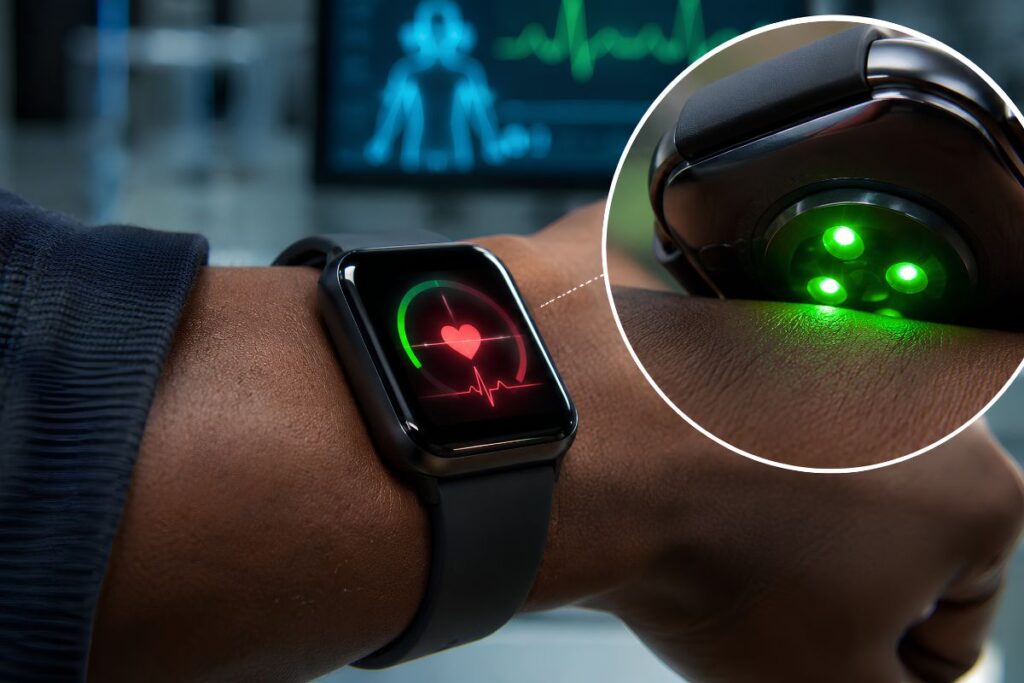
Smartwatches give less accurate heart rate and blood oxygen readings on darker skin because their green-light sensors are heavily absorbed by melanin. This optical loss widens error margins and forces software to guess missing pulses, making readings least reliable in populations facing the highest rates of high blood pressure and heart disease.
Why Does Melanin Interfere With Smartwatch Heart Rate Sensors?
Photoplethysmography is an optical technique that measures blood volume changes by shining light into tissue and detecting how much light reflects back to a photodiode sensor.
At the center of every consumer optical heart monitor is an unyielding principle of physics: melanin absorbs light across the visible spectrum, reaching peak absorption at shorter wavelengths. Most commercial smartwatches rely on green light, centered at roughly 530 nanometers. When that light enters skin with high concentrations of epidermal melanin, categorized as Fitzpatrick skin phototypes V and VI, it weakens before reaching the blood vessels beneath.
Data from bench-testing protocols evaluating optical sensors, such as clinical datasets from Duke University’s BigIdeasLab and peer-reviewed sensor reviews published in npj Digital Medicine, demonstrate that this absorption profile significantly suppresses the signal-to-noise ratio. On light skin (Fitzpatrick phototypes I–II), the optical sensor receives a clear pulse waveform. On dark skin, the raw optical signal-to-noise ratio drops by 8 to 12 decibels under identical resting conditions.
When that signal deteriorates, the device cannot reliably capture every physical heartbeat directly. Instead, software filters run predictive algorithms to bridge the missing data, estimating where peaks ought to fall rather than recording raw arterial pulses.
Did FDA Clearance Require Wearable Testing on Diverse Skin Tones?
Federal regulators cleared major smartwatch cardiac features without mandating proportional representation across different skin tones.
The federal clearance process for consumer wearable features did not enforce proportional demographic quotas across skin tones. When device makers submitted their irregular rhythm applications to the United States Food and Drug Administration (FDA) under the 510(k) pathway, validation testing frequently drew from majority-white cohorts.
A review of the FDA’s 510(k) Premarket Notification Database illustrates how substantial equivalence operates in practice. Regulatory summaries, such as the Fitbit ECG App clearance (K200948) and Samsung’s updated ECG algorithm clearance (K240909), reveal participant demographics where White subjects accounted for 87.7% of the clinical cohort, while Black or darker-skinned representation formed a fraction of the enrolled population.
The FDA evaluates substantial equivalence to existing predicate devices, rather than demanding the large multi-center clinical trials required for novel high-risk implants. While the agency has increasingly emphasized clinical trial diversity in recent guidance, historical clearance files continue to underpin current consumer software.
Device manufacturers note that their consumer smartwatches are cleared as secondary notification systems rather than diagnostic tools. They maintain that multi-LED clusters, ambient light sensors, and machine learning models compensate for background noise across daily wearing conditions.
Why Do Smartwatches Use Green Light Instead of Infrared?
Smartwatches use green LEDs instead of infrared light because green wavelengths resist motion interference during exercise and consume significantly less battery power.
Clinical pulse oximeters, such as the finger clips used in hospitals, do not use green light. They use dual-wavelength arrays: red light at 660 nanometers and infrared light at 940 nanometers. Melanin absorbs red and infrared light far less than green light, allowing the signal to travel through deeply pigmented tissue.
Wristwear manufacturers turned away from red and infrared light for routine heart-rate tracking due to two constraints: motion and battery consumption.
Red and infrared light penetrate deep tissue layers, but any movement of the wrist shifts muscle and skin, creating severe motion artifacts. Green light penetrates only into the upper dermis. While that shallow depth makes it vulnerable to melanin absorption, it leaves the signal far less distorted by moving tendons during daily exercise.
Sensor component engineering documentation from HQG LED Wearable Power & Thermal Specifications notes that smartwatches rely on small 300–400mAh batteries. Driving high-power optical emitters continuously drains power in hours. Low-power green emitters require less current to deliver motion-resistant readings, prompting hardware teams to accept green light as the wearable standard.
How Does the Sensor Error Margin Intersect With Heart Disease Risk?
The optical drop in smartwatch sensors aligns directly with populations that suffer the highest rates of cardiovascular disease.
The technical limitation does not exist in an epidemiological vacuum. The populations subject to the largest optical signal loss correlate with those bearing the highest burden of cardiovascular and metabolic illness.
According to demographic surveillance published by the Centers for Disease Control and Prevention (CDC), non-Hispanic Black adults in the United States have an age-adjusted hypertension prevalence of 59.6%, compared to 44.5% for non-Hispanic White adults. Black Americans also experience disproportionately higher rates of fatal stroke and cardiovascular complications.
Because optical attenuation peaks in Fitzpatrick types V and VI, people at higher statistical risk for hypertensive heart disease receive readings from sensors operating at their widest standard deviation. When sensor accuracy weakens, false negatives risk masking abnormal heart rhythms, while false positives trigger unnecessary anxiety.
What Are the Engineering Trade-Offs in Fixing the Optical Gap?
Fixing the optical gap requires pumping more electrical current through LEDs or adding multi-spectral arrays, both of which shorten battery life and create wrist heat.
Correcting the optical disparity requires either changing the light source or driving more electrical current through the skin. Both options reduce battery performance.
Pumping higher drive current through green LEDs compensates for melanin absorption by forcing more photons through the epidermis. However, increasing emitter current drains battery cells rapidly. In sealed, compact watch cases, higher power density also generates localized heat against the skin.
Engineers are testing alternatives, including ASME-documented polarized sensor architectures, which isolate deeper vascular reflections without relying purely on high optical intensity. Still, consumer wearable brands market multi-day battery lives as a key selling point. Resolving optical variance on high-melanin skin involves an unavoidable hardware trade-off: sacrificing battery longevity to generate cleaner physical light signals.
How Should Doctors Handle Smartwatch Data From Diverse Patients?
Clinicians currently lack guidelines to tell whether a patient’s exported smartwatch recording reflects genuine physical telemetry or algorithmic estimation.
Because consumer wearables are marketed around health awareness, primary care doctors and cardiologists increasingly manage visits triggered by consumer sensor tracings.
In clinical practice guidance from the American College of Cardiology (ACC), cardiologists note that while wearable devices show high sensitivity for atrial fibrillation under ideal conditions, there are no standardized guidelines on handling consumer-grade telemetry across diverse patient populations. A doctor reviewing an exported smartwatch PDF has no notation indicating whether the underlying tracing was captured with high optical fidelity or reconstructed through algorithmic interpolation.
Without standardized reporting on signal confidence and skin calibration, doctors must either repeat the entire diagnostic workup using traditional 12-lead ECGs and Holter monitors or dismiss the patient’s data entirely. As long as wristwear manufacturers treat light absorption as an edge case resolved by software smoothing, the physical limitation remains on the wrist and in the clinic.
Related analysis: Explore how employers address wearable security in our guide to workplace Apple Watch bans and our medical investigation into diagnostic delays in underserved patient demographics.
Frequently Asked Questions
Why are smartwatches less accurate on dark skin tones?
Smartwatches use green LEDs (~530nm) for heart-rate monitoring, a wavelength that melanin absorbs much more readily than red or infrared light. On darker skin (Fitzpatrick types V–VI), this absorption weakens the reflected light signal by 8 to 12 decibels, forcing the watch’s software to mathematically predict missing heartbeats.
Did the FDA test Apple, Samsung, and Fitbit watches on dark skin before clearing them?
FDA 510(k) clearances evaluate whether a product is substantially equivalent to existing devices, which allowed manufacturers to submit clinical studies with majority-white validation cohorts. In regulatory filings like Fitbit’s K200948 and Samsung’s K240909, white participants accounted for over 87% of the clinical cohort, leaving darker skin phototypes minimally represented.
Why don’t smartwatch makers simply switch to red or infrared light?
Red and infrared wavelengths penetrate deeper tissue, making them far more vulnerable to motion distortions caused by flexing wrist tendons during everyday movement. Green light stays in the upper dermis, where it resists motion noise and uses far less battery power, allowing devices to maintain multi-day battery life.
Can doctors rely on smartwatch ECG and heart rate data for medical diagnoses?
Smartwatch exports to doctors do not indicate whether a reading was an actual pulse or an algorithmically filled estimate. Because professional guidelines from the American College of Cardiology lack calibration standards for skin phototypes, physicians typically must re-test patients using standard clinical 12-lead ECGs and Holter monitors.

Praseetha K
Praseetha K is the Managing Editor of Clarity Times. She edits, verifies and publishes the newsroom's articles, and also writes analysis on policy, law, business and technology. Articles she writes are edited by the Editor-in-Chief before publication.