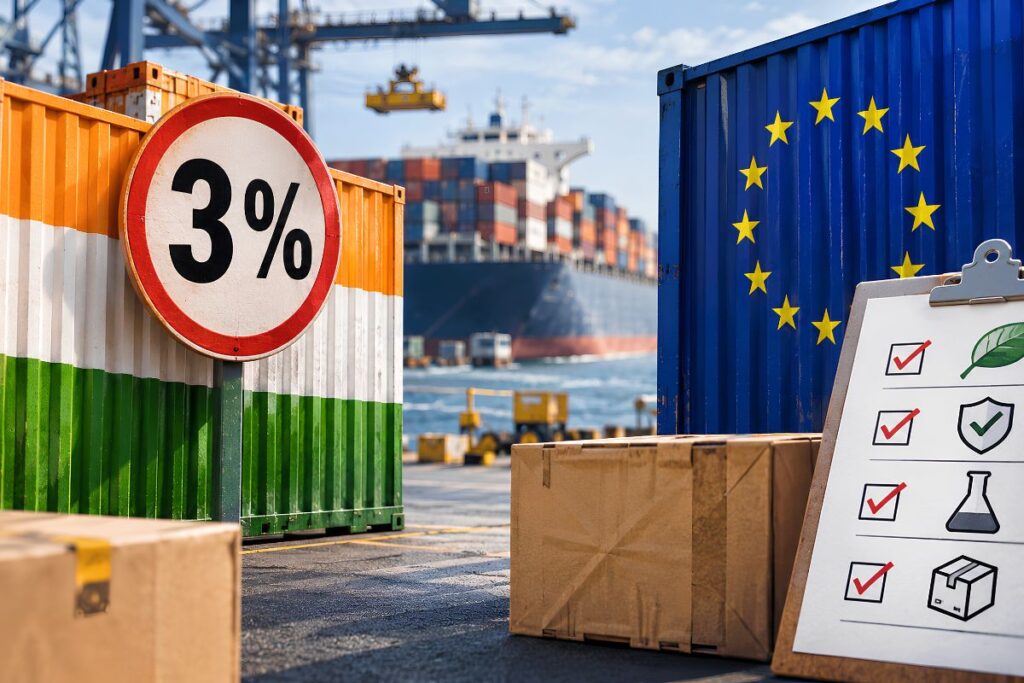
Clearing non-tariff barriers in India-EU trade costs an Indian small-to-midsize exporter between 8% and 15% of shipment value in recurring testing, audits, and compliance fees. Because average European import tariffs on Indian manufactured goods were already below 4%, duty cuts alone cannot offset the regulatory expenses that govern actual market access.
Did Import Tariffs Ever Restrict Indian Goods Entering Europe?
Import tariffs rarely determined whether Indian goods crossed the European border.
A matching of transaction records from India’s Directorate General of Commercial Intelligence and Statistics (DGCI&S) against the European Commission’s TARIC Consultation Database shows that over 70% of Indian export value entered the European single market under applied Most Favoured Nation (MFN) duties between 0% and 3%. MFN duties are the standard, baseline customs tariffs that World Trade Organization members charge imports from all other members when no preferential trade treaty applies.
For IT hardware, polished diamonds, bulk active pharmaceutical ingredients, and primary organic chemical lines, base border duties stood at zero long before free-trade negotiators finalized terms.
Tariffs did matter in specific product classes. Indian ready-made garments and leather footwear paid European duties between 9% and 12%, placing them at a direct price disadvantage against competitors from Bangladesh, which entered tariff-free under the European Union’s Everything But Arms trade program. Eliminating those duties creates price parity at European docks.
Yet for the broader manufacturing base, the elimination of a 3% to 4% average tariff removes a barrier that had already largely vanished. An empirical study on technical harmonization published by the Indian Council for Research on International Economic Relations (ICRIER) confirms that product technical standards, not border customs duties, exert the dominant drag on trade volumes between developing nations and advanced trade blocs. The true gatekeeper sits inside the testing laboratory and the audit trail.
How High Is the Real India-EU FTA Compliance Cost for MSMEs?
The real India-EU FTA compliance cost functions as an 8% to 15% surtax on small-batch exports, far outweighing the average 3% to 4% tariff cut negotiated in the agreement.
Quantitative estimates from the United Nations Conference on Trade and Development via the UNCTAD TRAINS Database indicate that the ad valorem equivalent, the estimated percentage tax rate of a non-tariff regulation expressed as a direct border duty, of technical standards and sanitary controls routinely exceeds nominal import duties by several multiples. When measured against invoice values, those mandates impose an effective compliance surcharge of 8% to 15% on smaller export consignments.
Consider the mandatory line items facing an engineering workshop shipping industrial valves or cast components to Germany:
- Conformity Assessments and CE Marking: Third-party product safety evaluations require factory production control audits that run between €4,000 and €9,000 per product family. CE marking is the mandatory conformity mark required for industrial and electronic products sold within the European Single Market, certifying compliance with EU health and safety directives.
- Chemical Registration (REACH): Under the European Chemicals Agency framework, laboratory substance screening to prove materials are free of restricted chemicals costs between €1,200 and €2,500 per material formulation. REACH stands for Registration, Evaluation, Authorisation and Restriction of Chemicals, the European Union’s chemical safety statute.
- EU Authorised Representative Retainers: Non-EU manufacturers must retain a legal entity based inside the bloc to hold technical files and handle regulatory inquiries. Annual retainers range from €1,500 to €3,500, plus per-incident handling charges.
- Traceability and Packaging Audits: Under updated European waste, packaging, and digital product passport frameworks, separate national registrations across individual member states add recurring administrative fees.
For an exporter shipping €60,000 worth of specialized engineering valves in a quarter, an €8,000 compliance, testing, and legal outlay works out to a 13.3% surcharge on that trade flow.
The tariff dropped by 3%. The regulatory entry ticket took four times that amount.
Why Can’t a Free Trade Agreement Eliminate EU Standards?
A free trade agreement eliminates border tariffs between nations, but it legally cannot lower or suspend domestic consumer safety and environmental standards enforced inside the destination market.
The finalized text of the India-EU agreement includes dedicated chapters on Technical Barriers to Trade (TBT) and Sanitary and Phytosanitary (SPS) measures. Those chapters establish bilateral working groups to discuss rules and streamline paperwork. They do not alter European safety ceilings.
Under European Union law, regulations like the General Product Safety Regulation (GPSR), the REACH chemical registry, and the Ecodesign for Sustainable Products Regulation are non-discriminatory domestic baselines. European authorities apply them equally to a foundry in Bavaria and a foundry in Coimbatore. The European Commission cannot legally grant an Indian factory a waiver on lead content or machinery safety mechanisms without rewriting legislation that governs 27 member states.
The treaty eliminates border taxes. The single market’s internal product standards remain absolute.
How Does EU CE Marking Cost Create a Scale Squeeze on Indian MSMEs?
Because European testing and certification fees are fixed rather than proportional to volume, small enterprises absorb an overhead burden up to six times higher than large conglomerates on identical product lines.
A testing agency charges the same fee to certify a batch of 500 garments as it does for a batch of 50,000. It charges the same fee to test the tensile strength and alloy purity of ten pump housings as it does for ten thousand.
- A conglomerate exporting €5,000,000 worth of goods across a quarter absorbs a €20,000 testing bill as a 0.4% overhead on turnover.
- A micro, small, or medium enterprise (MSME) shipping €50,000 over the same period absorbs that same testing bill, or a minimal €4,000 single-product equivalent, as an 8% to 10% hit to gross revenue.
The fixed nature of these testing mandates gives domestic Indian conglomerates a decisive advantage over small-scale competitors in the same industrial clusters.
Trade analysis published by the Federation of Indian Micro and Small & Medium Enterprises (FISME) warns that without dedicated compliance mechanisms, small producers will face margin erosion as European buyers push regulatory burdens downstream.
European testing, inspection, and certification providers operate accredited facilities in Indian hubs. Their pricing reflects global technical rates, not local operating margins.
Because small businesses cannot amortize fixed auditing bills across millions of units, they face a choice: absorb the overhead and wipe out operating margins, or retreat from direct European exports to act as sub-tier suppliers for domestic conglomerates that hold the master certificates.
Why Does the NABL Accredited Lab Shortage Delay Shipments to Europe?
A severe domestic shortage of laboratories with European notified-body recognition forces Indian exporters to reroute test samples to Europe, adding two to five weeks of production delays and steep foreign currency fees.
India’s National Accreditation Board for Testing and Calibration Laboratories (NABL) maintains international Mutual Recognition Arrangements through ILAC and APAC. Yet only a narrow fraction of those domestic laboratories hold formal notification status or specific sector agreements with European regulators such as the European Chemicals Agency or European notified bodies under EU directives. NABL is the statutory body authorized by the Government of India to assess the technical competence of testing and calibration laboratories.
Without direct EU-notified status, European customs officials at entry points like Rotterdam, Hamburg, or Antwerp do not automatically accept test certificates issued by unapproved domestic laboratories.
Exporters face two choices. They can pay international testing agencies operating inside India to certify their consignments, or they can air-freight product samples to European testing centers before dispatching cargo. Shipping samples to laboratories in France or Germany adds two to five weeks to production lead times, along with air-courier and foreign currency testing invoices.
When documentation fails, cargo stalls. Border rejection and detention records from the European Commission’s Rapid Alert System for Food and Feed (RASFF) and the EU Safety Gate portal document regular consignments of Indian spices, agricultural goods, and consumer hardware flagged for pesticide residues, hazardous chemicals, or missing conformity paperwork.
Demurrage charges at European ports rapidly turn delayed shipments into total write-offs.
What Practical Interventions Do Exporters Need to Reach the EU Market?
Actual market access requires the Indian government to fund accredited domestic testing facilities and negotiate mutual recognition agreements, rather than relying on border tariff cuts alone.
The European Commission maintains that product safety rules protect 450 million consumers from unsafe electronics, hazardous chemicals, and contaminated food. The rules apply identically to domestic European manufacturers, who must shoulder the same testing burdens and legal responsibilities.
From the Indian government’s perspective, securing zero-duty terms was an essential defensive move. Commerce Ministry negotiators point out that without tariff parity, Indian exporters in labor-heavy sectors like garments, leather goods, and home textiles faced an immediate 9% to 12% price disadvantage against regional competitors. Eliminating that tariff wall was a necessary first step.
Yet zero-tariff status creates an entry permit, not a market share guarantee.
Domestic export programs like the Market Access Initiative and the Remission of Duties and Taxes on Exported Products (RoDTEP) were designed around freight costs and local tax rebates. They provide little direct financial or technical support for the complex, recurring costs of international conformity certification.
When Vietnam secured its free trade agreement with the EU, its government invested directly in state-backed laboratory certifications, subsidized international accreditation programs, and built centralized digital supply-chain traceability platforms for agricultural and light industrial clusters.
Unless India couples tariff relief with a parallel build-out of state-funded, EU-recognized domestic testing infrastructure, the gains from the agreement will flow primarily to high-volume conglomerates that already have capital to clear the compliance barrier.
Small producers will find that while the tariff wall at the border came down, the paperwork gate remained closed.
Frequently Asked Questions
What are the main non-tariff barriers Indian exporters face when selling to the European Union?
Indian exporters face European technical and chemical regulations, including CE marking conformity assessments, REACH chemical limits, and the General Product Safety Regulation. Meeting these standards requires product lab tests, continuous supply-chain traceability audits, and mandatory retainers for EU-based Authorised Representatives.
How much do EU compliance requirements cost an Indian MSME?
For a small-to-midsize Indian exporter shipping €50,000 to €60,000 worth of goods per quarter, initial testing, product registration, and compliance retainers average €4,000 to €8,000 per product category. According to exporter billing audits and UNCTAD trade data, this expenditure amounts to an 8% to 15% surcharge on shipment value.
Can the India-EU Free Trade Agreement waive European product standards for Indian goods?
No, the bilateral trade agreement cannot waive European product standards. While the treaty eliminates import duties at border customs, regulations like REACH, GPSR, and EU deforestation rules are non-discriminatory internal consumer safety laws that apply uniformly to all products sold within the 27 EU member states.
Why cannot Indian exporters use domestic NABL laboratories for EU export certification?
While India has hundreds of NABL-accredited facilities, very few hold formal notification status or mutual recognition agreements with specialized European regulators like the European Chemicals Agency or European notified bodies. Without direct EU recognition, European port customs officials require certifications from international inspection agencies or overseas European laboratories.

Praseetha K
Praseetha K is the Managing Editor of Clarity Times. She edits, verifies and publishes the newsroom's articles, and also writes analysis on policy, law, business and technology. Articles she writes are edited by the Editor-in-Chief before publication.