
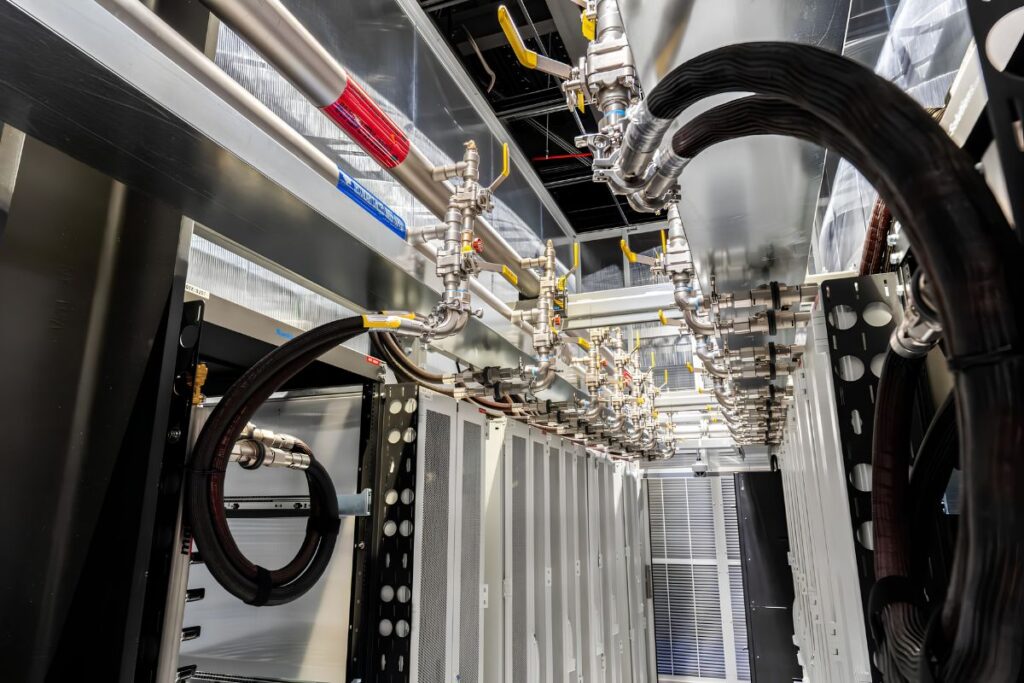
Data centre cooling suppliers like Aeroflex Industries Limited and MTAR Technologies Limited risk finding their multi-hundred-crore factory expansions misaligned with market demand by FY28. Their new production lines manufacture single-phase water-glycol manifolds, while upcoming artificial intelligence server racks drawing over 120 kilowatts require high-pressure direct-to-chip phase-change or dielectric systems that standard flexible metal hoses cannot accommodate.
A liquid cooling skid is a modular mechanical framework that houses the pumps, heat exchangers, valves, and manifold connections needed to circulate fluid through server racks.
According to technical specifications published by the Open Compute Project (OCP) Cooling Environments community, standard single-phase liquid cooling systems will encounter structural fluid limits as rack power density crosses 120 kilowatts.
| Metric / Feature | Current Single-Phase (Water/PG25) | Next-Gen Two-Phase |
| Rack Power Capacity | 30 kW – 80 kW (Strained @ 120 kW) | 120 kW – 200+ kW |
| Primary Coolant | Water-Propylene Glycol (PG25) | Dielectric / Fluorochemicals |
| Required Fluid Flow Rate | >1.45 Litres/min per kW | Latent Heat (Low Volumetric Flow) |
| Core Hose Metallurgy | 304 / 316L Stainless Steel | Ultra-Clean Vacuum Brazed Alloys |
| Primary Joint Seals | Crimped EPDM / Nitrile Elastomer | Brazed Metal-to-Metal / PTFE |
| Asset Re-tooling Risk | Sunset standard for high-density | High Capital Barrier |
Why Does Next-Gen AI Chip Architecture Break Existing Factory Tooling?
Next-generation artificial intelligence silicon generates heat concentrations that exceed the thermal dissipation capacity of standard single-phase liquid cooling.
Single-phase liquid cooling refers to thermal management systems in which a coolant, typically water mixed with propylene glycol, remains entirely liquid while absorbing heat from computer chips. That design functions reliably when server racks consume between 30 and 80 kilowatts.
Above 120 kilowatts per rack, the baseline demand set by architectures like the NVIDIA GB200 NVL72 and competing accelerator clusters, the physical limits of fluid transport emerge.
According to Open Compute Project yvlkoilsce, dissipating more than 120 kilowatts with single-phase water-glycol requires volumetric flow rates exceeding 1.45 litres per minute per kilowatt. To cool a single 130-kilowatt rack, a cooling distribution unit must circulate roughly 190 litres of liquid every minute through tight cabinet manifolds.
At that speed, standard 304 and 316L corrugated flexible stainless steel hoses experience severe differential pressure drops. Pumping liquid at this volume induces cavitation, a physical process where vapor bubbles form and violently collapse, eroding metal hose walls from the inside.
To overcome this hydraulic barrier, thermal engineers are shifting rack designs toward direct-to-chip two-phase cooling and dielectric chemistries. In two-phase systems, low-boiling-point fluid vaporizes inside the cold plate, using the latent heat of vaporization to absorb heat before condensing in a secondary heat exchanger. This phase change removes thermal loads without requiring extreme flow rates.
This architectural change removes the need for conventional flexible metal hoses designed for low-pressure water loops.
What Is the Timeline Mismatch in Current Precision Engineering Capex?
Indian precision engineering suppliers are deploying long-gestation capital into production infrastructure configured for single-phase hardware that may face reduced demand by completion.
Aeroflex Industries Limited is executing a ₹202 crore capital expenditure plan across its flexible hose and skid divisions to reach full output by March 2028, according to its corporate disclosures filed with the BSE and reported in Free Press Journal’s industrial coverage. The company is allocating ₹124 crore to scale stainless steel hose and braiding capacity to 30 million metres, alongside ₹78 crore to boost liquid cooling skid capacity to 30,000 units annually.
MTAR Technologies Limited has similarly expanded its conventional CNC machining and precision fabrication footprint across its Hyderabad manufacturing facilities to capture data centre and clean-energy demand.
The machinery arriving on these factory floors consists primarily of mechanical tube corrugators, automated wire braiders, and atmospheric tungsten inert gas (TIG) welding cells. These machines are engineered to fabricate corrugated stainless steel assemblies for standard industrial fluid movement and first-generation cooling skids.
The procurement and commissioning cycle for these industrial production lines requires 18 to 24 months. By the time this capacity reaches peak operating volume in FY28, tier-1 data centre operators will already be deploying their second generation of high-density phase-change server racks.
Can Hose Fabricators Easily Adapt to Dielectric and Two-Phase Chemistries?
Adapting a manufacturing line from water-glycol assemblies to dielectric fluid systems requires an overhaul of metallurgical standards, joining techniques, and plant contamination controls.
Dielectric coolants are non-conductive fluids designed to circulate directly over or around electrical components without causing short circuits. These specialized fluids and fluorochemical coolants possess lower surface tension and lower viscosity than water-glycol mixtures. A fitting sealed to hold water at 6 bar of pressure will leak when carrying low-surface-tension dielectric liquids under continuous operating pressure.
Standard industrial assemblies rely on mechanically crimped joints and elastomeric seals made from nitrile or ethylene propylene diene monomer (EPDM) rubber. Fluorochemical coolants break down these rubber compounds over months of use, leaching plasticizers into the fluid and clogging the microscopic coolant channels inside server cold plates.
Two-phase systems instead demand specialized fluoropolymer seals, vacuum brazing, and metal-to-metal orbital welds performed under controlled clean-room conditions. They must satisfy the piping integrity standards set by the American Society of Mechanical Engineers under ASME B31.3 Process Piping specifications, which govern leak-tight pressure retention and radiographic weld inspections.
A manufacturing facility equipped for mechanical braiding and hydrostatic bubble testing cannot produce certified components for phase-change chemistries without replacing its core production tools.
Who Absorbs the Financial Loss When Data Centre Hardware Redesigns Occur?
Domestic component manufacturers do not contract directly with cloud operators such as Microsoft Corporation, Alphabet Inc., or Amazon.com Inc.; they sell as sub-tier vendors to global thermal management integrators.
These buyers include global equipment specialists such as Vertiv Holdings Co., Schneider Electric SE, and Modine Manufacturing Company, alongside energy OEMs like Bloom Energy Corporation.
This contract tiering determines which company absorbs the capital cost when specifications change.
Master Service Agreements in this sector operate on build-to-print purchase orders: the global integrator supplies the blueprint, and the sub-tier vendor manufactures the hardware.
These supplier contracts contain no take-or-pay volume guarantees for unreleased product generations. If an integrator alters its skid designs to support direct immersion or two-phase cold plates, earlier component purchase orders simply stop.
Integrators protect their margins by reallocating supply contracts to vendors that possess certified vacuum-brazing and clean-room assembly infrastructure. Indian component fabricators, having built factory buildings and installed specialized machinery, bear the financial depreciation on their balance sheets.
Representatives for thermal equipment integrators point out that single-phase water cooling will remain standard across mainstream computing. Water-glycol loops remain the lowest-cost design for enterprise data centres running workloads below 60 kilowatts per rack. For component makers supplying this broader market, existing flexible hose capacity will find steady industrial use.
The financial risk centres on market valuation: the high price-to-earnings multiples assigned to precision component vendors assume exposure to the premium AI server supply chain, not conventional facility plumbing.
How Does Redirecting Capacity to Traditional Industrial Sectors Impact Margins?
If newly built skid lines fail qualification tests for high-density AI server installations, manufacturers must redirect that production capacity into conventional industrial markets.
Alternative buyers include commercial heating, ventilation, and air conditioning (HVAC) systems, agricultural pumping networks, and basic chemical fluid transfer.
The financial gap between these markets is substantial:
- Data Centre Liquid Cooling Skids: Gross operating margins range from 22% to 26%, supported by tight tolerances and vendor qualification barriers.
- Legacy Industrial Fluid Transfer: Gross operating margins average between 12% and 15% in an open market supplied by numerous regional fabricators.
Diverting output from a ₹200-crore manufacturing line into conventional piping markets drops realization per unit by 35% to 45%. Based on segmental financial disclosures, this margin contraction reduces the division’s earnings before interest, taxes, depreciation, and amortisation (EBITDA) by 700 to 900 basis points compared to management targets.
At the same time, the business must record depreciation expenses on its newly commissioned equipment. Instead of lifting Return on Capital Employed (ROCE) above historical medians, unabsorbed overhead dilutes overall capital efficiency.
Corporate leadership teams maintain that their modular production units are fluid-agnostic, stating that existing tooling can adjust to revised cooling designs with minor modifications.
Whether those production facilities can adjust quickly enough to match silicon redesign cycles will determine whether these FY28 expansions generate high-margin cash flow or create surplus capacity in the general industrial piping market.
Frequently Asked Questions
Why is 120 kW per rack considered the limit for single-phase liquid cooling?
Single-phase water-glycol cooling requires flow rates above 1.45 litres per minute per kilowatt to manage heat loads over 120 kilowatts, according to Open Compute Project guidelines. At those speeds, standard stainless steel hoses suffer severe pressure drops and internal cavitation that damage piping walls.
How does two-phase direct-to-chip cooling differ from single-phase cooling?
Single-phase cooling keeps fluid entirely in a liquid state as it absorbs heat, demanding high pumping volumes. Two-phase cooling uses specialized dielectric fluids that boil directly inside the cold plate, absorbing heat through vaporization without requiring extreme fluid flow.
What happens to suppliers if their cooling skids are not qualified for next-generation AI hardware?
Suppliers unable to meet next-generation specifications must redirect factory output into legacy HVAC or general industrial fluid markets. That redirection reduces average operating margins from the 22%–26% typical of data centre hardware down to 12%–15%.
Can existing tube braiding and welding machinery be used for dielectric fluids?
Dielectric fluids possess lower surface tension than water-glycol, causing them to leak through standard mechanical crimps and break down common rubber seals. Manufacturing assemblies for dielectric fluids requires vacuum brazing, clean-room assembly, and fluoropolymer seals rather than standard shop-floor TIG welding

Praseetha K
Praseetha K is the Managing Editor of Clarity Times. She edits, verifies and publishes the newsroom's articles, and also writes analysis on policy, law, business and technology. Articles she writes are edited by the Editor-in-Chief before publication.