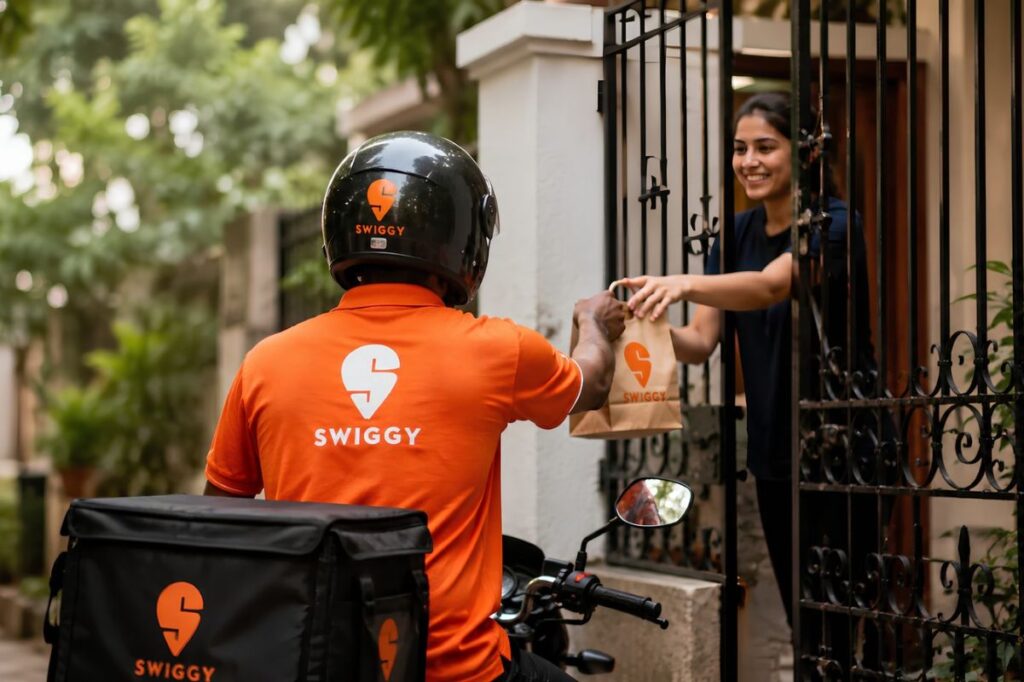
Swiggy’s 36% revenue surge was driven by charging existing users more per order, not just acquiring new ones. The gap between the company’s revenue growth and its actual order value growth reveals that a significant portion of this top-line performance came directly from a record-high take rate, increased platform fees, and higher delivery charges.
Where is Swiggy’s 36% revenue growth coming from?
Swiggy’s revenue and Gross Order Value (GOV) growth for Q2 FY27:
| Metric | Value (₹ crore) | YoY Growth (%) |
| Revenue | 7,571 | 36.1 |
| Consumer-facing Gross Order Value (GOV) | 20,793 | 24.6 |
| Food Delivery GOV | 10,054 | 17.7 |
How did Swiggy increase per-order prices?
The shift in consumer costs happened incrementally as Swiggy introduced new line-item charges and increased delivery fees. Users checking out today pay fees that are actively engineered to pad the top line.
Swiggy’s internal metric of “consolidated adjusted revenue”, which hit ₹7,909 crore this quarter, explicitly adds user delivery charges and user fees to the reported revenue. Swiggy management views these fees as a necessary structural correction. Executives maintain that charging for platform use normalizes unit economics and covers legitimate inflationary logistics costs required to reach profitability.
Is Swiggy’s user base actually growing?
The top-line revenue percentage outpaces actual platform adoption, meaning users are paying more at checkout for the same utility.
Mainstream reports focus on the company’s narrowed net loss, down to ₹922 crore, and the apparent stability of the food delivery segment. In the food delivery segment specifically, GOV grew just 17.7% year-on-year, according to Q2 filings.
When overall revenue grows at 36.1% while food delivery order value grows at half that rate, the gap is funded by unit price increases.
Why are restaurant commissions increasing?
Increased commission rates contribute directly to the platform’s revenue jump, helping subsidize massive cash burn in other divisions.
Consumers are not the only stakeholders absorbing the push for revenue. Restaurant partners face identical margin pressures as the platform’s record 26.1% take rate eats into supply-side payouts.
This capital helps subsidize the quick-commerce division, where Instamart’s adjusted EBITDA loss widened to ₹895 crore as the company fights Blinkit and Zepto for market share.
What is the limit on Swiggy’s price-driven growth?
Consumer price elasticity, the point at which users stop ordering because prices are too high, will eventually dictate the ceiling on this revenue strategy.
Public markets reward top-line growth, and Swiggy delivered that required metric in Q2. A duopoly market allows both Swiggy and Zomato to raise prices in tandem without immediate customer flight. This tests whether Swiggy can achieve actual volume growth before the fee hikes reach their limit.
Frequently Asked Questions
How much did Swiggy’s revenue grow in Q2 FY27?
Swiggy reported a revenue increase of 36.1% to ₹7,571 crore for Q2 FY27. However, the consumer-facing Gross Order Value (GOV) grew by only 24.6%, indicating revenue was driven by fee increases rather than order volume.
What is Swiggy’s current take rate?
Swiggy’s take rate, the percentage of each transaction the platform keeps, climbed to a record 26.1% in Q2 FY27, according to company filings. This higher take rate is the primary driver behind the reported revenue growth.
Why is Swiggy charging higher platform fees?
Swiggy management states that charging for platform use normalizes unit economics and covers inflationary logistics costs. These increased fees across consumers and restaurants also subsidize the quick-commerce division, where Instamart reported an ₹895 crore loss.

Praseetha K
Praseetha K is the Managing Editor of Clarity Times. She edits, verifies and publishes the newsroom's articles, and also writes analysis on policy, law, business and technology. Articles she writes are edited by the Editor-in-Chief before publication.