
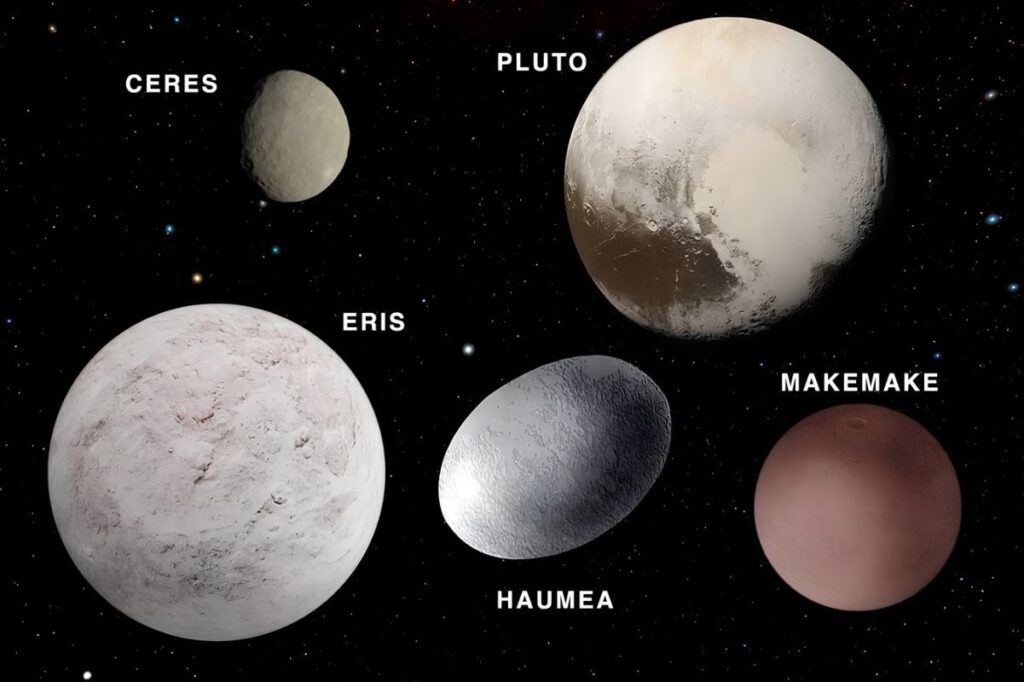
Distant icy body 2026 ED138 will not become the Solar System’s sixth official dwarf planet. The International Astronomical Union (IAU) has frozen its official roster at five since 2008 under an administrative brightness rule that 2026 ED138 fails by a factor of 7.5, leaving it behind four larger, measured worlds the IAU still declines to induct.
Why Does the IAU Classification Rule Disqualify 2026 ED138 Immediately?
Mainstream news coverage of 2026 ED138 repeats a single assumption: once infrared space telescopes measure the object’s size and confirm it is round, the body will join Pluto, Eris, Haumea, Makemake, and Ceres as the Solar System’s five recognized dwarf planets. That assumption collides with a standing rule adopted by the International Astronomical Union, the professional body responsible for classifying and naming celestial objects.
On June 11, 2008, in IAU Press Release iau0804 (“Plutoid chosen as name for Solar System objects like Pluto”), the International Astronomical Union established an administrative filter for any trans-Neptunian object, an icy body orbiting the Sun beyond Neptune. To qualify for official dwarf-planet naming review without prior proof of a gravity-rounded shape, a trans-Neptunian object must have an absolute magnitude brighter than $H = +1.0$.
Astronomers use absolute magnitude ($H$) to measure a Solar System object’s intrinsic brightness: how bright the object would appear if placed one astronomical unit (the average Earth–Sun distance, about 150 million kilometers) from both the Sun and Earth. Lower numbers indicate brighter objects.
According to the discovery preprint by Center for Astrophysics astronomer Matthew Holman and 21 co-authors (arXiv:2610.38693), 2026 ED138 has a measured visual-light absolute magnitude of $H_V = 3.19 \pm 0.04$ (and $H = 2.85 \pm 0.23$ in the Jet Propulsion Laboratory Small-Body Database). Both figures miss the International Astronomical Union threshold of $+1.0$ by roughly two full magnitudes.
Because the astronomical magnitude scale is logarithmic, each step of 1.0 magnitude equals a 2.512-fold change in reflected light. Based on Pogson’s flux ratio ($10^{0.4 \times 2.19}$), the 2.19-magnitude gap between the International Astronomical Union $1.00$ cutoff and 2026 ED138’s $3.19$ measurement works out to a factor of 7.52. In intrinsic luminosity, 2026 ED138 reflects roughly 7.5 times less light than the minimum threshold required to enter the International Astronomical Union dwarf-planet naming pipeline.
How Large Is 2026 ED138 According to Rubin Observatory Data?
The discovery itself comes from early commissioning and science-validation observations at the National Science Foundation–Department of Energy Vera C. Rubin Observatory in Chile, a ground-based optical survey facility mapping the southern sky every few nights. On October 27, 2026, at the Division for Planetary Sciences meeting in Spokane, Washington, Holman and Rubin Solar System Lead Scientist Mario Jurić announced 2026 ED138 via NOIRLab Science Release noirlab2626 and Minor Planet Electronic Circular MPEC 2026-U85.
Holman identified the object at roughly 46 astronomical units from the Sun, 15% farther out than Pluto’s 40-astronomical-unit average distance, on an orbit tilted nearly 25 degrees relative to the plane of the planets. Using custom linking software named pointdexter, his team connected Rubin exposures captured between March 4 and July 11, 2026 with 45 archival exposures recorded across 14 nights between 2016 and 2023 by the Dark Energy Camera.
While the NOIRLab announcement used conditional phrasing, describing 2026 ED138 as a “dwarf planet candidate” with an estimated diameter of 600 to 1,500 kilometers, headlines quickly anchored on the 1,500-kilometer top end. In optical telescope images, however, a distant world appears as a single unresolved dot of light. A 1,500-kilometer world covered in dark soot reflects the exact same amount of sunlight as a 600-kilometer world coated in bright ice.
Planetary scientists express this surface reflectivity as geometric albedo, scaled from 0 (pitch black) to 1 (a perfect mirror). In the full text of the discovery paper (arXiv:2610.38693v1, Section VIII), Holman and his co-authors benchmark three reference albedos (0.25, 0.10, and 0.04), which yield diameters of 612, 968, and 1,530 kilometers. Reaching the 1,530-kilometer upper limit requires a coal-dark albedo of 0.04, meaning the surface reflects just 4% of incoming sunlight.
Rubin’s multi-filter camera measured 2026 ED138’s surface color across six optical bands, finding a moderately red spectrum with a green-minus-red color index ($g – r$) of $0.63 \pm 0.07$ and a red-minus-infrared index ($r – i$) of $0.26 \pm 0.05$. When Holman’s team applied surface reflectivities typical for outer Solar System objects with those moderately red color indices (albedos between 0.10 and 0.25), they constrained 2026 ED138’s likely diameter from the full 612–1,530 kilometer span down to 612–968 kilometers, a 37% reduction at the upper bound, from 1,530 kilometers to 968 kilometers.
From an observational standpoint, Holman and his co-authors explain in arXiv:2610.38693v1 why they reported both the full 612–1,530 kilometer span and the candidate label:
“2026 ED138 has absolute magnitude $H_V = 3.19$, implying a diameter of 612, 968, and 1530 km. Measured TNO albedos span this range… It is a dwarf-planet candidate, pending an albedo measurement.”
Under physical classifications used by planetary astronomers, such as Caltech astronomer Mike Brown’s Dwarf Planet Catalog, any icy body larger than roughly 600 kilometers is considered “likely” or “highly likely” to be rounded by self-gravity regardless of whether an International Astronomical Union committee updates its official list, and quoting the full 0.04 to 0.25 albedo diameter range is standard practice before thermal infrared data exist.
Which Unacknowledged Worlds Are Already Ahead of 2026 ED138?
Even if the International Astronomical Union repealed its $H = +1.0$ brightness cutoff tomorrow and judged candidates strictly by measured physical size, 2026 ED138 would still not be next in line. At least four known trans-Neptunian worlds already have direct size measurements placing them ahead of or overlapping 2026 ED138’s 612–968 kilometer likely diameter range, and none of the four appear on the IAU Minor Planet Center official five-member dwarf planet list.
Astronomers have measured those four worlds using two precision techniques that have not yet been applied to 2026 ED138: thermal radiometry (using space telescopes such as the Herschel Space Observatory and the James Webb Space Telescope to measure an object’s infrared heat emission, separating physical surface area from reflectivity) and stellar occultations (timing to the millisecond how long a distant object blocks a background star’s light from multiple telescopes on Earth to trace its exact silhouette).
Published Herschel radiometry and satellite-mass analyses by Csaba Kiss and colleagues, JWST infrared spectroscopy led by Joshua Emery, and multi-chord stellar occultation campaigns establish the physical dimensions of the four uninducted worlds waiting ahead of 2026 ED138:
- 225088 Gonggong (2007 OR10): Diameter of $1,230 \pm 50$ kilometers via combined Herschel thermal radiometry and Hubble satellite-orbit modeling, 27% wider than 2026 ED138’s 968-kilometer likely upper bound (up by 262 kilometers) , with an absolute magnitude of $H = 1.8$.
- 50000 Quaoar: Volume-equivalent diameter of $1,086$ to $1,115$ kilometers measured via multi-chord stellar occultations, 12% to 15% wider than 2026 ED138’s 968-kilometer likely upper bound (up by 118 to 147 kilometers), with an absolute magnitude of $H = 2.4$ to $2.7$.
- 90377 Sedna: Diameter between 906 and 1,041 kilometers via Herschel and Spitzer thermal measurements, with an absolute magnitude of $H = 1.5$ to $1.8$.
- 90482 Orcus: Diameter of $910$ to $983$ kilometers via thermal radiometry and stellar occultations, with an absolute magnitude of $H = 2.2$ to $2.3$.
All four worlds exceed the roughly 800-to-900-kilometer threshold where icy bodies are expected to relax into rounded shapes. All four remain classified by the International Astronomical Union simply as numbered minor planets.
Why Has the International Astronomical Union Maintained an 18-Year Bureaucratic Freeze?
Why have Gonggong, Quaoar, Sedna, and Orcus remained excluded for 18 years, and why will infrared follow-up of 2026 ED138 from the James Webb Space Telescope meet the same dead end? The answer lies in the gap between the legal text of the International Astronomical Union 2006 planet definition and what space telescopes can physically measure at 46 astronomical units.
Under Resolution B5, as recorded by the IAU Minor Planet Center, a dwarf planet is defined as a celestial body that “(a) is in orbit around the Sun, (b) has sufficient mass for its self-gravity to overcome rigid body forces so that it assumes a hydrostatic equilibrium (nearly round) shape, (c) has not cleared the neighbourhood around its orbit, and (d) is not a satellite.”
Hydrostatic equilibrium means a body’s internal gravity is strong enough to crush the mechanical strength of its own rock and ice, molding the entire world into a smooth sphere or ellipsoid. Proving that state from Earth orbit is a different problem from measuring width.
When reporters write that James Webb Space Telescope infrared observations will confirm whether 2026 ED138 is spherical, they conflate two distinct measurements. Thermal infrared radiometry from the telescope measures the total heat radiated by an object’s sunlit hemisphere. That heat flux tells astronomers the object’s equivalent circular surface area (its effective diameter) and its surface albedo, not its three-dimensional shape or whether its interior has relaxed into hydrostatic equilibrium.
Under the IAU Working Group for Small Bodies Nomenclature (WGSBN) Rules and Guidelines for Names of Non-Cometary Small Solar-System Bodies and the WGSBN functional mandate, only objects brighter than $H = +1.0$ are routed to joint review with the Working Group for Planetary System Nomenclature for official dwarf-planet designation. Every fainter trans-Neptunian body, including Gonggong (named via the minor-planet track in February 2020), Quaoar, and now 2026 ED138, is routed strictly through the minor-planet naming pipeline. As confirmed by the USGS/IAU Gazetteer of Planetary Nomenclature, since Makemake ($H = -0.2$) and Haumea ($H = +0.1$) cleared that brightness filter in July and September 2008, zero candidates have been added.
From the perspective of the International Astronomical Union nomenclature framework, the $H = +1.0$ rule was never meant to be a physical definition of a dwarf planet. As stated directly in IAU Press Release iau0804, the threshold was created in 2008 as a conservative administrative safeguard so that if “further investigations show that the object is not massive enough and does not qualify as a plutoid, it will keep its name but change category,” , ensuring the International Astronomical Union would not prematurely certify candidates before their physical properties could be established. Because proving true hydrostatic equilibrium at 46 astronomical units is observationally ambiguous without a close spacecraft flyby, such as the Dawn mission at Ceres or New Horizons at Pluto, withholding formal certification preserves taxonomic rigor.
How Do Planetary Scientists Classify Trans-Neptunian Worlds Outside the IAU Roster?
Faced with a classification pipeline that requires either an $H = +1.0$ brightness or an impossible spacecraft visit to dozens of distant worlds, working planetary astronomers have largely stopped relying on the International Astronomical Union five-object roster in peer-reviewed research. In its place, researchers use empirical measurements of internal density, surface volatile chemistry, and gravitational compression.
By tracking binary trans-Neptunian objects, distant worlds orbited by small moons whose orbital periods and distances reveal the central body’s exact mass via Kepler’s laws, astronomers can calculate bulk density in grams per cubic centimeter. In a 2019 Icarus study on mid-sized trans-Neptunian binary densities, Lowell Observatory astronomer Will Grundy and colleagues analyzed mid-sized outer Solar System bodies such as (229762) G!kún||’hòmdímà (diameter ~612–640 kilometers, bulk density $1.007\text{ g/cm}^3$) and identified a physical transition between 900 and 1,000 kilometers in diameter.
Icy worlds smaller than roughly 900 kilometers have low bulk densities of $1.0\text{ g/cm}^3$ or less, matching or falling below the density of liquid water ($1.0\text{ g/cm}^3$). Instead of collapsing under self-gravity into solid, differentiated spheres in hydrostatic equilibrium, bodies below 900 kilometers retain porous, sponge-like interiors filled with uncrushed void space left over from their formation. Worlds larger than 1,000 kilometers, such as Gonggong at $1.75 \pm 0.07\text{ g/cm}^3$, show substantially higher densities, indicating that internal gravity and heating have crushed out the pore spaces.
A 2024 JWST spectroscopic survey led by Joshua Emery, Grundy, and colleagues (arXiv:2309.15230) reinforced this physical boundary from the chemical side, explicitly titling their study of Sedna, Gonggong, and Quaoar “A Tale of 3 Dwarf Planets” despite none of the three holding official IAU status:
“We suggest that these three bodies have undergone internal melting and geochemical evolution similar to the larger dwarf planets and distinct from all smaller KBOs.”
That physical boundary explains why planetary scientists are eager to observe 2026 ED138 even though it has no path to official IAU status. At a likely diameter of 612 to 968 kilometers, 2026 ED138 straddles the 900-to-1,000-kilometer transition zone between porous planetesimals like G!kún||’hòmdímà (612 kilometers) and collapsed, geochemically evolved dwarf planets like Quaoar, Sedna, and Gonggong.
When astronomers eventually catch 2026 ED138 passing in front of a background star or measure its heat and spectrum with the James Webb Space Telescope, the result will not add a sixth name to the International Astronomical Union 2008 roster. Instead, that measurement will answer a physical question: whether 2026 ED138 sits below the 900-kilometer porous-ice boundary as an uncrushed remnant of the early Solar System, or above it as the fifth uninducted world waiting in line behind Gonggong, Quaoar, Sedna, and Orcus.
Frequently Asked Questions
Will 2026 ED138 become the Solar System’s sixth official dwarf planet?
No, 2026 ED138 will not become an official dwarf planet under current International Astronomical Union rules. According to Holman et al. (arXiv:2610.38693v1), it has an absolute magnitude of $H_V = 3.19$, which fails the IAU’s $H = +1.0$ administrative brightness threshold by a factor of roughly 7.5.
Why hasn’t the International Astronomical Union added any new dwarf planets since 2008?
The IAU has maintained an 18-year freeze because its nomenclature guidelines require an absolute magnitude brighter than $H = +1.0$ for automatic review without a spacecraft visit. Since Makemake and Haumea were added in 2008, all fainter trans-Neptunian discoveries have been routed exclusively through the minor-planet tracking system.
What is the actual size of 2026 ED138?
Initial news reports cited an upper bound of 1,500 kilometers based on an extreme dark albedo of 0.04, but Holman et al. constrained 2026 ED138’s likely diameter to between 612 and 968 kilometers by applying typical outer Solar System surface reflectivities that match its moderately red color indices ($g – r = 0.63$).
What larger objects are waiting ahead of 2026 ED138?
At least four trans-Neptunian worlds with measured diameters between 906 and 1,230 kilometers, Gonggong, Quaoar, Sedna, and Orcus, are larger than 2026 ED138’s likely size range. All four have thermal or occultation measurements that prove their scale, yet none are recognized on the IAU’s five-member dwarf planet roster.
How do planetary astronomers classify objects like 2026 ED138 if not by the IAU list?
Working planetary scientists rely on empirical physical metrics such as bulk density and interior porosity measured via binary orbital masses. Objects smaller than 900 kilometers often retain porous, low-density interiors ($\le 1.0\text{ g/cm}^3$), whereas larger bodies show geochemical differentiation, providing a physical classification framework independent of IAU naming committees.

Praseetha K
Praseetha K is the Managing Editor of Clarity Times. She edits, verifies and publishes the newsroom's articles, and also writes analysis on policy, law, business and technology. Articles she writes are edited by the Editor-in-Chief before publication.