At Clarity Times, we examine what mainstream narratives omit. This dispatch investigates institutional incentives, policy fine print, and multi-dimensional community impacts.
If Earth’s moon formed in five hours rather than millions of years, astronomers searching for habitable exoplanets must abandon a primary strategy. Because a 5-hour moon formation leaves no long-lasting dust rings, researchers are shifting James Webb Space Telescope proposals to locate life-stabilizing worlds in clean, dust-free star systems.
Why Is JWST Shifting Exoplanet Targets?
Astronomers are shifting James Webb Space Telescope (JWST) – NASA’s flagship infrared observatory – targets because a visible debris disk is no longer considered a prerequisite for finding habitable exomoons.
Until recently, researchers relied on these visible rings of dust and rock as proxies to book JWST observation time. That requirement is now being scrapped. Observation teams are actively pivoting their requests based on recent lunar modeling.
For example, Columbia University astronomer David Kipping and the Cool Worlds Lab recently secured 60 hours of JWST time to observe Kepler-167e – a Jupiter-analogue in a system without a debris disk proxy. The absence of a dust ring around a distant star is no longer a disqualifier for habitability.
How Does the 5-Hour Moon Formation Invalidate Debris Disks?
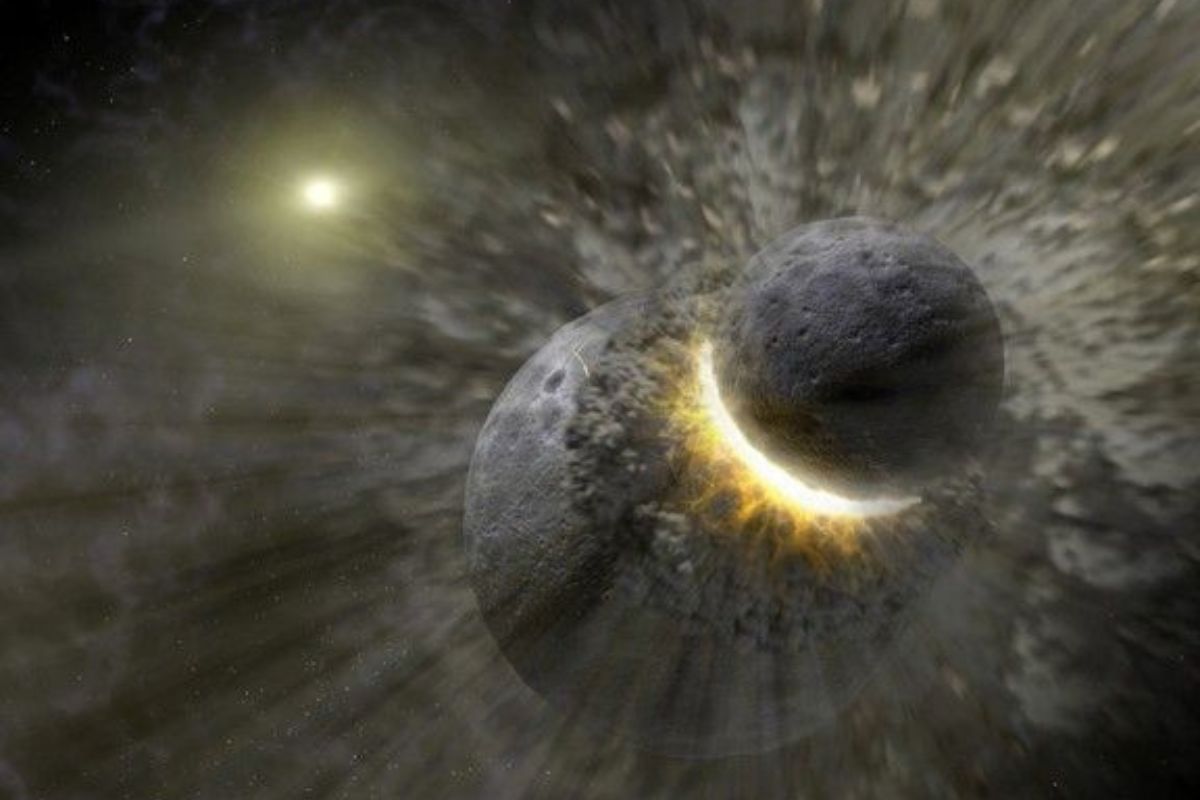
If a moon coalesces instantly from a collision, it absorbs the available material before a long-term debris disk can form.
Astrobiologists previously relied on searching for dusty exoplanet systems to find moons. The logic was sequential: moons coalesce slowly from a ring of planetary debris over millions of years, leaving behind a detectable dust signature. Finding the dust meant a higher probability of finding a moon.
A computational simulation from Durham University challenges that timeline. The model suggests the Earth’s moon formed in a matter of hours after a Mars-sized object collided with Earth.
If a moon forms instantly from intact chunks of a collision, it absorbs the available material. According to study co-author Vincent Eke, fast-forming impacts disperse rock far less widely than traditional models suggest. No long-term debris disk remains to flag the system for observers.
Which Systems Are Astronomers Targeting Now?
Without the guarantee of a dust proxy, astronomers are now directing JWST toward older, clean systems and free-floating planets.
This theoretical rapid formation is altering how observational time is requested. Telescope time is finite. Researchers submit detailed proposals justifying their targets to the Space Telescope Science Institute (STScI), which weighs the probability of a discovery against the cost of telescope hours.
Proposal authors are pointing the telescope at systems that appear clean. Astronomers are now directing JWST toward free-floating planets like WISE 0855, or older, settled systems like Kepler-167e, trusting that a lack of collisional dust does not mean a lack of moons.
How Do Astronomers Detect Exomoons Without Dust?
In systems without a debris disk, astronomers measure transit timing variations (TTVs) – minute shifts in when a planet crosses in front of its star – to detect the gravitational tug of an invisible moon.
If astronomers cannot use dust rings as signposts for moon-stabilized planets, they must use secondary detection methods. A clean system requires measuring light dips and gravitational tugs.
When an exoplanet blocks a fraction of the star’s light, a large, invisible moon’s gravity pulls on the planet, causing the transit to happen slightly earlier or later than a strict orbit dictates.
What Is the Scientific Risk of Following This Simulation?
If the Durham simulation proves inaccurate, the JWST hours spent staring at clean systems will yield no data on habitable moons.
The shift in targeting strategy is not universal. Some astronomers warn against altering physical observation targets based entirely on a computer model. The Durham study is a parameter-tuned simulation, not physical proof.
Shifting telescope time away from known debris disks carries scientific risk. Finding exomoons is difficult; according to Kipping, his team previously surveyed over 300 exoplanets and found only two candidates.
As Kipping noted regarding empty observation runs, failing to find moons in these clean systems would mean astronomers “essentially have to rip up the textbook.”
Frequently Asked Questions
Does a 5-hour moon formation create a debris disk? No. According to the Durham University simulation, a fast-forming moon absorbs the available material from a planetary collision almost instantly. This rapid accretion prevents the formation of a long-lasting, visible debris ring.
How does the new moon model affect James Webb Space Telescope targets? The model is prompting astronomers to rewrite JWST observation proposals. Researchers are abandoning the traditional requirement of a visible dust ring and instead targeting clean, dust-free star systems to hunt for habitable exomoons.
How do astronomers find exomoons without a dust ring proxy? Astronomers use transit timing variations (TTVs) to detect exomoons in clean systems. By measuring minute shifts in the timing of a planet’s transit across its star, researchers can detect the gravitational pull of an unseen moon.
Editorial Independence & Corrections
Clarity Times is published by Beeps Venture Technologies LLP under strict editorial independence charters. We uphold rigorous sourcing and verification protocols. Noticed a factual omission or error? Review our Correction Protocols or contact our editorial desk at mail@claritytimes.org.

Praseetha K
Investigative journalist and research analyst contributing independent field reports and structural analysis for Clarity Times.