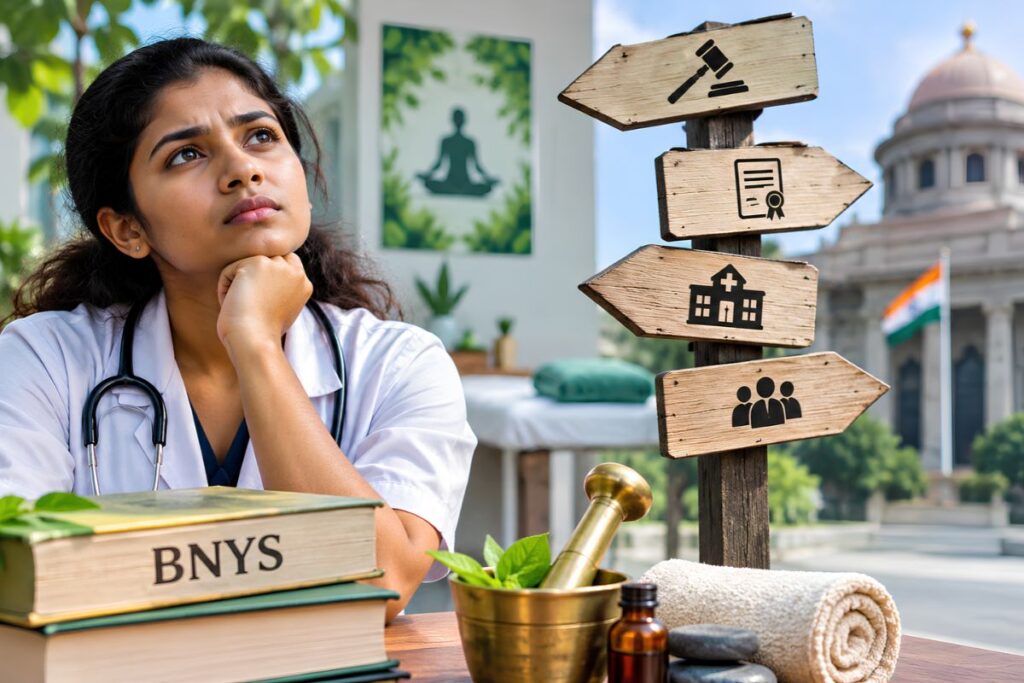
A Bachelor of Naturopathy and Yogic Sciences (BNYS) degree is not automatically recognized for clinical practice across all Indian states. Because Parliament excluded Yoga and Naturopathy from the 2020 central AYUSH regulatory laws, graduates lack a national registration council and must apply separately under inconsistent state rules, creating licensing delays, hiring barriers, and legal ambiguity.
Why Were BNYS Graduates Left Out of Central AYUSH Regulation?
Parliament omitted Yoga and Naturopathy when it enacted two central statutory commissions in 2020, leaving BNYS degree recognition in India dependent on state-level rules rather than a national register.
In 2020, Parliament restructured how traditional medical systems are regulated across the country by passing the National Commission for Indian System of Medicine (NCISM) Act, 2020 for Ayurveda, Siddha, Unani, and Sowa-Rigpa, and the National Commission for Homoeopathy (NCH) Act, 2020 for Homoeopathy. Both laws created central registers that let doctors transfer licenses across state lines.
Yoga and Naturopathy were left out of both statutes. Graduates completing the five-and-a-half-year BNYS degree, four-and-a-half years of academic study plus a one-year compulsory clinical internship, therefore receive no central statutory registration number.
In response to Lok Sabha Unstarred Question No. 3181 on December 13, 2024, Union Minister of State for Ayush Prataprao Jadhav confirmed that “presently there is no regulation for the Yoga and Naturopathy education at Central level.” An earlier Right to Information (RTI) reply from the Central Council for Research in Yoga & Naturopathy (CCRYN), the apex government research body under the Ministry of AYUSH, confirmed that the council neither accredits BNYS colleges nor acts as a statutory licensing authority.
What Does the November 2026 National Naturopathy Day Announcement Promise?
Ahead of the 9th National Naturopathy Day on November 18, 2026, in Nagamangala, Karnataka, Press Information Bureau (PIB) releases highlighted how institutions such as the National Institute of Naturopathy (NIN) in Pune, Maharashtra, including its BNYS college at Nisarg Gram, prepare graduates for careers in healthcare, research, academics, and private practice.
Those statements frame naturopathy education as a direct pipeline into India’s preventive health workforce, without noting that a graduate’s legal authority to practice depends on which state they enter after convocation.
How Does Naturopathy Registration Differ Across Indian States?
Naturopathy registration in India operates through a state-by-state patchwork: a handful of southern and western states maintain statutory boards, while many others rely on executive orders or lack registration mechanisms entirely.
Southern states that host most of India’s BNYS colleges maintain formal registration frameworks. Karnataka registers BNYS graduates under the Karnataka Ayurvedic, Naturopathy, Siddha, Unani and Yoga Practitioners’ Registration and Medical Practitioners’ Miscellaneous Provisions Act, 1961, while Tamil Nadu grants Class “A” registration through the Tamil Nadu Board of Indian Medicine.
Kerala issued Government Order G.O.(Ms) No. 12/2026/AYUSH in March 2026 to formalize state registration for BNYS graduates from 61 approved out-of-state institutions, alongside state registration boards in Telangana and Rajasthan.
Across several northern, eastern, and northeastern states, dedicated statutory Yoga and Naturopathy boards either do not exist or operate through administrative executive orders rather than legislation. Without a central council to enforce interstate reciprocity, the legal recognition of a professional license issued by another state, a graduate registered in Karnataka or Tamil Nadu cannot automatically transfer their license to states lacking a statutory board.
How Does the Missing Central Registry Affect Hospital Hiring and Insurance?
Without a central statutory registration number, BNYS graduates face credentialing delays during hospital recruitment, insurance empanelment, and legal scope reviews.
Hospitals seeking accreditation under the NABH Ayush Hospitals Accreditation Programme, run by the National Accreditation Board for Hospitals and Healthcare Providers, must verify the qualifications and statutory registration credentials of clinical staff. Similarly, health insurance rules under the IRDAI Master Circular on Health Insurance Business (2024), issued by the Insurance Regulatory and Development Authority of India, require inpatient Ayush treatment to be supervised round the clock by a registered AYUSH practitioner at a recognized facility with at least five inpatient beds.
When a state lacks a statutory naturopathy board, hospital human-resources teams, state public service commissions, and insurance third-party administrators face uncertainty over what counts as valid registration. Practitioners frequently have to submit state executive orders or university verification letters during credentialing checks.
Legal exposure is a second issue. Although BNYS graduates practice drugless therapies, diet, hydrotherapy, mud packs, and yoga, without prescribing scheduled pharmaceuticals, clinicians working in states without a statutory board lack the uniform statutory indemnity and professional-conduct protections granted to doctors registered under NCISM or the National Medical Commission (NMC).
Why Did a Central Council for Yoga and Naturopathy Stall?
Proposals for a central statutory council stalled for years over how to regulate a drugless discipline, though a Parliamentary Consultative Committee backed a unified regulatory mechanism in August 2026.
BNYS students and college administrators have sought a central statutory council, noting that graduates complete five-and-a-half years of medical coursework in anatomy, physiology, pathology, and clinical diagnostics comparable in duration to Ayurveda and Homoeopathy degrees, and need a national register for uniform pay scales and interstate mobility.
In August 2026, during a Parliamentary Consultative Committee meeting chaired by Minister Prataprao Jadhav, Members of Parliament and expert members agreed on the need for a unified regulatory mechanism for Yoga and Naturopathy education, registration, and standardization. Until Parliament passes enabling legislation, the Ministry of AYUSH relies on state registration boards, NABH hospital accreditation, and voluntary credentialing bodies such as the Yoga Certification Board (YCB) to set quality benchmarks for its non-pharmacological workforce.
Until Parliament converts that consultative consensus into a binding national register with interstate reciprocity, BNYS graduates remain divided by geography, holding statutory standing in a handful of states while working through administrative gray zones across the rest of the country.
Related reporting: Read our analysis on preventive diabetes screening business models and imported standards inside Indian diagnostic cards.
Frequently Asked Questions
Is a BNYS degree valid across all states in India?
A BNYS degree is an approved five-and-a-half-year undergraduate medical qualification, but clinical practice registration is not automatically valid nationwide. Because Yoga and Naturopathy were excluded from the 2020 NCISM and NCH Acts, graduates must register separately with individual state boards where available.
Which Indian states have formal registration for BNYS graduates?
States including Karnataka, Tamil Nadu, Telangana, and Rajasthan maintain registration mechanisms for BNYS graduates, and Kerala issued Government Order G.O.(Ms.) No. 12/2026/AYUSH in March 2026 covering graduates from 61 approved out-of-state institutions. Several northern, eastern, and northeastern states still lack dedicated statutory boards.
Does India have a central statutory council for Yoga and Naturopathy?
No. In a December 2024 Lok Sabha reply, Union Minister of State for AYUSH Prataprao Jadhav confirmed there is no central regulation for Yoga and Naturopathy education, though a Parliamentary Consultative Committee in August 2026 endorsed creating a unified regulatory mechanism.
How does the lack of central registration affect BNYS doctors in hospitals and insurance?
Accreditation bodies such as NABH and insurance guidelines under IRDAI require facilities to verify practitioner registration. In states without a statutory board, hospital recruiters and insurance administrators require extra university or executive-order documentation to verify a BNYS practitioner’s credentials

Praseetha K
Praseetha K is the Managing Editor of Clarity Times. She edits, verifies and publishes the newsroom's articles, and also writes analysis on policy, law, business and technology. Articles she writes are edited by the Editor-in-Chief before publication.