
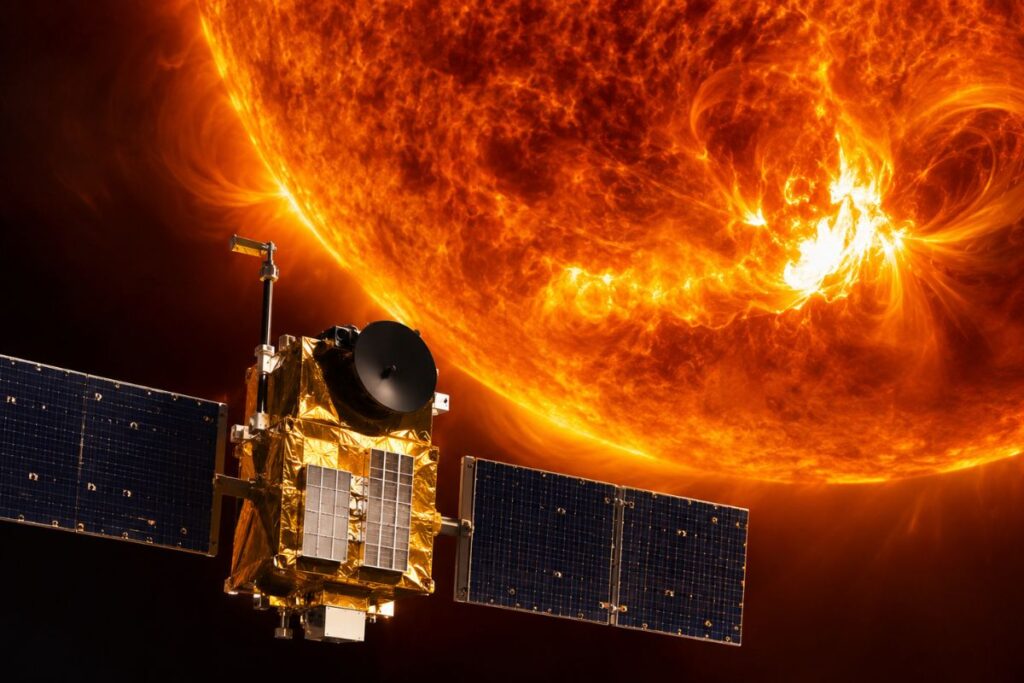
An Aditya-L1 solar storm warning cannot alert Earth before a dangerous eruption arrives. While high-speed coronal mass ejections strike our planet in 15 to 30 hours, downloading telemetry through scheduled ground passes and completing spectroscopic calculations takes upwards of 36 to 48 hours. India’s solar observatory operates as an archival research platform, not an operational early-warning siren.
Why Does Solar Storm Transit Outrun Aditya-L1’s Data Pipeline Latency?
Severe solar eruptions reach Earth hours before Aditya-L1’s telemetry can clear transmission queues and mathematical conversion pipelines.
When a severe coronal mass ejection, a massive expulsion of magnetized solar plasma and high-energy particles from the Sun’s outer atmosphere, erupts toward Earth, it travels between 1,500 and 2,500 kilometers per second. At those speeds, the plasma front crosses the 150-million-kilometer Sun-Earth distance in 15 to 30 hours. Historical records show the extreme solar storm of August 1972 covered that distance in approximately 14.6 hours.
The Aditya-L1 data pipeline latency operates on a much slower timeline.
According to mission operational standards published in ISRO’s Aditya-L1 mission overview, translating raw instrument counts into a calibrated Doppler profile, which reveals plasma speed, tilt, and asymmetric spread, involves a multi-stage data-reduction sequence designed for scientific research rather than rapid defense alerts.
Between waiting for scheduled ground passes, transmitting raw telemetry packets, and running pixel-by-pixel mathematical conversions, the full data turnaround spans 36 to 48 hours. By the time scientists determine whether an eruption is tilted toward a vulnerable quadrant of Earth’s magnetosphere, the storm front has already passed the planet.
How Does the IDSN Byalalu Ground Station Downlink Create a Bottleneck?
Data from Aditya-L1 does not stream to Earth continuously because the spacecraft relies on batched radio dumps during scheduled tracking passes.
Positioned in a halo orbit around the Sun-Earth Lagrange Point 1 (L1), a gravitationally balanced outpost 1.5 million kilometers sunward from Earth, the observatory records observations on an onboard solid-state recorder. That stored information reaches the ground through the Indian Space Research Organisation Telemetry, Tracking and Command Network (ISTRAC). Its primary receiving terminal is the Indian Deep Space Network (IDSN) located at Byalalu, Karnataka, which uses 32-meter and 18-meter parabolic antennas.
Because the Earth rotates away from the spacecraft’s orbital line of sight, the IDSN Byalalu ground station downlink provides intermittent coverage rather than a constant connection. Without continuous coverage purchased across international tracking assets like the European Space Agency’s Estrack network or NASA’s Deep Space Network, science files sit in solid-state storage for hours between visible windows.
Physical link constraints compound the delay. According to technical documentation compiled in ESA eoPortal’s technical review of Aditya-L1’s data handling subsystem, the spacecraft stores telemetry on a 32-gigabit solid-state recorder and dumps science packets across an X-band radio link capped at a maximum throughput of 32 megabits per second. Clearing dense sequences of high-resolution spectral frames consumes substantial time during each tracking pass.
What Causes the VELC Spectroscopic Inversion Delay at the Processing Center?
Raw instrument counts from Aditya-L1 require hours of complex computational filtering and multi-slit line fitting before any velocity measurements exist.
When raw data packets from the Visible Emission Line Coronagraph (VELC) reach Earth as Level-0 telemetry, they are routed to the Payload Operations Centre at the Indian Institute of Astrophysics in Bengaluru. A coronagraph is an optical instrument designed to block the blinding direct disc of the Sun so that researchers can observe the faint surrounding corona.
The VELC spectroscopic inversion delay stems from the multi-phase mathematics required to produce Level-2 science products. According to payload pipeline specifications published on the ISSDC PRADAN data portal, raw data must pass through three mandatory reduction stages:
- Detector calibration: Merging split top and bottom CMOS sensor readouts, masking inactive edge pixels, subtracting dark current electronic noise, and applying flat-field illumination corrections.
- Coronal scatter removal: Filtering out stray optical light, which is orders of magnitude brighter than the faint emission line emitted by ionized iron atoms at 530.3 nanometers.
- Spectroscopic line fitting: Calculating Doppler shifts by fitting Gaussian curves across thousands of discrete slit coordinates to measure sub-Ångström wavelength variations.
This spectroscopic reduction is an intensive batch process rather than an automated instantaneous calculation. Resolving asymmetric expansion vectors takes days of supervised analysis, precluding any real-time alert role.
How Does an Operational Space Weather Early Warning System Differ From a Research Observatory?
Operational warning systems trade high spatial resolution for sub-15-minute data delivery, whereas research platforms prioritize photographic precision over transmission speed.
A functional space weather early warning system relies on low-latency monitoring beacons. For example, the National Oceanic and Atmospheric Administration (NOAA) operates platforms such as the Deep Space Climate Observatory (DSCOVR) and the Space Weather Follow-On mission.
Those spacecraft broadcast simple, low-bandwidth telemetry directly to international ground receivers 24 hours a day, feeding raw magnetic vectors and solar wind densities into NOAA Space Weather Prediction Center models within 15 minutes. The spatial resolution is coarse, but the speed gives grid operators and satellite controllers time to adjust protective systems.
ISRO built Aditya-L1 for astrophysics. Its scientific mandate is to resolve coronal heating physics and magnetic reconnection mechanisms down to 1.05 solar radii, regions standard operational monitors bypass. ISRO’s Science Data Management Policy establishes structured verification tiers that prioritize data integrity over rapid civil defense dispatch. The observatory delivers detailed post-event physics, not early alerts.
What Upgrades Would Turn Aditya-L1 Into a Real-Time Warning Platform?
Converting Aditya-L1 into an active alert instrument requires continuous international antenna handoffs and automated on-board edge computing.
To close the delivery gap, ISRO would first need round-the-clock ground coverage. Contracting continuous antenna time across global ground stations in Europe, the Americas, and Australia would eliminate the dead time science files spend sitting in the spacecraft’s memory buffer.
The data pipeline would also require onboard edge processing. Instead of downlinking massive raw files for manual reduction at the Bengaluru center, the spacecraft’s flight computers would need algorithms capable of detecting Doppler anomalies automatically and transmitting lightweight numerical alerts across low-bandwidth channels.
Without those structural and software investments, describing Aditya-L1 as an early-warning defense system confuses retrospective scientific analysis with real-time forecasting. The spacecraft captures invaluable insights into why solar eruptions expand unevenly, but only long after the shock front has arrived.
Frequently Asked Questions
Can Aditya-L1 give an early warning before a solar storm hits Earth?
No. Fast coronal mass ejections reach Earth in 15 to 30 hours, but Aditya-L1’s data turnaround takes 36 to 48 hours due to scheduled ground station passes and complex multi-slit spectroscopic processing.
Why does Aditya-L1 data take up to 48 hours to process?
Raw data downlinked from the VELC instrument must undergo dark-current subtraction, flat-fielding, scattered-light modeling, and multi-slit Gaussian line fitting at the Indian Institute of Astrophysics before researchers can extract Doppler velocity maps.
How does Aditya-L1 differ from NOAA’s DSCOVR satellite?
NOAA’s DSCOVR is an operational warning monitor that transmits low-resolution solar-wind data to forecasting centers within 15 minutes. Aditya-L1 is a high-resolution scientific observatory built to study coronal physics in fine detail, prioritizing image precision over instant alerting.

Praseetha K
Praseetha K is the Managing Editor of Clarity Times. She edits, verifies and publishes the newsroom's articles, and also writes analysis on policy, law, business and technology. Articles she writes are edited by the Editor-in-Chief before publication.