
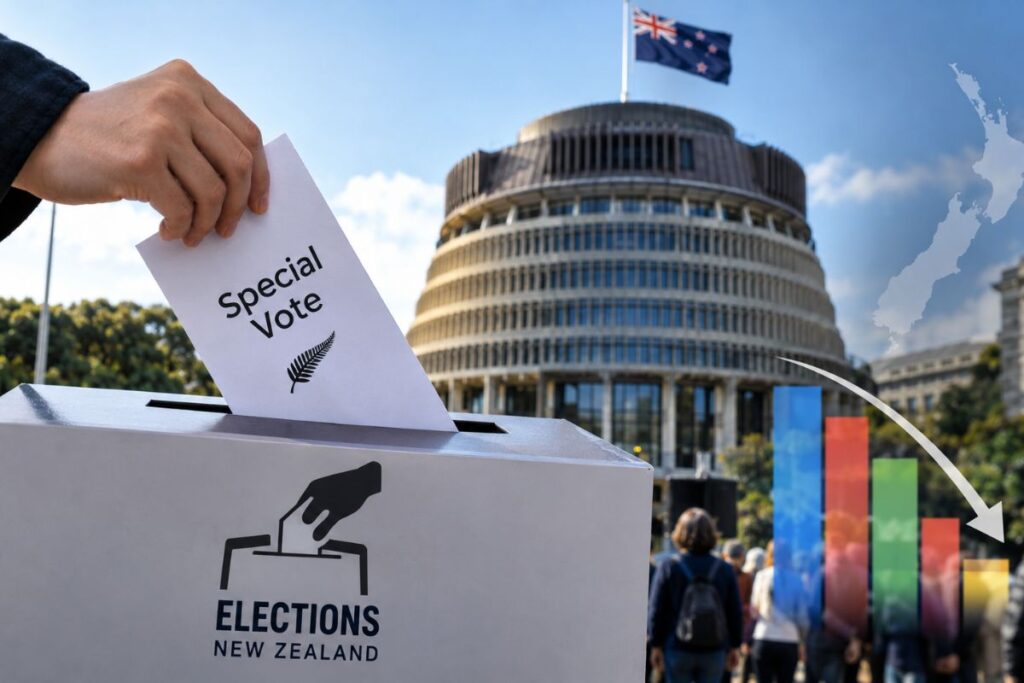
Yes, New Zealand election special votes routinely overturn election-night results, and historical data indicates the centre-right New Zealand National Party is statistically positioned to lose seats. Special declaration votes consistently pull final party-vote margins leftward, erasing narrow one- or two-seat leads before official tallies conclude.
Why Is a Two-Seat Lead on Election Night Statistically Vulnerable?
A preliminary two-seat lead under New Zealand’s Mixed Member Proportional (MMP) electoral system rarely survives the official count because special declaration ballots systematically shift party percentages toward left-leaning parties. In New Zealand, MMP is a proportional voting system where each elector casts two votes: one to choose a local electorate Member of Parliament (MP), and one for their preferred political party.
Across the four general elections held between 2014 and 2023, the official count of special declaration votes reduced the New Zealand National Party’s preliminary party vote by an average of 0.8 to 1.1 percentage points. Over those same cycles, this postal and declaration vote surge consistently delivered corresponding seat gains to the Green Party of Aotearoa New Zealand and Te Pāti Māori.
The statutory arithmetic of that shift has produced measurable seat realignments across past parliamentary terms:
- In the 2014 general election, the final count stripped the New Zealand National Party of its preliminary absolute majority, dropping its caucus from 61 seats to 60.
- In the 2017 general election, the final special vote count transferred two seats from the National-led parliamentary bloc to the New Zealand Labour Party and Green Party bloc.
- In the 2023 general election, National dropped two seats between election night and the declaration of amended official results released by the Electoral Commission, falling from 50 seats to 48 and terminating an outright National-ACT majority.
When preliminary counts show a one- or two-seat buffer for a right-leaning parliamentary coalition, that majority exists only within an incomplete count. Electoral Commission records across the past decade show that the final count consistently reallocates one to two seats across the parliamentary floor.
Who Casts Special Votes in New Zealand, and Why Do They Skew Left?
Special votes skew left because over 70% of them are cast by electors under age 30 enrolling late and by citizens voting from overseas missions, demographics that consistently favor progressive parties. In New Zealand electoral law, a special vote is a declaration ballot cast by an elector whose name is not on the printed electoral roll at their local polling station, who votes outside their registered home electorate, or who casts a ballot from overseas.
These ballots represent a substantial share of total turnout. According to the official Report of the Electoral Commission on the 2023 General Election, electors cast 602,778 special votes, representing 20.9% of all ballots counted.
Under the Electoral Act 1993, special declaration voting gives legal access to electors who moved electorates without updating their details, registered on election day, or submitted ballots through international embassies in cities like London, Sydney, and Melbourne.
According to longitudinal turnout surveys conducted by the New Zealand Election Study (NZES), voters under 30 and expat citizens vote for Green Party, Labour Party, and Te Pāti Māori candidates at higher rates than older domestic cohorts.
Campaign strategists within the New Zealand National Party argue that high early voting numbers, which frequently exceed 50% of the total vote, have diversified the early voting electorate, pointing out that historical swings do not guarantee an identical pattern every election. However, the administrative verification required to validate voter eligibility under statutory law means election officials count these declaration ballots during the post-election period rather than on election night.
Can Special Votes Overturn Individual Electorate Seats?
Special votes frequently overturn individual electorate candidate races whenever election-night victory margins fall below roughly 600 votes. An electorate seat is a geographical voting district where the local candidate with the most votes wins a direct seat in the House of Representatives.
The vulnerability threshold has been demonstrated repeatedly in tight electorates. In the 2023 general election, this specific mechanism flipped four candidate seats between the preliminary count and the final tally, as documented in 1News’ official tally analysis:
- Nelson: National candidate Blair Cameron held a 54-vote preliminary lead on election night, but special votes reversed the seat, electing Labour MP Rachel Boyack with a 29-vote majority.
- Te Atatū: National candidate Angee Nicholas led the preliminary count by 30 votes, but the final tally delivered a 131-vote victory to Labour MP Phil Twyford.
- Tāmaki Makaurau: Labour incumbent Peeni Henare held a 495-vote preliminary buffer, which special votes erased to elect Te Pāti Māori candidate Takutai Tarsh Kemp by 4 votes.
- Te Tai Tokerau: Labour deputy leader Kelvin Davis held a 487-vote lead on election night, but lost the seat to Te Pāti Māori candidate Mariameno Kapa-Kingi by 517 votes once special votes were tallied.
- Mount Albert: Labour MP Helen White saw her preliminary lead of 106 votes reduced to a final margin of 20 votes against National candidate Melissa Lee.
When an electorate flips to a party whose constituency seat wins exceed its nationwide party vote allocation, the system generates an overhang seat. An overhang seat occurs when a party wins more geographic electorate seats than its proportional party vote entitlement, temporarily expanding the total size of Parliament beyond 120 seats and raising the threshold required to form a governing majority.
How Does the Sainte-Laguë Formula Reallocate List Seats?
The Sainte-Laguë formula reallocates list seats by recalculating party seat quotas using final national party-vote percentages, meaning a drop of just one percentage point can strip a major party of one or two parliamentary seats. The Sainte-Laguë formula is the statutory mathematical divisor system established under New Zealand electoral law to distribute parliamentary list seats in proportion to total party votes.
Under Section 191 of the Electoral Act 1993, the formula divides each qualifying party’s total nationwide party vote by sequential odd integers (1, 3, 5, 7, etc.) to establish ranking quotients for seat allocation.
Because list seat distributions depend on fractional quotients at the threshold margins, minor decimal adjustments across 500,000 special votes alter parliamentary allocations. A decline of 0.8 to 1.1 percentage points in a party’s national vote share routinely costs that party one to two list seats.
The Sainte-Laguë calculation reallocates those seats directly to parties whose overall shares rose during the special vote tabulation, regularly expanding the parliamentary delegations of the Green Party or Te Pāti Māori.
How Do Special Vote Shifts Alter Coalition Negotiations?
Special vote shifts alter coalition negotiations by removing two-party majorities, turning smaller cross-bench parties from optional partners into mandatory kingmakers.
Under the Cabinet Manual’s caretaker conventions, the incumbent executive administration continues to manage routine government business while party leaders negotiate behind closed doors. The caretaker convention is a set of constitutional rules requiring the governing ministry to avoid making significant new long-term policy decisions or major public appointments until a new government is formed.
These negotiations take place while party leaders review preliminary tallies that both political camps know will change. If preliminary tallies give a two-party coalition an interim total of 61 seats, signing a binding agreement on those numbers introduces severe administrative risk.
In both the 2017 and 2023 elections, post-election seat adjustments removed narrow two-party majorities. That mathematical drop forced party leaders to include New Zealand First in formal governing agreements to secure a reliable legislative majority.
Negotiators spend the statutory two-week counting window conducting preliminary consultations, but binding coalition agreements rarely close before the Electoral Commission formally gazettes the official election results. The working majority of the next executive government remains directly tied to the demographic distribution of those uncounted declaration ballots.
Frequently Asked Questions
What are special votes in a New Zealand general election?
Special votes are declaration ballots cast by electors who vote outside their home electorate, enroll after the writ day deadline, or cast their ballots from overseas. In the 2023 election, they totaled 602,778 ballots, making up 20.9% of the overall vote.
Why do special votes in New Zealand favor the political left?
Over 70% of special declaration votes come from voters under 30 who register during advance voting or on election day, alongside citizens living abroad. Turnout data from the New Zealand Election Study confirms these groups vote for Green, Labour, and Te Pāti Māori candidates at significantly higher rates than the broader population.
How many seats does the National Party usually lose from special votes?
Between 2014 and 2023, the New Zealand National Party lost an average of 0.8 to 1.1 percentage points of its preliminary party vote during the official count. This shift has stripped the National-led parliamentary bloc of one to two seats in almost every recent election cycle.
When are the official New Zealand election results declared?
The New Zealand Electoral Commission requires approximately two weeks following election day to verify voter rolls, resolve dual-voting checks, and count all special declaration votes before declaring the official results under the Electoral Act 1993.

Praseetha K
Praseetha K is the Managing Editor of Clarity Times. She edits, verifies and publishes the newsroom's articles, and also writes analysis on policy, law, business and technology. Articles she writes are edited by the Editor-in-Chief before publication.