
Will West Bengal’s Single-Teacher Primary Model Improve Student Learning?
Assigning a single teacher to instruct a primary class across all subjects will not raise learning outcomes until West Bengal fixes its rural staffing deficit. While the plan requires at least four teachers per school, according to UDISE+ data cited by National Herald, 6,769 state schools currently operate with just one teacher across all grades, leaving generalist instructors without subject retraining or administrative relief.
That staffing gap collides directly with the state cabinet’s classroom design. Assign one teacher to Class I, one to Class II, one to Class III, and one to Class IV, and every primary school requires a minimum baseline of four full-time instructors before a single class begins.
According to the Ministry of Education’s Unified District Information System for Education Plus (UDISE+) dataset, a national database tracking school infrastructure, enrollment, and teacher deployment, 6,769 schools in West Bengal operate with only one teacher for the entire institution. Unified District Information System for Education Plus (UDISE+) is an automated information system covering all recognized schools in India to monitor educational indicators.
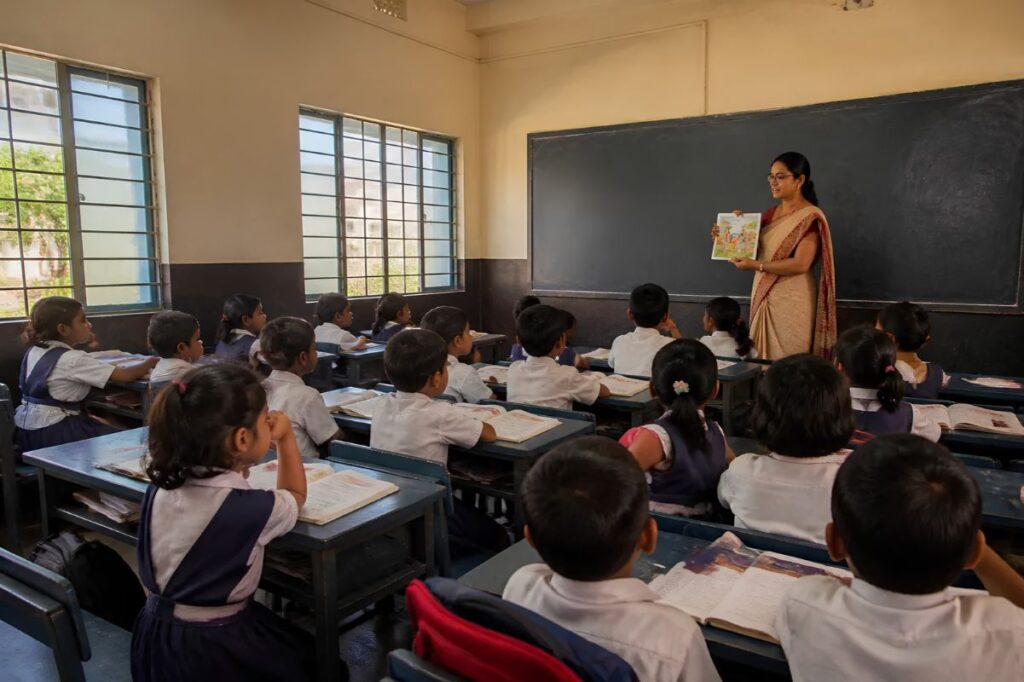
In those 6,769 schools, a single teacher sits in one room managing students from Classes I through IV at the same time. Rural primary head teachers and District Primary School Council (DPSC) field administrators, who oversee local primary school management at the district level, point out that a homeroom model only functions when every school has four to five full-time teachers, dedicated clerks for paperwork, and in-service subject training. None of those three conditions currently exist across rural West Bengal.
Why Does Generalist Training Create a Subject-Proficiency Deficit?
Locking one generalist teacher into a single primary class for all subjects removes staff pooling and risks substandard instruction in English and Mathematics if that instructor lacks subject fluency.
Even in schools employing four or more teachers, ending subject rotation introduces a curriculum problem. Following an October 2026 review meeting in Kolkata with the chairpersons of the state’s 21 District Primary School Councils, School Education Minister Dipak Barman announced that the government is weighing a single-teacher classroom system where one instructor teaches Bengali, English, Mathematics, and Geography to a single primary class, alongside proposals to tie annual salary increments to student reading proficiency and reintroduce a pass-fail detention rule.
State education officials defend the homeroom structure on child-development grounds. Early childhood and foundational pedagogy frameworks, including India’s National Education Policy (NEP) 2020 foundational stage guidelines and primary models used in countries like Finland, favor keeping young children aged six to nine with a single homeroom teacher. A single teacher builds stronger emotional security with young learners, tracks progress across literacy and numeracy, and removes the disruption of rotating four different adults through a Class I or Class II room every day.
That homeroom model, however, depends on how primary teachers are trained and hired. Under the recruitment rules of the West Bengal Board of Primary Education (WBBPE), the statutory body conducting the Teacher Eligibility Test (TET) and hiring primary teachers, candidates qualify as generalists. A candidate needs a Higher Secondary (Class XII) certificate with 50% marks and a two-year Diploma in Elementary Education (D.El.Ed), with no requirement to hold an undergraduate degree in English, Mathematics, or Science.
Under the current rotation system, rural primary schools compensate for that generalist training by pooling staff strengths: a teacher comfortable with English handles English periods across Classes I to IV, while a colleague strong in numeracy teaches Mathematics. Locking one generalist teacher into a single class for all subjects removes that safety net. If the teacher assigned to Class III has weak proficiency in English or Mathematics, that entire cohort receives weak instruction in those subjects for the full academic year.
How Do Administrative Duties Create an Absenteeism Bottleneck?
Consolidating all subjects under one instructor magnifies daily instruction loss because every hour a sole teacher spends on state-mandated paperwork wipes out 100% of that cohort’s class time.
Under a multi-teacher timetable, if one teacher is pulled out of the classroom for two hours, the class misses a single subject period. Under a single-teacher-per-class timetable, when that sole instructor leaves the room, all subject instruction stops for the day.
Primary teachers in West Bengal are required by state circulars to perform multiple non-teaching administrative tasks during school hours:
- Supervising daily cooking, weighing supplies, and logging beneficiary counts for the PM POSHAN (Mid-Day Meal) nutrition scheme.
- Entering student attendance, scholarship data, and assessment records onto the state’s Banglar Shiksha online portal.
- Serving as Booth Level Officers (BLOs) for electoral roll revisions and verification drives.
Layer statutory leave allowances onto those daily administrative tasks. Under WBBPE leave rules, permanent primary staff are entitled to casual leave, medical leave, and maternity or child-care leave. In a four-grade school with exactly four teachers and no floating substitute, a single teacher taking casual leave or attending a block-level administrative meeting leaves an entire class without any subject teacher for the day.
Can State Recruitment Resolve the Deployment Paradox and Zero-Enrollment Schools?
Hiring 13,000 new primary teachers falls short of staffing single-teacher schools unless the state transfers surplus staff out of its 4,133 zero-enrollment schools.
To supply enough instructors for the proposed classroom model, School Education Minister Dipak Barman stated after the DPSC review meeting that the government plans to recruit at least 13,000 primary teachers to bring the state’s primary Pupil-Teacher Ratio (PTR), the average number of students per teacher, down toward 20-to-1.
Hiring 13,000 new teachers still leaves a math problem on the ground unless the state redistributes its existing workforce. According to UDISE+ figures verified by the West Bengal School Education Department during physical school audits, West Bengal has 4,133 schools with zero student enrollment that still retain salaried teachers on their payrolls.
Based on the state’s deficit of 6,769 single-teacher schools, bringing every one-teacher primary school up to the four-teacher minimum required to assign one teacher per grade requires 20,307 additional teacher postings. Adding 13,000 recruits covers less than two-thirds of that gap, leaving a shortfall of 7,307 teachers, unless the West Bengal Board of Primary Education transfers surplus staff out of zero-enrollment and low-enrollment urban schools in districts like Kolkata and North 24 Parganas into high-enrollment rural classrooms in Malda, Murshidabad, and Uttar Dinajpur, where classrooms routinely exceed the Right to Education Act’s 30-to-1 ceiling.
Why Does Performance-Pay Create an Assessment Conflict of Interest?
Tying teacher salary hikes to student reading scores while placing a single teacher in charge of teaching, testing, and grading creates an incentive to inflate internal scores.
The staffing and subject gaps converge in the final piece of the cabinet’s blueprint: tying teacher pay to student reading scores while bringing back the pass-fail system. Under the accountability rule outlined by the state education administration, if 15 out of 20 students in a primary classroom fail to develop basic reading skills, the teacher must submit a formal explanation before receiving an annual salary increment or promotion. At the same time, the state is reviewing the reintroduction of a formal pass-fail examination system at the primary level, modifying the no-detention policy under Section 16 of the Right to Education Act.
In lower primary grades (Classes I to III), West Bengal conducts no external board examination. The classroom teacher teaches the syllabus, writes the internal assessment, and grades the students.
Putting a single teacher in charge of teaching all subjects to a class, grading that same class’s foundational reading tests, and facing a frozen salary increment if 15 out of 20 students fall short creates a direct financial conflict of interest. When a teacher without subject support or administrative relief is told their annual pay raise depends on internal pass rates, the system rewards either inflating internal reading marks to clear the 20-student threshold or holding back struggling first-generation learners before they reach external audits.
Frequently Asked Questions
Does West Bengal’s single-teacher primary model apply to all state schools?
No. While the state cabinet is reviewing a single-teacher-per-class model, UDISE+ data shows that 6,769 state schools currently operate with just one teacher for all grades combined. In those schools, a single instructor already manages multiple grade levels simultaneously rather than focusing on a single primary class.
How does generalist training affect primary subject instruction in West Bengal?
Under West Bengal Board of Primary Education (WBBPE) recruitment rules, primary teachers qualify as generalists holding a Higher Secondary certificate and a two-year D.El.Ed diploma without subject-specific undergraduate degrees. Ending subject rotation means a teacher weak in English or Mathematics will teach those subjects to the same cohort all year.
What administrative duties disrupt single-teacher primary classrooms?
Primary teachers must supervise daily PM POSHAN (Mid-Day Meal) cooking and beneficiary counts, enter student data on the Banglar Shiksha portal, and serve as Booth Level Officers for electoral work. In a single-teacher classroom, an instructor’s absence for these duties halts 100% of subject instruction for the day.
Can the state’s 13,000 new teacher recruits solve rural school staffing shortages?
Hiring 13,000 primary teachers leaves a 7,307-position shortfall against the 20,307 teachers needed to bring 6,769 single-teacher schools up to a four-teacher minimum, unless the state redistributes teachers from its 4,133 zero-enrollment schools.

Praseetha K
Praseetha K is the Managing Editor of Clarity Times. She edits, verifies and publishes the newsroom's articles, and also writes analysis on policy, law, business and technology. Articles she writes are edited by the Editor-in-Chief before publication.