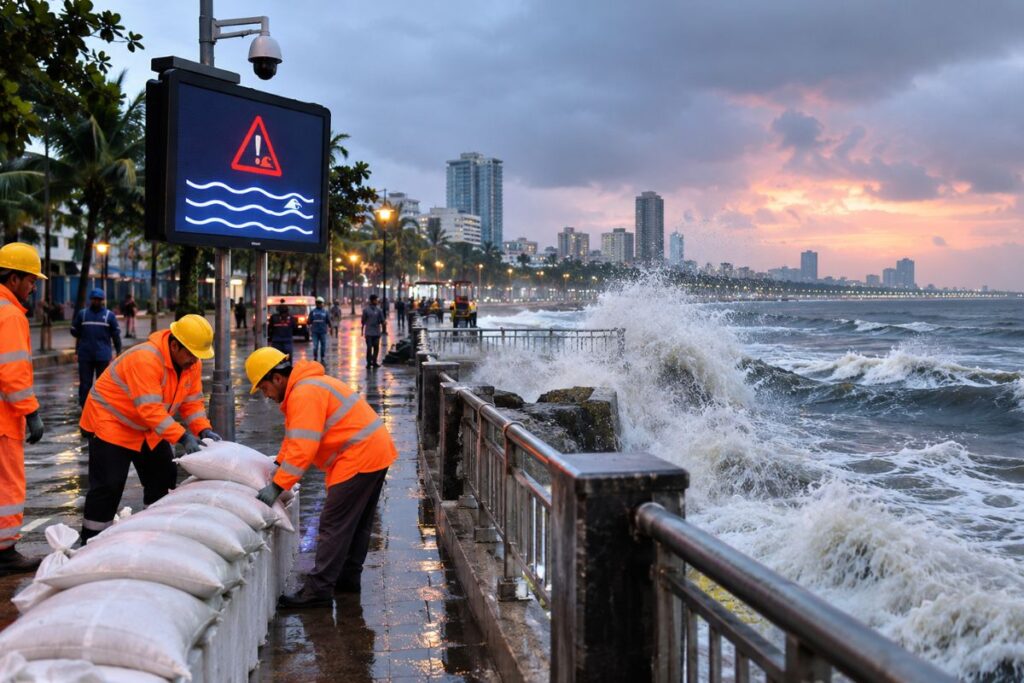
Coastal cities prepare for perigean spring tides by deploying mechanical defenses before astronomical peak water levels hit. Municipal crews inspect one-way storm valves, position portable diesel bypass pumps, and barricade low-lying roads to prevent an extra 3 to 8 inches of lunar tidal lift from reversing gravity drainage and flooding streets.
How Do Public Works Crews Manage Drainage Ahead of a Supermoon?
Public works crews manage drainage ahead of a supermoon by clearing sediment from subterranean check valves, manually securing slide gates, and staging temporary diesel bypass pumps.
A perigean spring tide, often colloquially termed a King Tide, is an exceptionally high astronomical tide that occurs when the moon’s full or new phase aligns with its closest orbital approach to Earth. Ahead of these events, municipal crews across coastal flood corridors follow formal prevention routines. Under operational guidelines outlined in the City of Charleston Check Valve Program and field protocols from the City of Norfolk Storm Water Division, public works staff inspect underground drainage infrastructure along exposed waterfront corridors.
The front line of defense is mechanical. Crews scrape away barnacles, oyster shells, and silt from one-way check valves, heavy elastomeric duckbill sleeves, or cast-iron flapper gates installed inside outfall pipes. If a valve is wedged open by debris, incoming seawater flows backward into the system.
Where gravity outfalls lack permanent backflow prevention, field teams manually screw shut slide gates or inflate heavy pneumatic plugs inside the pipes. Closing these valves locks municipal street runoff behind the bulkhead. To counter that trapped runoff, crews position trailer-mounted diesel bypass pumps at low-lying intersections, pumping accumulated rainfall and street wash-up over the seawall directly into the bay.
Why Does an Extra 3 to 8 Inches of Tide Break Gravity Drainage?
An extra 3 to 8 inches of tidal water breaks gravity drainage by submerging the outfall pipe’s invert elevation, which neutralizes the downhill slope needed for stormwater to drain.
Older coastal municipal systems rely on gravity stormwater drainage: rain running off streets enters curb inlets and flows downhill through subterranean concrete lines to discharge into tidal bays, rivers, or harbors. For water to discharge, the hydraulic head, the physical difference in water elevation between the street drain and the receiving bay, must remain positive toward the sea.
Data compiled by the National Oceanic and Atmospheric Administration (NOAA) Center for Operational Oceanographic Products and Services confirms that perigee-syzygy drives high-water baselines past normal monthly marks. According to the NOAA High Tide Flooding Outlook, perigean spring tides lift local astronomical water levels by 3 to 8 inches above normal Mean Higher High Water datums.
That vertical lift in sea level causes gravity stormwater drainage head reversal. When the bay’s surface rises higher than the outfall pipe’s interior invert, the outward hydraulic gradient collapses. Ocean water forces its way backward through underground pipes, bubbling up into street gutters through catch-basin grates under clear, cloudless skies.
How Does Perigee Differ From a Standard Biweekly Spring Tide?
A standard biweekly spring tide is driven by gravitational alignment alone, while a perigean spring tide magnifies that pull through orbital proximity.
Tides follow predictable orbital geometry. Standard spring tides occur twice every 29.5-day lunar month during syzygy: the straight-line alignment of the Earth, Moon, and Sun at both the new and full moon phases. During syzygy, solar and lunar tidal bulges merge, producing higher-than-average high tides and lower-than-average low tides.
As documented by the NOAA National Ocean Service King Tide analysis, a perigean tide occurs when syzygy coincides with perigee, the point in the moon’s elliptical orbit where it reaches approximately 221,500 miles from Earth, compared to an apogee distance of 252,700 miles. Because gravitational tidal-forcing strength follows an inverse-cube law relative to distance, that physical proximity magnifies the moon’s tidal pull, lifting high-water datums beyond typical biweekly spring baselines.
Why Do Autumn Winds Compound Sunny Day Tidal Flooding?
Autumn winds compound sunny day tidal flooding by pushing open water into shallow estuaries, preventing low-tide drainage between consecutive high-tide peaks.
During November and December, mid-latitude low-pressure systems and offshore nor’easters generate sustained onshore winds along the Atlantic and Gulf coasts. A sustained onshore wind blowing at 15 to 20 knots exerts frictional drag on the ocean surface, driving water into shallow sounds, river mouths, and bays.
Water-level monitoring networks managed under NOAA Sea Level and Coastal Flooding tracking show that a 15-to-20-knot onshore breeze can raise predicted perigean tides past local moderate flood stages. In enclosed basins like Chesapeake Bay, Charleston Harbor, or Biscayne Bay, water piles against the shoreline in a dynamic known as estuarine stacking.
Estuarine stacking prevents water from receding during regular low-tide cycles. When high tide returns six hours later, the incoming astronomical wave builds upon an already elevated baseline, erasing the drainage safety margin and flooding road corridors that remain dry during summer perigee events.
What Does “Sunny Day” Tidal Defense Cost Municipal Taxpayers?
Defending streets against recurring perigean tides costs municipalities tens of thousands of dollars per tidal cycle in mobile equipment rentals, field overtime, and valve installations.
Municipal capital improvement budgets show that retrofitting stormwater outfalls with storm drain backflow check valves requires significant capital outlay. According to municipal infrastructure reporting by the Chesapeake Bay Journal on Municipal Flood Measures, outfitting a single stormwater conduit with an elastomeric duckbill or wafer check valve costs between $20,000 and $60,000, depending on pipe diameter and tidal flow velocity. Coastal cities often operate dozens of unprotected outfalls.
Operating expenses compound during every King Tide window. Cities spend thousands of dollars per multi-day cycle renting portable diesel trash pumps, dispatching police for traffic diversions, paying overtime to public works crews monitoring valve gates, and running street-sweeping sweepers to wash corrosive brine off road asphalt and bridge expansion joints.
Engineering an entire city’s subterranean stormwater network to withstand peak perigean high water would demand billions of dollars for deep storage tunnels, elevated seawalls, and high-capacity electrical lift stations. For municipal budget directors, renting auxiliary pumps, installing check valves at chronic bottlenecks, and detouring traffic around low intersections for two hours per cycle remains the most defensible use of public funds.
Frequently Asked Questions
Why does salt water come up through city storm drains during a supermoon?
During a supermoon, perigean spring tides lift sea levels 3 to 8 inches above normal high-tide datums, submerging outfall pipe exits. This reverses hydraulic head pressure, pushing ocean water backward through gravity-fed storm pipes and up onto city streets.
What is the difference between a normal spring tide and a perigean spring tide?
A normal spring tide happens twice a month when the Earth, Moon, and Sun align; a perigean spring tide occurs when that alignment coincides with the Moon’s closest orbital approach to Earth, producing substantially higher tidal datums.
How do cities stop salt water from backing up through drainage networks?
Municipalities install one-way elastomeric duckbill or flapper check valves on outfall pipes, manually close knife-gate valves before high tide, and run portable diesel bypass pumps to push accumulated street runoff over seawalls.
How much does an elastomeric storm drain check valve cost to install?
Installing a commercial one-way check valve on a municipal stormwater outfall costs between $20,000 and $60,000 per pipe, depending on conduit diameter, access conditions, and tidal current forces

Praseetha K
Praseetha K is the Managing Editor of Clarity Times. She edits, verifies and publishes the newsroom's articles, and also writes analysis on policy, law, business and technology. Articles she writes are edited by the Editor-in-Chief before publication.