
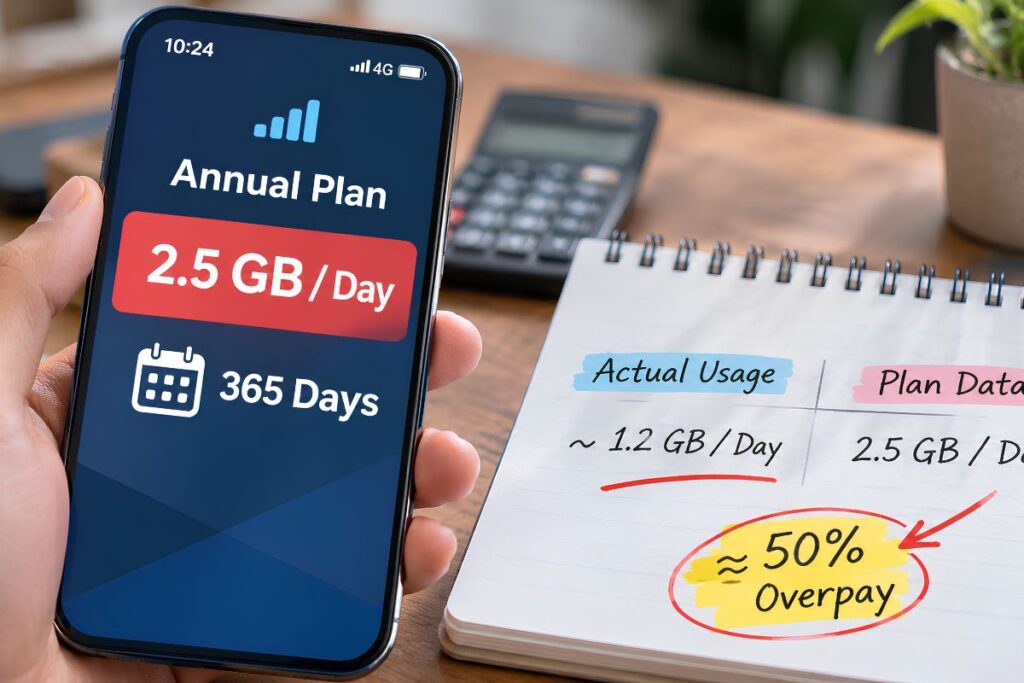
A 2.5GB per day annual plan is almost never cheaper per gigabyte for typical smartphone owners. Because unused daily allowances vanish every night at midnight, anyone using standard home or office Wi-Fi loses most of their data to daily resets, driving their real cost to roughly ₹9.86 per consumed gigabyte.
What Do You Actually Pay for the Cellular Data You Touch?
Subscribers on a 2.5GB per day annual plan pay an effective rate of ₹9.86 per utilized gigabyte, more than double the advertised unit price, if they consume 1GB of cellular data daily.
Retail listings for flagship 365-day prepaid tiers from Reliance Jio Infocomm Limited and Bharti Airtel Limited advertise high total capacities. A prepaid tier is a mobile plan paid for upfront before service begins, operating on set allowances rather than post-service billing. At current rates centering on ₹3,599 for 2.5GB a day, dividing the ₹3,599 price by 912.5 total gigabytes suggests a rate of ₹3.94 per gigabyte.
That calculation assumes an impossible pattern: consuming exactly 2,560 megabytes every 24 hours without interruption.
Indian cellular networks run on an unbanked daily quota: any portion of your daily data limit left unused when the clock hits 12:00 AM is erased rather than rolled over. If a subscriber uses 1GB during daytime hours, the remaining 1.5GB does not carry forward to the next morning. It disappears.
A subscriber using an average of 1GB of cellular bandwidth each day consumes 365GB across the entire year. Dividing the ₹3,599 upfront cost by those 365 consumed gigabytes yields a true unit cost of ₹9.86 per gigabyte. The buyer pays for 912.5GB, loses 547.5GB to midnight cutoffs, and carries the balance-sheet loss alone.
How Much Cellular Data Does an Average Indian Mobile User Really Consume?
Official regulatory data proves the average Indian mobile subscriber uses less than 1GB of cellular data daily, leaving over 64% of a 2.5GB daily allowance unspent.
According to performance indicator reports from the Telecom Regulatory Authority of India (TRAI), the average wireless data usage per active subscriber across India hovers around 25 to 27 gigabytes per month. Spread across a standard thirty-day window, median cellular demand works out to roughly 0.83GB to 0.90GB per day. Even among heavy data-only smartphone users tracked in the Ericsson Mobility Report, regular monthly consumption on mobile connections falls short of high-tier daily limits.
Comparing national usage to a 2.5GB daily cap exposes the scale of unconsumed bandwidth:
- Over 64% of the purchased data bucket in a 2.5GB per day annual plan expires unspent by the average cellular user.
- Across 365 days, a median user consuming 0.85GB daily touches only 310GB out of the 912.5GB allowance they funded upfront.
- At the standard ₹3,599 retail price point, that median user’s effective cost works out to ₹11.60 per consumed gigabyte.
The gap stems from fixed-broadband offload: the deliberate switching of a phone’s internet connection from mobile radio towers to local Wi-Fi networks. High-bandwidth activities, streaming movies, backing up photos, downloading software updates, and taking video calls, run predominantly on fixed connections at home and the office. Cell towers handle what remains: transit navigation, text messaging, and intermittent browsing on the go.
Why Do Telecom Operators Bundle 365-Day Validity With Oversized Daily Data?
Carriers pair 365-day account validity with large daily quotas because daily resets protect cell towers from traffic spikes while guaranteeing higher revenue per customer.
Service validity is the operating lifespan of a prepaid account during which an operator keeps the SIM card active to receive calls and access network spectrum. Operator rate cards offer very few ways to buy 365 days of active line status without also buying heavy daily data. Entry-level long-validity tiers with modest bulk allocations, such as legacy 24GB or 30GB lump-sum allotments, have been isolated into basic voice tiers with zero high-speed allowances or removed from promotion.
Subscribers who want unbroken phone service for twelve months without running monthly recharges are directed toward catalog tiers that bundle high daily data allowances with the dial tone.
Is an Annual Plan Cheaper Than a Basic Validity Tier With Data Vouchers?
For anyone with consistent Wi-Fi access, splitting an account into a basic validity plan paired with standalone data vouchers cuts annual telecom spending by 35% to 45%.
Financial returns vary directly with offload habits across three primary usage patterns:
- The Connected Worker: Relies on Wi-Fi at home and work, using 0.8GB of mobile data daily (292GB annually).
- The Commuter: Connects to Wi-Fi only at night, averaging 1.4GB of mobile data daily (511GB annually).
- The Mobile-Only User: Operates without fixed broadband, using 2.3GB of cellular data daily (839.5GB annually).
For the Connected Worker, an annual ₹3,599 recharge delivers 292GB of actual consumption at an effective rate of ₹12.32 per gigabyte. Choosing a base validity option and supplementing it with targeted data vouchers, add-on data packs that provide a fixed block of data without midnight expiration rules, reduces total annual outlay by 35% to 45%.
For the Commuter, the plan delivers 511GB of actual use at an effective rate of ₹7.04 per gigabyte. While this approaches price parity with shorter renewal cycles, the user still forfeits roughly 44% of the data they purchased.
Only the Mobile-Only User captures the plan’s advertised efficiency. At 2.3GB of daily consumption, their effective cost drops to ₹4.28 per consumed gigabyte.
A subscriber must consistently consume at least 1.8GB of cellular data every day of the week, including weekends, before a 2.5GB per day annual plan becomes cheaper per gigabyte than buying basic validity alongside targeted data boosters.
What Are Subscribers Actually Paying for With an Annual Prepaid Recharge?
Subscribers buying a high-capacity annual pack are paying an insurance and convenience premium rather than getting wholesale-rate data.
Cellular radio spectrum is a perishable resource: unused radio capacity available at 2:00 PM on a Tuesday afternoon cannot be stored in a tank and redistributed on a Saturday evening. The Cellular Operators Association of India (COAI) has repeatedly stated in submissions to regulators that daily reset mechanisms prevent severe network congestion. Without daily caps, millions of subscribers rushing to exhaust accumulated monthly or yearly balances before their expiration dates would overwhelm local cell towers.
For the subscriber, purchasing the plan provides distinct non-financial utility:
- It locks in tariff rates for 365 days, hedging against interim price increases by carriers.
- It eliminates eleven manual monthly recharge transactions and payment-gateway checkpoints.
- It removes the risk of service cutoffs, missed calls, or verification delays caused by an expired billing date.
That security carries a measurable cost. Evaluating an annual plan on cost per day or nominal cost per gigabyte values bandwidth that never gets used. For homes and workplaces equipped with a Wi-Fi router, an annual 2.5GB per day prepaid recharge functions as a prepaid convenience retainer, not a low-cost data package.
Frequently Asked Questions
Does unused data from a 2.5GB per day prepaid pack carry over to the next day?
No. Indian telecom operators run daily quota plans on a strict midnight reset schedule, meaning any unused portion of the 2,560MB allowance expires every night at 12:00 AM. Unused data does not accumulate or roll over into future balances.
What is the break-even usage point for a 2.5GB per day annual plan?
A smartphone subscriber must use at least 1.8GB of cellular data every single day, without offloading to home or workplace Wi-Fi, for an annual 2.5GB per day recharge to match the cost efficiency of a base validity plan supplemented with on-demand data vouchers.
How much cellular data does the average Indian smartphone subscriber use per day?
According to quarterly performance reports from the Telecom Regulatory Authority of India (TRAI), the average active wireless subscriber consumes approximately 25GB to 27GB per month, which works out to an average of 0.83GB to 0.90GB per day.

Praseetha K
Praseetha K is the Managing Editor of Clarity Times. She edits, verifies and publishes the newsroom's articles, and also writes analysis on policy, law, business and technology. Articles she writes are edited by the Editor-in-Chief before publication.