
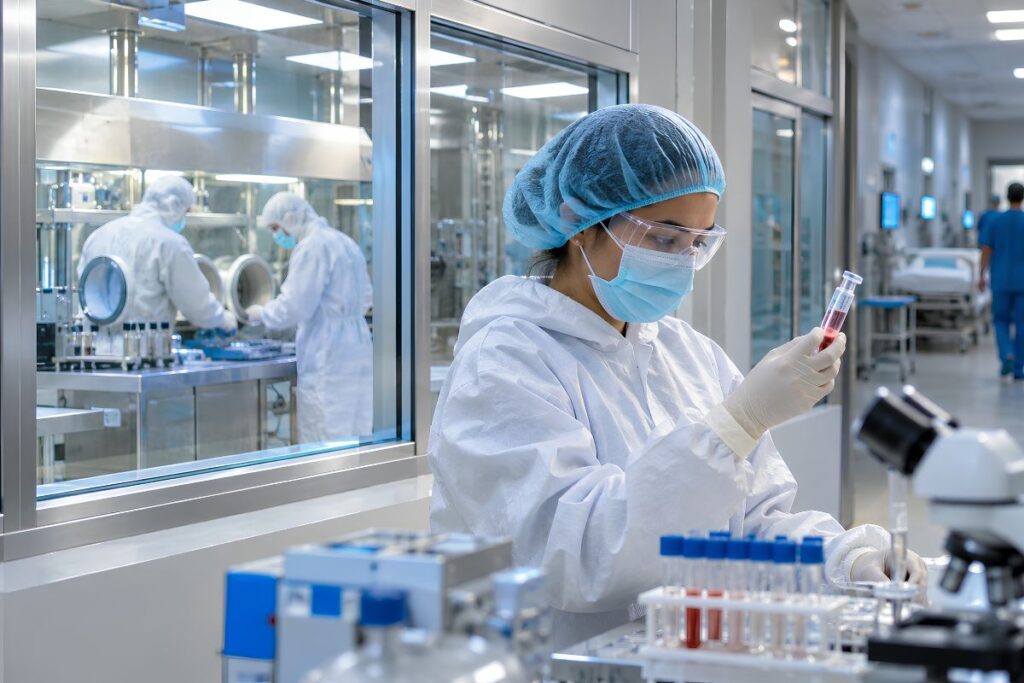
In vivo cell therapy, injecting messenger RNA inside targeted lipid nanoparticles directly into a patient’s vein, creates a serious in vivo cell therapy cleanroom risk for cancer centers. Hospitals and commercial manufacturers that spent billions building specialized suites to harvest, culture, and freeze patient cells face underused facilities, long-term bond liabilities, and stranded capital if engineering shifts inside the body.
Why Does In Vivo Delivery Threaten Ex-Vivo Cleanrooms?
In vivo cell engineering eliminates the external processing laboratory entirely by instructing the patient’s own body to produce therapeutic immune cells.
Specialized cancer centers spent the past eight years constructing good manufacturing practice (GMP) suites, certified sterile environments that prevent airborne contamination during biological preparation—designed around a single, highly manual workflow: autologous cell therapy. In that model, clinicians draw a patient’s blood, extract immune cells through apheresis, transfer those cells to an ultra-clean processing suite, genetically modify them in incubators over several weeks, run quality tests, and re-infuse them.
The physical plants constructed to run this pipeline are rigid. They require dedicated cleanroom suites, air-handling machinery capable of continuous high-efficiency particulate air (HEPA) filtration, uninterrupted liquid nitrogen storage for cryopreservation, and dedicated apheresis bays.
Academic medical centers financed these capital additions directly through institutional reserves and long-term public debt. In its audited annual financial disclosures, The University of Texas MD Anderson Cancer Center detailed capital asset additions of $705.9 million in fiscal year 2024 alone, with $452.3 million tied up in ongoing facility construction projects to house advanced therapies and specialized research suites. These multi-decade capital allocations funded footprints engineered specifically around handling living cells outside the body.
An in vivo injection bypasses this entire infrastructure. The drug arrives as a frozen vial, thaws in a standard hospital pharmacy, and drips through a peripheral vein over an hour. The patient’s blood never leaves circulation. No apheresis technicians, cleanroom operators, or external cell incubators are needed.
Can Hospitals Pay Off Cleanroom Debt If Cell Therapies Move Inside the Body?
Health systems face fixed long-term bond payments on cleanrooms even if patient-specific cellular processing volumes migrate to direct pharmaceutical infusions.
Modern high-containment suites carry steep autologous CAR-T infrastructure costs, with buildouts ranging between $1,200 and $2,500 per square foot for specialized modular configurations, according to cleanroom engineering benchmarks from BioClean Technologies. Routine maintenance adds constant overhead: operators must fund continuous airborne particle monitoring, scheduled sterility validation, and specialized technical labor around the clock.
Health systems and private operators financed these footprints on expectations of compounding clinical demand. Industry reports from BioProcess International tracking biomanufacturing facility trends document how contract manufacturers and health networks expanded dedicated CDMO cleanroom capacity to clear patient waitlists for autologous therapies.
If therapies requiring custom cell manufacturing lose clinical share to off-the-shelf in vivo injections over the next decade, the revenue generated per suite drops, but the fixed maintenance and debt service remain unchanged.
For dedicated contract development and manufacturing organizations (CDMOs) that built excess suite capacity to clear commercial CAR-T backlogs, the shift carries immediate valuation consequences. When the manufacturing step moves from a multi-week external cell process to a mass-produced chemical vial, the cleanroom ceases to be a revenue driver. It becomes an overhead burden.
Can Specialized Cell Processing Suites Be Repurposed for Other Drugs?
Most cleanroom suites built for autologous cell therapy cannot easily pivot to mass vial production because their physical layouts are engineered for small, patient-specific batches rather than continuous manufacturing.
The cleanroom footprint will not vanish overnight. Liquid tumors, highly complex multi-gene edits, and therapies requiring long-term cellular persistence will rely on ex-vivo methods for years while in vivo delivery vehicles solve challenges related to human liver clearance and short mRNA half-lives.
Hospital operations teams point out that certain cleanroom footprints can be adapted. High-grade sterile suites configured for autologous engineering can technically pivot toward adjacent biologics, such as personalized neoantigen peptide compounding or regional dendritic cell vaccines.
Yet adaptation has severe physical boundaries. Process equipment designed specifically for automated cell isolation, acoustic washing, and closed-system bioreactor expansion cannot run high-throughput vial filling or nanoparticle lipid mixing without stripping suites down to their subflooring and ductwork. Technical guidance and translation analyses archived at the National Center for Biotechnology Information document that while in vivo formulations eliminate complex external culturing, overcoming targeted delivery barriers and off-target clearance remains the primary hurdle dictating how fast medicine can retire ex-vivo cleanrooms.
Equipment purchased specifically for ex-vivo harvesting depreciates on corporate balance sheets whether it runs batches or sits dark. As utilization rates soften, the operational cost of maintaining isolated air handlers and sterile cleaning validation cycles must be absorbed by shrinking numbers of autologous patients.
What Does In Vivo Technology Mean for Hospital Capital Budgets?
Health networks must decide immediately whether to pause planned cleanroom construction projects or risk creating ex-vivo manufacturing stranded assets as in vivo alternatives enter human trials.
Medical research focuses on biological mechanisms: whether an injected lipid nanoparticle reaches the right white blood cell inside a living patient. The institutional fallout, however, will be measured in square footage, balance-sheet write-downs, and capital reallocations across hospital systems.
Health networks entering planning cycles for multi-million-dollar cleanroom expansions must now weigh committing long-term capital to physical infrastructure built around ex-vivo handling against the rapid maturation of systemic delivery platforms.
Frequently Asked Questions
How does in vivo cell therapy cause hospital cleanroom obsolescence? In vivo cell therapy uses targeted lipid nanoparticles to deliver messenger RNA directly into a patient’s bloodstream, programming immune cells inside the body. This process bypasses the external harvesting, culturing, and cryopreservation workflows that multi-million-dollar hospital cleanroom suites were constructed to house.
Why are hospital cleanrooms at risk of becoming stranded assets? Cancer centers financed cleanrooms using multi-decade bonds on the assumption that personalized cell therapy would always require specialized external laboratory manipulation. When off-the-shelf in vivo injections replace manual cell engineering, these suites generate significantly lower processing revenues while their fixed debt service and sterile maintenance costs remain.
Can hospitals convert CAR-T cleanrooms to produce mass-market pharmaceuticals? Converting autologous cleanrooms to high-volume drug manufacturing is difficult because their physical layouts, air-handling zones, and drainage systems are built around small, patient-specific batches rather than high-throughput vial filling. Repurposing these suites typically requires stripping the facility down to subflooring and ductwork.

Praseetha K
Praseetha K is the Managing Editor of Clarity Times. She edits, verifies and publishes the newsroom's articles, and also writes analysis on policy, law, business and technology. Articles she writes are edited by the Editor-in-Chief before publication.