
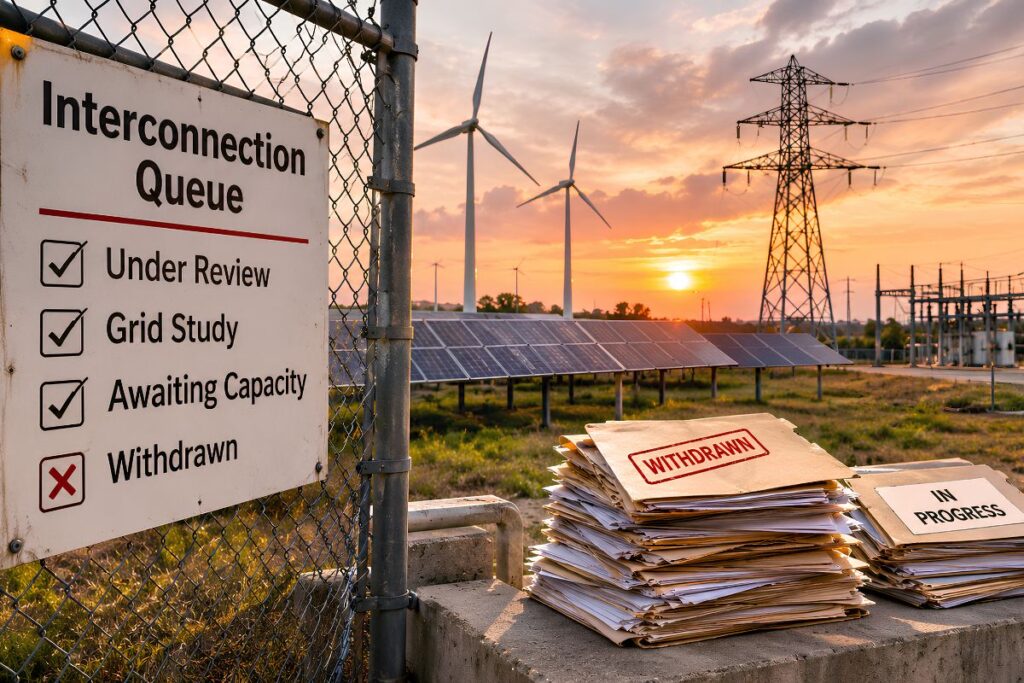
Between 70% and 80% of power projects in the regional interconnection queue backlog will withdraw before building a single megawatt. Rather than signaling an immediate physical shortage of electricity, the nation’s multi-gigawatt grid logjam is primarily an administrative bottleneck driven by placeholder filings, speculative financing, and cascading engineering restudies.
An interconnection queue is the official administrative waiting list managed by regional grid operators to evaluate whether proposed power plants can safely connect to the transmission network. Across the regional grids operated by PJM Interconnection and the Midcontinent Independent System Operator (MISO), waiting lists are routinely cited as proof that artificial intelligence and data centers are exhausting available electric supply.
Long-term records show a different reality. According to historical interconnection data compiled in the Lawrence Berkeley National Laboratory Queued Up Report, between 70% and 80% of all capacity entering these queues withdraws rather than reaches commercial operation. Across historical development cycles, only 14% to 21% of requested capacity achieved commercial completion. Regulatory filings submitted to the Federal Energy Regulatory Commission PJM RTO Metrics reveal that over 80% of system impact studies conducted by grid operators evaluate projects that developers ultimately abandon.
The queues are not backlogged with physical hardware waiting for wire. They are clogged with paper applications.
When regional transmission organizations run reliability models to calculate available capacity, federal rules require them to model every early project in line as if it will be built. When seven out of ten projects exist primarily as balance-sheet options, the baseline calculations artificially distort the true physical capacity of the transmission grid.
How Do Speculative Developers Profit from Ghost Interconnection Filings?
Speculative developers profit from ghost interconnection filings by reserving low-cost transmission access and flipping those priority rights to commercial buyers at steep premiums.
Historically, securing an early queue spot required minimal at-risk capital: a preliminary study deposit, basic site control documentation, and an exploratory engineering concept. Project tracking records across the MISO Generator Interconnection Queue Dashboard show that project entity ownership frequently turns over between initial submittal and commercial execution.
Early-stage developers routinely submit multiple applications across various substations without intending to build every site. Independent power producer transaction records show that applicants frequently secure non-exclusive land options or commit nominal earnest money simply to establish priority.
The underlying business model relies on secondary market arbitrage. Once a project advances through preliminary system impact studies without triggering prohibitive network upgrade fees, that position becomes a liquid asset. Developers sell these positions to hyperscalers or utility-scale operators before executing a formal generator interconnection agreement, the binding legal contract between a developer and a grid operator that establishes technical terms and cost obligations for physical connection.
Early-stage developers point out that multi-filing functions as practical risk mitigation. Because regulated utilities do not publish transparent, real-time hosting capacity maps showing where lines can absorb generation, developers file at multiple nodes to determine where an interconnection is physically feasible.
Why Do Upstream Project Withdrawals Delay Viable Generation?
Upstream project withdrawals delay viable generation because removing a single project invalidates electrical baseline models, triggering mandatory restudies for every applicant behind it.
When an early-stage project reaches advanced engineering review, the regional grid operator issues a binding cost allocation for required transmission upgrades, which frequently totals tens of millions of dollars for new substations or reconductored circuits.
Speculative applicants withdraw once hit with these capital requirements. Because grid software models treat all preceding units as active participants sharing system reinforcement costs, that single exit collapses the engineering assumptions for every project in the study cluster.
The grid operator must pause the cluster and execute a mandatory restudy. Technical filings presented in the MISO Order 2023 Compliance & Planning Presentations show that upstream dropouts force complete re-evaluations of system stability limits, power flows, and network upgrade bills.
During these restudy cycles, fully financed clean energy and battery storage installations sit idle. Engineering teams spend months recalculating fault currents and cost shares, freezing capital deployment for 18 to 36 months.
Why Do FERC Order 2023 Penalties Fail to Deter Transmission Capacity Speculation?
Federal Energy Regulatory Commission Order 2023 penalties fail to stop transmission capacity speculation because secondary market acquisition payouts dwarf the administrative fines imposed for dropping out.
Federal regulators attempted to close administrative loopholes through FERC Order No. 2023 on Generator Interconnection Reform, replacing “first-come, first-served” queues with a “first-ready, first-served” cluster process. The rule introduced commercial readiness deposits, required 100% exclusive site control, and enacted withdrawal penalties that can exceed $1 million for a 200-megawatt project.
Grid operators state that these procedural hurdles are clearing unviable applications. They maintain that administrative due process requires methodical validation before any application can be rejected.
Yet the commercial mathematics of hyperscale data center development overwhelms these penalties. While an RTO may assess a $1.6 million penalty for a project withdrawal, data center developers and infrastructure private equity funds offer acquisition premiums ranging from $5 million to over $20 million for early-stage interconnection rights. For a well-capitalized fund, a seven-figure regulatory penalty remains an ordinary cost of doing business.
Who Ultimately Pays for Queue-Related Gridlock?
Captive electricity ratepayers absorb the financial burden of queue churn through transmission tariff riders that fund administrative restudy overhead.
Regional grid operators pass the costs of hiring third-party engineering consultants, legal defense teams, and software contractors directly into regional transmission rates, as documented in FERC Form 715 Annual Transmission Planning Disclosures.
More significantly, treating gross queue volumes as verified power demand skews energy legislation. When state and federal policy debates assume that every gigawatt in an interconnection queue represents a shovel-ready project delayed solely by environmental review, statutory fixes target the wrong pinch point.
Stripped of speculative filings, the volume of projects possessing financing, site rights, and commercial power-purchase contracts represents a fraction of the reported backlog. Until regional market rules eliminate the arbitrage spread between low-cost queue reservations and high-value project transfers, administrative paper will continue to lock out operational megawatts.
Frequently Asked Questions
What percentage of projects in the U.S. interconnection queue actually get built?
According to historical data from Lawrence Berkeley National Laboratory, only 14% to 21% of proposed capacity in regional interconnection queues reaches commercial operation. Between 70% and 80% of all submitted project capacity withdraws before construction begins.
What is a ghost interconnection filing?
A ghost interconnection filing is an exploratory application submitted to reserve transmission priority at a grid substation without committed capital, construction financing, or intended commercial execution. Speculators hold these positions to flip development rights to late-stage buyers once preliminary grid studies verify low upgrade costs.
How does a project withdrawal cause cascading restudies?
When an upstream project drops out of a shared queue cluster, the regional grid operator must recalculate power-flow equations and reallocate shared transmission upgrade costs across all remaining downstream applicants. This administrative recalculation halts development reviews and delays viable projects by 18 to 36 months.
Why don’t FERC Order 2023 withdrawal penalties stop speculative filings?
FERC Order 2023 imposes withdrawal penalties of roughly $1 million to $1.6 million for large projects, but hyperscalers and energy developers pay $5 million to over $20 million on secondary markets to acquire early grid access. The profit margin on a successful transaction substantially exceeds the cost of the regulatory fine.

Praseetha K
Praseetha K is the Managing Editor of Clarity Times. She edits, verifies and publishes the newsroom's articles, and also writes analysis on policy, law, business and technology. Articles she writes are edited by the Editor-in-Chief before publication.