
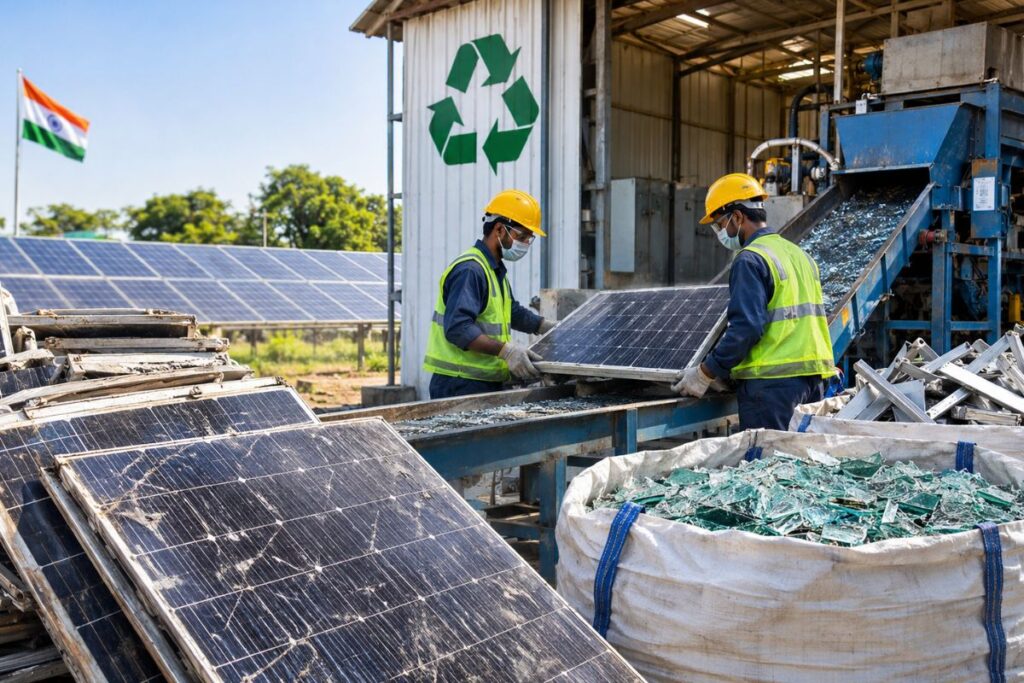
Indian solar manufacturers are pushing to link solar panel recycling rules in India to government procurement lists to counter low-cost imports. By requiring localized recycling facilities and long-term take-back bonds, the proposed rules add compliance costs that foreign suppliers cannot meet without local assets, effectively pricing imported modules out of state-backed solar projects.
Why Are Manufacturers Looking Beyond Import Tariffs?
Tariffs alone have not stopped imported solar equipment from entering Indian projects. With basic customs duties set at 40% on modules and 25% on cells, price gaps between domestic and overseas hardware have narrowed, yet foreign assemblies remain competitive in commercial, industrial, and open-access installations.
To secure market share across public and private contracts, domestic trade groups are shifting their focus from border levies to domestic technical criteria. Through policy advocacy led by the Indian Solar Manufacturers Association (ISMA), an industry body representing domestic photovoltaic module and cell fabricators, domestic producers are treating circular economy regulations as a market-defense mechanism.
The industry’s core proposal to the Ministry of New and Renewable Energy (MNRE) and the Ministry of Environment, Forest and Climate Change (MoEFCC) asks that proof of operating an in-country solar module recycling facility serve as an eligibility prerequisite for government procurement clearance. Under this approach, environmental compliance becomes an administrative filter. Foreign manufacturers without physical facilities or local corporate subsidiaries in India cannot clear that hurdle, shifting tender qualification from pricing to domestic asset ownership.
How Do the Proposed Solar Panel Recycling Rules in India Function as a Trade Barrier?
The industry’s strategy relies on two specific compliance requirements that overseas competitors cannot easily satisfy.
First, domestic lobbies want the Ministry of New and Renewable Energy to mandate that any panel enlisted on the Approved List of Models and Manufacturers (ALMM), the government’s roster of certified module designs permitted in state-backed solar projects, maintain an active partnership with a registered domestic e-waste processing facility. Under Chapter V of the E-Waste (Management) Rules, 2022, manufacturers face inventory-filing obligations while physical module recycling targets remain deferred until the 2034–2035 fiscal year. The proposed procurement rule change would bypass that waiting period, making local processing capabilities an immediate requirement for project vendors.
Second, the proposals call for an upfront decommissioning bank guarantee or escrow deposit for every module sold into the country. Because solar panels carry a standard 25-year performance warranty, suppliers would have to lock up capital in Indian banks for a quarter of a century to fund end-of-life collection.
Compliance demands are operationally demanding. According to statutory [CPCB Guidelines for Storage and Handling of Waste Solar PV Modules](https://eprewaste.cpcb.gov.in/assets/PDF/Guidlines%20for%20Storage%20and%20Handling%20of%20Waste%20Solar%20Photo-Voltaic%20Modules%20or%20Panels%20or%20Cell%20(Under%20E-Waste%20(Management)Rules,%202022_0001_compressed.pdf), handlers must maintain non-leachable, covered storage yards equipped with fire-suppression systems and live inventory databases. Overseas original equipment manufacturers with no registered Indian office or local staff cannot run these reverse-logistics networks, effectively knocking them out of consideration before bids open.
What Did the Original ALMM Order Prove About Administrative Market Control?
This initiative follows the playbook established by the original ALMM mandate in 2019. The policy established an administrative roster to govern which hardware could supply government-supported tenders, direct power purchase agreements, and subsidized rooftop installations.
Getting on the list requires in-person audits of manufacturing plants by inspection teams from the National Institute of Solar Energy (NISE). Travel restrictions, bureaucratic delays, and application queues kept overseas factories off the roster, allowing Indian module makers on ALMM List-I to expand capacity from 8,200 megawatts in 2021 to more than 217,000 megawatts by mid-2026.
When the government reimposed the list in April 2024 following a one-year pause, overseas shipments to utility-scale projects dropped immediately. Attaching physical solar panel recycling rules in India to this existing list creates an environmental barrier across commercial developments and open-access networks.
Why Are Solar Project Developers Resisting New Take-Back Liabilities?
Power developers view the recycling mandate as an added capital liability that strains balance sheets.
Processing costs are already steep. According to financial modeling by the Council on Energy, Environment and Water (CEEW), recycling crystalline silicon modules currently costs between ₹883 and ₹1,079 per module, or roughly ₹4.11 to ₹5.02 per watt peak. Meeting mandatory reverse-logistics requirements and holding 25-year decommissioning escrows adds an estimated ₹1.50 to ₹2.00 per watt peak to module procurement costs. On a 500-megawatt utility installation, that requirement ties up ₹75 crore to ₹100 crore in capital, altering power purchase tariffs and project debt models.
Independent power producers report that foreign suppliers are countering these proposals by inserting risk-transfer clauses into supply agreements. If an overseas manufacturer has no legal presence in India, the statutory duty to collect decommissioned panels falls squarely on the Indian project owner.
Domestic power producers would inherit full legal responsibility for millions of aging modules at the end of their operational life, despite owning no processing infrastructure.
Do Stricter E-Waste Mandates Comply With International Trade Law?
Domestic manufacturers defend the mandate as basic fairness. Indian companies pay domestic corporate taxes, undergo regular pollution audits, and remain subject to local courts if equipment causes contamination decades down the road.
Allowing foreign vendors to supply public utility contracts without dedicated recycling infrastructure forces local authorities and taxpayers to bear future waste cleanup costs. Unregulated exits by foreign vendors risk turning retired solar farms into toxic dumping grounds once performance guarantees expire.
Power developers and overseas suppliers maintain that linking ALMM status to localized recycling operations breaches global trade agreements. Under the World Trade Organization (WTO) Agreement on Technical Barriers to Trade, national technical regulations must not create arbitrary obstacles to international commerce.
A previous WTO dispute brought against India, India – Certain Measures Relating to Solar Cells and Solar Modules (DS456), saw the WTO Appellate Body rule that domestic content mandates violated national treatment principles under Article III:4 of the General Agreement on Tariffs and Trade (GATT). If recycling compliance requirements are applied selectively via procurement rosters to favor local production, the policy invites fresh challenges in international trade tribunals.
For now, the battle continues inside ministry working groups, where waste regulations are being structured into tools of industrial policy.
Frequently Asked Questions
How do solar panel recycling rules in India affect imported panel prices?
Establishing dedicated domestic recovery infrastructure and maintaining 25-year decommissioning escrow deposits adds an estimated ₹1.50 to ₹2.00 per watt peak to equipment costs. For a 500-megawatt utility installation, this requires developers to post between ₹75 crore and ₹100 crore in upfront financial guarantees.
What is the connection between the ALMM solar module list and e-waste rules?
The Approved List of Models and Manufacturers (ALMM) currently certifies solar equipment for public projects based on factory production quality. Domestic manufacturing associations are lobbying the Ministry of New and Renewable Energy to make physical tie-ups with registered Indian e-waste recycling facilities a mandatory eligibility condition for ALMM enlistment.
Can foreign solar manufacturers comply with Indian solar panel recycling rules?
Foreign suppliers without an Indian corporate entity face practical hurdles under Central Pollution Control Board handling rules, which require registered local storage and reverse-logistics channels. Consequently, overseas vendors are inserting contractual terms that transfer all long-term end-of-life recovery liabilities directly to Indian project developers.

Praseetha K
Praseetha K is the Managing Editor of Clarity Times. She edits, verifies and publishes the newsroom's articles, and also writes analysis on policy, law, business and technology. Articles she writes are edited by the Editor-in-Chief before publication.