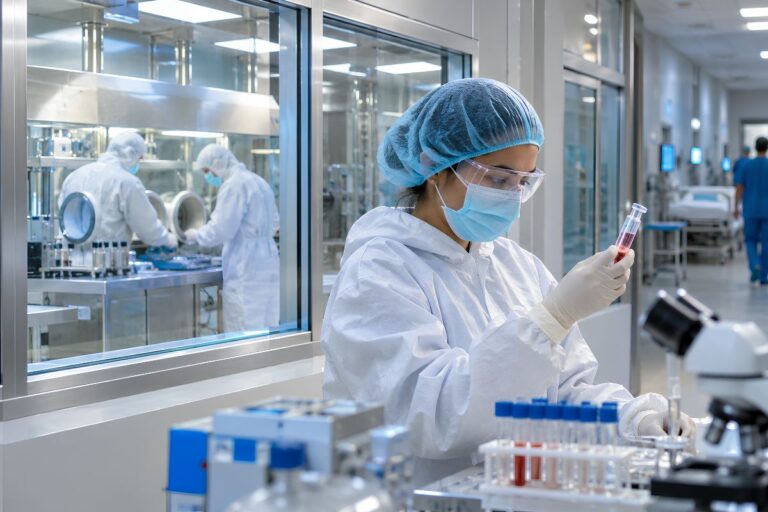
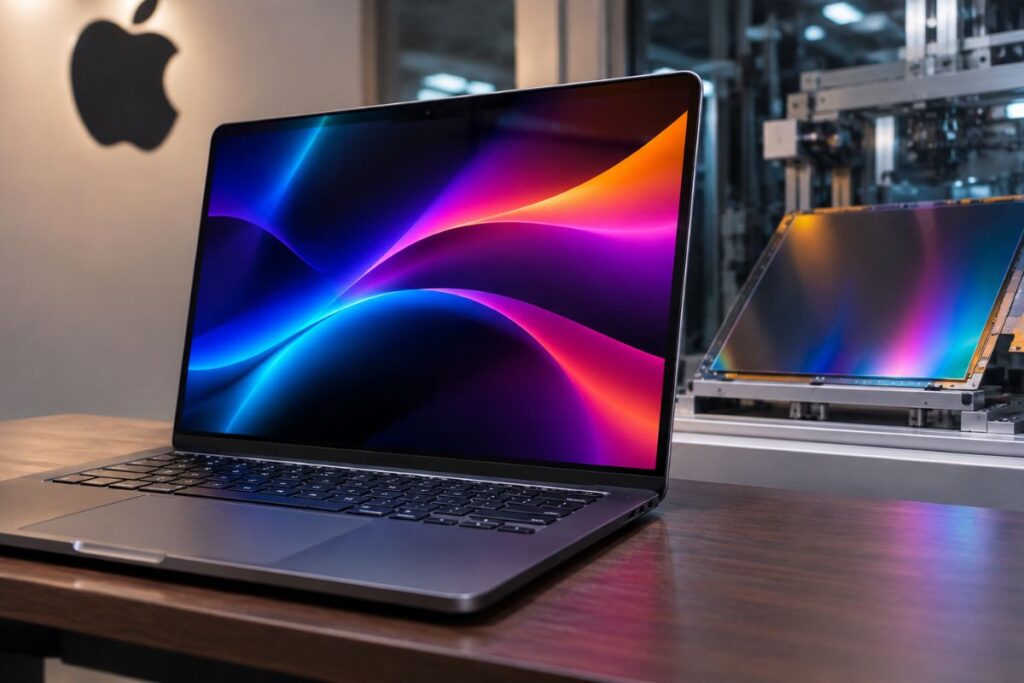
If your tandem OLED MacBook Pro backorder stretches three to four weeks, the delay is not caused by unprecedented customer demand. The bottleneck stems from sub-60% production yields at display fabrication plants in South Korea, where Samsung Display currently manufactures roughly 70% of early panels while LG Display works through tooling constraints.
Why Is Your Tandem OLED MacBook Pro Delayed?
The MacBook Pro delivery delays are created on cleanroom floors in Asan and Paju, South Korea, where fabrication lines fail to produce usable display glass fast enough to feed downstream final assembly plants. Within hours of launch, retail ship dates slipped into four- to six-week dispatch windows, a lag commonly attributed to record pre-orders.
Factory component shipments tell a different story. Market monitors tracking IT-panel manufacturing at Omdia and Display Supply Chain Consultants (DSCC) show that substrate run-rates sit well below commercial target volumes. Finished laptop assembly lines in Chengdu, China, and Bac Giang, Vietnam, are waiting on display panels rather than clearing backlogged device orders.
“When you scale dual-stack vacuum evaporation from a six-inch phone screen to a fourteen-inch panel, the physics change completely,” says Eric Chiou, Senior Research Vice President at TrendForce, an upstream semiconductor and display intelligence firm. “Early substrate runs across the major Korean fabs are tracking below normal commercial qualification curves. The retail backlogs you see in consumer channels reflect fab throughput rates, not a sudden spike in consumer purchasing.”
Apple typically relies on multi-sourcing contracts to balance operational exposure across independent component manufacturers. When the primary supplier encounters mechanical roadblocks during fabrication, delivery timelines across finished goods slip regardless of order volume.
How Do Gen 8.6 FMM Yields Restrict Panel Production?
A fragile metal stencil measuring less than one-tenth the thickness of a human hair is the primary point of failure slowing down production. That component is the Fine Metal Mask (FMM), an ultra-thin invar alloy sheet perforated with microscopic holes through which vaporized organic light-emitting chemicals pass to form individual red, green, and blue subpixels on a glass plate.
Smartphone manufacturing relies on smaller Generation 6 motherglass substrates measuring approximately 1.5 by 1.8 meters. To manufacture 14-inch and 16-inch laptops economically, display suppliers transitioned to Generation 8.6 lines, where motherglass measures roughly 2.29 by 2.62 meters.
That increased surface area triggers a severe mechanical penalty. Stretched across a Generation 8.6 vacuum chamber, the ultra-thin invar metal mask sags toward its center under its own weight.
Tandem OLED technology stacks two independent organic emission layers on top of each other to produce double the luminance without shortening panel life. This dual-emitter architecture leaves little margin for error: even a microscopic deviation in mask tension between the first and second chemical deposition passes ruins subpixel alignment.
According to cleanroom tracking data published by Display Supply Chain Consultants (DSCC), early commercial runs for these large-format dual-stack panels have experienced yields floating below 60%. Four out of every ten manufactured glass panels fail optical inspection and must be scrapped before reaching final module assembly.
Which Supplier Controls MacBook Pro PROLED XDR Display Production?
Samsung Display currently manufactures approximately 70% of all MacBook Pro PROLED XDR display units, leaving LG Display with a minority 30% share during the initial retail launch window.
Apple originally planned to balance procurement orders evenly between both suppliers to secure competitive unit pricing and protect production capacity. Equipment installation schedules upended that strategy. Samsung Display finalized purchase orders and cleanroom installations for Canon Tokki vertical evaporation machines months ahead of LG Display.
LG Display opted to modify existing production machinery to minimize capital expenditure, delaying its full-volume qualification timeline.
According to capital expenditure filings and supply-chain shipment tracking from TrendForce, LG Display supplied only about 30% of launch-quarter panel volumes. Until LG Display’s secondary lines clear full industrial qualification, Samsung Display commands decisive leverage over Apple’s immediate assembly cadence.
Samsung Display and LG Display declined to provide yield figures. In regulatory filings, both manufacturers noted that capital outlays for Generation 8.6 facilities represent multi-year investments where early scrap rates are standard industry practice and amortized over several fiscal cycles.
Why Did Apple Transition from Mini-LED to Tandem OLED?
Apple transitioned its flagship laptops to tandem OLED to eliminate image blooming while maintaining professional-grade sustained brightness. Liquid crystal panels with mini-LED backlights produce halo artifacts because clusters of miniature backlight diodes shine through groups of liquid crystals rather than controlling each subpixel individually.
Single-layer OLED displays produce per-pixel black levels, yet forcing a single organic stack to emit 1,000 nits of sustained full-screen brightness degrades the organic compounds rapidly. Apple’s PROLED XDR display specifications solve this durability limit by stacking two organic emitting layers in series:
- Reduced current per layer: Each diode layer operates at half the electrical load, doubling operational panel longevity.
- Pro-grade full-screen brightness: The dual-layer design delivers 1,000 nits of sustained brightness and 2,000 nits of peak HDR highlights without overheating.
- Zero local blooming: Every pixel functions as its own light source, delivering a 10,000,000:1 contrast ratio with sharp boundaries.
The visual performance gains are substantial. The trade-off is the dual-pass chemical deposition process currently restricting consumer stock.
How Does the Panel Scrap Rate Impact Pricing and Profit Margins?
Scrapping 40% of glass panels on the fabrication floor doubles the cost of the display component.
Bill-of-Materials (BOM) estimates from hardware teardown firms, including Counterpoint Research and TechInsights, show that previous mini-LED screen assemblies cost Apple between $105 and $115 per unit. The initial tandem OLED panel assembly costs significantly more: between $190 and $220 per unit.
That shift represents an 80% to 90% cost increase on the display module alone, jumping from roughly $110 to upwards of $200.
Apple absorbed a fraction of that component increase on baseline models, compressing launch-quarter gross hardware margins by two to three percentage points according to historical gross-margin models. To balance component inflation across the lineup, Apple eliminated lower-margin base tiers, raising starting unified memory and storage configurations while adjusting retail prices upward.
Apple maintains that its product margins remain balanced across the broader portfolio and that cleanroom learning curves routinely reduce component price premiums over the lifetime of a device family.
When Will Tandem OLED Panel Output Stabilize?
Display industry projections indicate that MacBook Pro delivery delays will begin to normalize during the second half of next year.
Equipment roadmaps confirm that LG Display’s Phase 2 fabrication expansion in Paju will reach commercial throughput during that period. Upstream equipment analysts project that as operators calibrate mask tension and temperature controls inside the evaporation chambers, baseline yields across both Korean manufacturers will improve from sub-60% levels to commercial standards above 80%.
Once panel scrap rates fall, component unit prices will move back toward historical averages, and online delivery estimates will align with standard regional warehouse inventory. Until those vacuum chambers master the mechanics of stretching wide metal masks over large glass sheets, order lead times will continue to reflect fabrication scrap rates in South Korea.
Frequently Asked Questions
Why is my tandem OLED MacBook Pro order delayed by several weeks?
The delay is caused by manufacturing bottlenecks on Generation 8.6 display fabrication lines in South Korea, not a sudden spike in consumer orders. Production yields for the laptop-sized tandem OLED panels remain below 60%, meaning four out of ten panels are discarded due to subpixel misalignment during chemical deposition.
Who makes the tandem OLED screen for the new MacBook Pro?
Samsung Display manufactures roughly 70% of the initial display allocation, while LG Display provides the remaining 30%. Samsung Display secured the larger share because it installed Canon Tokki vertical deposition machinery months ahead of LG Display’s facility upgrade schedule.
Why does the new MacBook Pro display cost more to produce than the mini-LED model?
The tandem OLED display module costs between $190 and $220 per unit, compared to $105 to $115 for the previous mini-LED screen. The 80% to 90% cost jump is driven by the complex dual-stack organic chemical deposition process and early factory scrap rates on large glass substrates.

Praseetha K
Praseetha K is the Managing Editor of Clarity Times. She edits, verifies and publishes the newsroom's articles, and also writes analysis on policy, law, business and technology. Articles she writes are edited by the Editor-in-Chief before publication.