
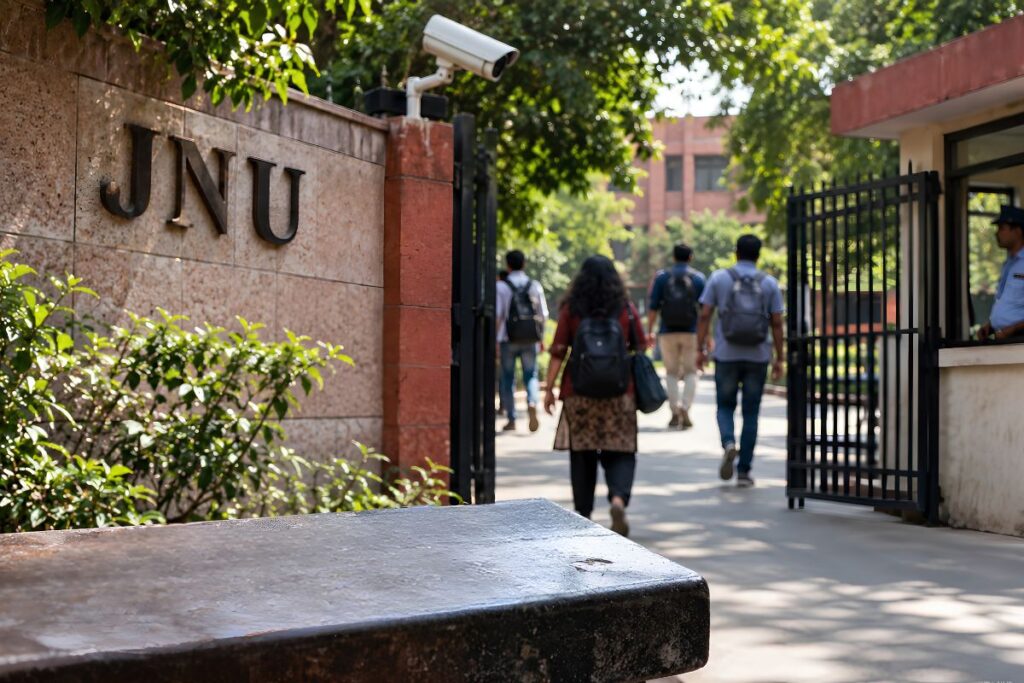
An industrial cleaver cleared Jawaharlal Nehru University’s perimeter and reached a hostel room because a systemic JNU hostel security failure left guards relying on visual checks rather than functional scanning equipment. Despite contracts mandating active screening tools, entry desks lack operating detectors, leaving low-wage guards unable and unauthorized to search personal baggage.
How Did an Industrial Cleaver Bypass JNU Perimeter Gates?
The cleaver bypassed two distinct checkpoints because guards at outer gates and residential halls operate without functional scanners or authorization to inspect bags.
On November 5, the weapon moved past an outer perimeter barrier, either the North Gate or the Saraswati Gate, along the ring road and through the front entrance of Barak Hostel into Room 114 without triggering an inspection.
At the main perimeter gates, guards document vehicle registration numbers in paper ledgers. Pedestrians and students carrying backpacks walk past the booths without physical screening. According to reporting, access control at university residential gates depended strictly on handwritten logbooks, leaving student baggage unexamined during peak afternoon hours.
At the entrance to Barak Hostel, the desk ledger logs outside visitors. Residents carrying duffel bags, athletic sacks, or backpacks routinely bypass desk staff without pause. No guard requested a manual inspection before the blade reached the residential wing.
What Do JNU’s Outsourced Security Contracts Actually Require?
JNU’s outsourced security contracts legally obligate vendor agencies to supply and maintain functional electronic detection equipment, including Handheld Metal Detectors, at primary campus checkpoints.
According to Schedule 18 (Administrative and Security Expenses) of the published Jawaharlal Nehru University Annual Accounts, the university expends between ₹15 crore and ₹20 crore annually on private security services procured through the Government e-Marketplace (GeM), the central government’s mandatory online portal for public procurement.
Model Service Level Agreements for security staffing published on the GeM Portal mandate that contracted private agencies provide Door Frame Metal Detectors and Handheld Metal Detectors across designated campus stations. Under these specifications, the vendor bears full financial responsibility for delivering, testing, and replacing broken scanning devices.
While procurement paperwork details an instrument-monitored checkpoint system, the physical desks at Barak Hostel operated entirely without working detection hardware.
Why Don’t Private Security Guards Search Bags at Hostel Entrances?
Private security guards do not inspect bags because they lack both detection gear and the statutory authority to search students’ belongings without administrative orders.
Frontline guards stationed at the perimeter gates and residential blocks work 12-hour shifts. Most receive base wages governed by the Delhi Government Labour Department statutory schedules for unskilled or semi-skilled employment.
None of the security personnel on duty at Barak Hostel possessed an operating handheld metal detector on November 5.
“We are instructed to check unknown visitors and write their names in the register,” said one security guard stationed at an adjacent hostel, who spoke on the condition of anonymity. “We do not have scanners. We cannot open the backpacks of students who live here. If we demand to search bags, it leads to arguments and confrontations.”
Contracted agencies provide guards with no formal training in detecting bladed weapons or managing physical violence. Operational procedures begin and end with sign-in registers.
Does JNU’s Physical Perimeter Create Security Blind Spots?
JNU’s 1,019-acre footprint along forested ridge terrain limits fence-line monitoring, making hostel desk checkpoints the decisive security barrier.
The campus shares porous borders with the Southern Ridge forest reserve, Mehrauli, and Vasant Kunj. Broken sections of stone masonry and chain-link fencing line the perimeter, where thick scrub obscures direct sightlines.
The attack unfolded within Barak Hostel, a modern residential facility on the southern edge of the built campus. The Delhi Police registered a First Information Report under Section 109 of the Bharatiya Nyaya Sanhita (the statutory provision covering attempt to murder in India’s penal code) at Vasant Kunj North Police Station, roughly 48 hours after medical staff admitted the injured students to the hospital.
Given the porous nature of a 1,000-acre open campus, residential desks serve as the primary defensive perimeter. When monitoring fails at the hostel threshold, no secondary barrier prevents weapons from entering residential corridors.
Why Do Inquiries Ignore Vendor Failures After Campus Violence?
University administrative inquiries consistently bypass vendor compliance because proctorial investigations focus exclusively on student discipline rather than contractual security enforcement.
Standard service agreements on the GeM portal contain liquidated damages clauses, which empower client institutions to deduct penalty sums directly from monthly vendor invoices whenever an agency fails to deploy required equipment.
Past administrative probes led by the JNU Chief Proctor’s Office have focused almost exclusively on student disciplinary rules under Statute 32 of the Jawaharlal Nehru University Act, 1966. Formal inquiry orders issued by the JNU Chief Proctor’s Office process summary dismissals against students, omitting reviews into whether the contracted security firm violated its service agreement by failing to provide detection equipment.
Security agency management points to operational limits. Vendor representatives note that private guards have no legal mandate to conduct personal searches of university students without written proctorial authorization or active police attendance, noting that bag searches spark student resistance.
The university administration maintains that JNU functions as an open academic institution rather than a restricted-access facility. Administrative officials state that stationing invasive checkpoints at residential entrances would compromise normal academic life and student mobility.
Because the administration resists intrusive personal searches and the contractor fails to provide mandated detection tools, bladed weapons move past campus gates undetected.
Frequently Asked Questions
How did a cleaver get past JNU security gates into Barak Hostel?
The weapon entered because outer security posts and Barak Hostel’s reception desk rely entirely on vehicle logs and visitor sign-in sheets rather than baggage screening. Contracted guards lacked handheld metal detectors and had no administrative authority to inspect students’ personal bags.
How much does JNU spend annually on private security?
JNU spends between ₹15 crore and ₹20 crore each year on outsourced private security services, as documented in Schedule 18 of the university’s published annual financial statements.
Were metal detectors operational at Barak Hostel during the attack?
No functional Door Frame Metal Detectors or Handheld Metal Detectors were present or operating at the Barak Hostel entry desk on November 5, leaving guards unable to detect concealed metallic weapons.
Why hasn’t JNU penalized the private security agency for the lapse?
Proctorial inquiries under Statute 32 of the JNU Act focus strictly on student conduct and rustications, avoiding scrutiny of vendor contract breaches or the enforcement of contractual liquidated damages clauses against security agencies.

Praseetha K
Praseetha K is the Managing Editor of Clarity Times. She edits, verifies and publishes the newsroom's articles, and also writes analysis on policy, law, business and technology. Articles she writes are edited by the Editor-in-Chief before publication.