At Clarity Times, we examine what mainstream narratives omit. This dispatch investigates institutional incentives, policy fine print, and multi-dimensional community impacts.
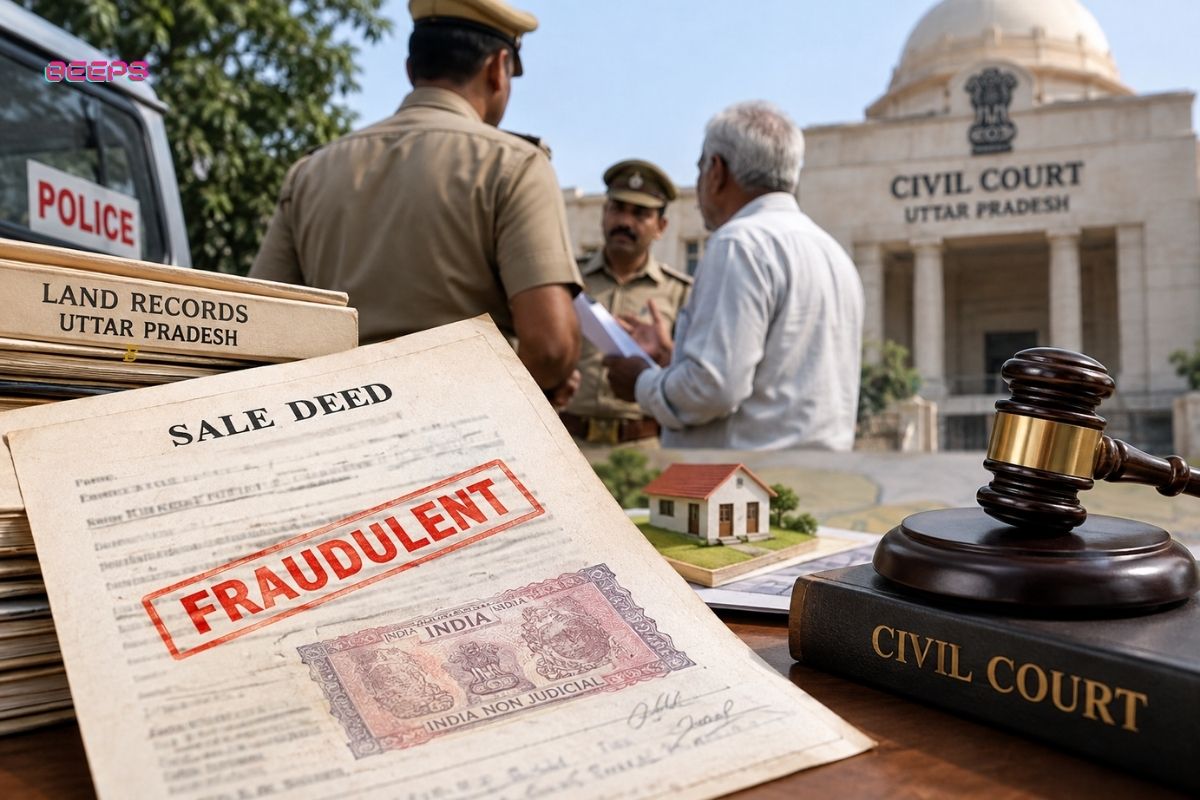
When police arrest scammers for property fraud, the rightful owner does not automatically get their land back. Executive authorities have no legal power to cancel a fake land registry in UP. The true owner must file a civil lawsuit to void the document, a process requiring expensive court fees and up to a decade of litigation.
Does a police arrest cancel a fake land registry in UP?
A criminal confession does not invalidate property paperwork. Under Section 31 of the Specific Relief Act – the Indian law governing civil remedies – a registered sale deed remains a legally binding document until a civil judge formally orders its cancellation. Executive authorities cannot touch it.
As the Supreme Court of India ruled in Satya Pal Anand v. State of M.P., sub-registrars and district magistrates serve purely administrative functions. They hold zero statutory jurisdiction to unilaterally cancel a registered sale deed, even after the accused admit to forgery.
Why do police arrests not solve property fraud?
This legal reality contradicts the narrative established during recent arrests in Bareilly. This week, the Aonla police arrested two individuals for using fake documents to register another person’s plot of land.
Local coverage framed the swift arrests as a complete resolution to the crime. For the state, the criminal investigation is largely finished. For the victim, the process of recovering the land has barely begun.
How long does a civil suit take for property disputes in India?
Undoing a fraudulent registry requires a dedicated civil suit. Throughout India, complex property disputes of this nature average seven to ten years before reaching a final resolution, according to legal consultancy data from LegalKart.
The financial burden falls entirely on the defrauded owner. Beyond advocate fees, Uttar Pradesh applies Section 7(iv-A) of the Court Fees Act to these cases.
Victims must pay ad valorem court fees – a tax calculated as a percentage of the property’s total market value – just to have their suit heard. They fund a multi-year litigation process to clear a title they never willingly transferred.
How do victims stop mutation (dakhil kharij) and third-party sales?
While waiting for a final judgment, the true owner faces an immediate ticking clock. Because the forged document remains active, the fraudulent buyer can use it to apply for mutation. Mutation, known locally as dakhil kharij, is the process of updating state revenue records to reflect a new owner.
The scammers can also quickly sell the land to a third party to complicate the title. To stop this, the victim must immediately petition the civil court for a temporary injunction under Order 39 of the Civil Procedure Code.
This specific court order freezes the property status. It enforces the legal principle of pendente lite, meaning no property transfers or record updates can occur while the litigation is pending.
Why does the law restrict deed cancellation to civil courts?
The inability of police or revenue officers to cancel a fake deed is a deliberate legal design, not an administrative oversight. The Registration Act of 1908 and the Specific Relief Act separate these powers strictly to prevent executive overreach.
If a sub-registrar or a police inspector held the authority to cancel land deeds based on initial fraud claims, corrupt officials could easily exploit that power.
As the Supreme Court noted, keeping cancellation powers strictly within the judiciary ensures that executive officers cannot unilaterally void legitimate property transactions or seize prime real estate without a trial.
The law protects the integrity of registered documents by requiring a formal trial. The downstream consequence is that victims of forgery inherit the severe financial and temporal cost of that protection.
Frequently Asked Questions
Can the District Magistrate or police cancel a forged sale deed in UP? No. Under the Specific Relief Act, only a civil court has the jurisdiction to cancel a registered sale deed. Executive officers like District Magistrates, police, or Sub-Registrars cannot void these documents, even if a criminal fraud investigation proves the deed is fake.
Do you have to pay court fees to cancel a fake property registry? Yes. In Uttar Pradesh, property fraud victims must pay ad valorem court fees under Section 7(iv-A) of the Court Fees Act. This means the filing fee is calculated as a percentage of the property’s current market value, placing a heavy financial burden on the defrauded owner.
How do you stop a fraudulent buyer from selling the land before the trial ends? The true owner must petition a civil court for a temporary injunction under Order 39 of the Civil Procedure Code. This enforces the rule of pendente lite, freezing the property so the land cannot be sold or mutated in state revenue records while the cancellation suit is ongoing.
Editorial Independence & Corrections
Clarity Times is published by Beeps Venture Technologies LLP under strict editorial independence charters. We uphold rigorous sourcing and verification protocols. Noticed a factual omission or error? Review our Correction Protocols or contact our editorial desk at mail@claritytimes.org.

Praseetha K
Investigative journalist and research analyst contributing independent field reports and structural analysis for Clarity Times.