
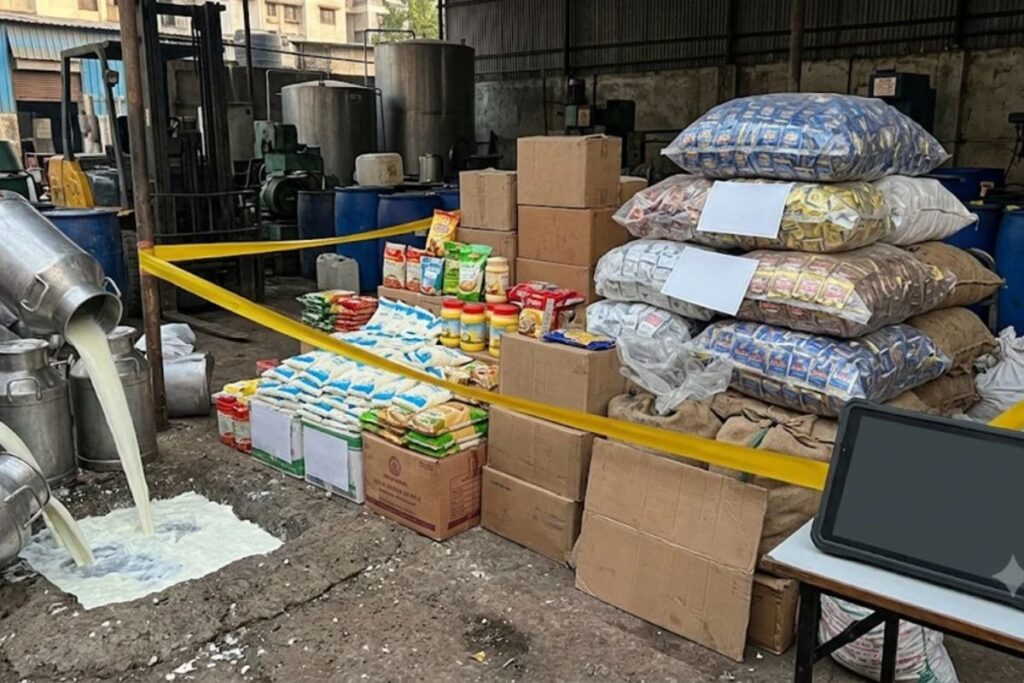
Every month, the Maharashtra Food and Drug Administration (FDA) issues triumphant press communiqués detailing highway checkpoints, intercepted shipping containers, and the seizure of prohibited gutkha and flavored tobacco valued in the crores. Flying squads celebrate the impounding of commercial heavy vehicles along the Bhiwandi-Thane corridor, Nashik bypass, and Surat-Mumbai expressway. Yet, examining the underlying First Information Reports (FIRs) and charge sheets filed across taluka police stations exposes a glaring systemic failure: law enforcement almost exclusively prosecutes expendable hired truck drivers and daily-wage cleaners, while the industrial manufacturing conglomerates and brand-owning factories in neighboring states operate with complete legal immunity.
The persistence of Maharashtra’s multi-thousand-crore illicit tobacco black market is not the result of lax highway surveillance; it is built into the fragmented jurisdictional architecture of the Food Safety and Standards Act (FSSA), 2006. By exploiting inter-state commerce protections, dummy billing entities, and the legal “twin-sachet” loophole, manufacturing barons in Gujarat, Madhya Pradesh, and Delhi-NCR flood banned consumer markets while ensuring that their corporate entities remain completely insulated from criminal liability.
The Highway Interception Theatrics: Million-Dollar Seizures with Zero Factory Liability
In standard interdiction operations—such as the recent interception of commercial vehicles near Yewai Bridge in Bhiwandi—flying squads seize thousands of cartons containing branded products such as Premium Raj Niwas Pan Masala, Vimal, and ZN-01 Zafrani Zarda valued at upwards of ₹2.7 crore. Physical seizure panchnamas meticulously catalog the registered trademark logos, batch numbers, and manufacturing dates stamped directly onto the commercial foils.
However, when the investigating officer drafts the formal criminal complaint under Sections 123, 223, and 274 of the Bharatiya Nyaya Sanhita (BNS), 2023 (formerly Sections 272, 273, and 328 of the Indian Penal Code) alongside FSSA regulations, the named accused are limited to the driver behind the wheel and the registered owner of the transport vehicle. The corporate directors, factory managers, and primary financiers whose names are registered with the Registrar of Companies (RoC) and the Ministry of Commerce are completely omitted from the charge sheet.
This dynamic mirrors the institutional risk-transfer mechanisms documented across other shadow supply chains. As examined in Clarity Times’ investigation into how specialized organized crime statutes replace street-level police enforcement, regulatory enforcement routinely targets low-tier peripheral runners while corporate syndicates absorb inventory losses as routine operational overhead.
The Jurisdictional Firewall: Inter-State Transit Protections and Bombay High Court Precedents
The primary legal barrier shielding manufacturing plants is territorial jurisdiction. Under Section 30(2)(a) of the Food Safety and Standards Act, a state Food Safety Commissioner possesses statutory authority to prohibit the manufacture, storage, distribution, or sale of any article of food in the interest of public health strictly within the territory of that specific state. Consequently, while Maharashtra has annually renewed its complete ban on gutkha, pan masala containing tobacco or nicotine, and flavored areca nut since 2012, manufacturing these identical products remains entirely legal in neighboring states that choose not to enact equivalent prohibitions.
This territorial boundary has been heavily reinforced by judicial precedent. In a series of landmark rulings, the Bombay High Court has repeatedly held that Maharashtra FDA food safety officers lack extraterritorial jurisdiction to enter neighboring states, inspect licensed factories, or seize financial assets of manufacturers operating legally within Gujarat, Karnataka, or Madhya Pradesh.
Furthermore, manufacturers exploit Article 301 of the Constitution of India, which guarantees freedom of trade, commerce, and intercourse throughout the territory of India. When trucks are intercepted on Maharashtra highways, transporters present transit declarations asserting that the cargo is merely in transit between legal manufacturing hubs in Gujarat and destination markets in southern India. Because state officers cannot legally restrict inter-state transit of goods that are lawful at origin and destination, syndicates routinely “divert” cargo into local Mumbai, Pune, and Nagpur godowns under the cover of legitimate transit manifests.
The Twin-Sachet Legal Arbitrage: How Separate Packaging Bypasses Regulation 2.3.4
The table below summarizes the regulatory evasion architecture developed by tobacco conglomerates to circumvent central and state prohibitions, drawing from Maharashtra FDA seizure records and Supreme Court litigation:
| Regulatory Vector | Statutory Prohibition (FSSA Reg. 2.3.4) | Industrial Evasion Architecture | Legal Shield Mechanism |
|---|---|---|---|
| Pre-Mixed Gutkha | Strict ban on mixing tobacco & nicotine into any food article | Twin-Sachet System (Separate Pan Masala + Pure Zarda pouch) | Pan Masala is sold as food; Zarda is sold as non-food tobacco under COTPA |
| Inter-State Transit | State ban applies to storage, sale & distribution within borders | Transit Pass Arbitrage (Consignment booked from Gujarat to Karnataka) | Article 301 constitutional protections prevent inter-state freight blockades |
| Corporate Liability | Section 66 FSSA (Offences by Companies & Directors) | Layered Benami Distributors & Front Trading Entities | Factory invoices goods to third-party cash buyer; severs paper trail at border |
| Tax Enforcement | Mandatory GST E-Way Bill for consignments over ₹50,000 | Ghost GSTINs & Circular Invoicing Loops | Consignee details dissolve into unverified postal addresses upon interception |
The Expendable Logistics Tier: Hawala Cash, Benami Transporters, and Discardable Drivers
For illicit distribution syndicates, seized freight is not an existential disaster; it is an actuarial certainty priced into the black-market markup. In Maharashtra retail kiosks, a banned sachet with a printed maximum retail price (MRP) of ₹10 sells for ₹25 to ₹40. This 150 to 300 percent black-market premium generates extraordinary profit margins capable of absorbing frequent highway seizures.
Transport logistics are managed through anonymous brokerage networks. Fleet operators contract drivers from economically depressed districts in Rajasthan and Uttar Pradesh, paying them modest trip bonuses to transport “mixed grocery consignments.” When a truck is intercepted, bail is promptly posted by local syndicate attorneys. The driver returns to his village, the impounded commercial vehicle is eventually auctioned or released on superdari bond, and the primary manufacturers maintain their spotless balance sheets.
This black-market supply chain directly fuels the devastating public health crisis explored in Clarity Times’ clinical investigations. As detailed in our report on why smokeless tobacco cancer patients present at Stage III and IV hospital wards and our analysis of how powdered oral tobacco formulations escape national cessation budgets, the unregulated availability of illicit oral tobacco maintains ubiquitous access across rural and urban markets.
The GST E-Way Bill Evasion: How Ghost Consignees Cleanse Contraband Transit
To move multi-crore contraband through commercial toll plazas without triggering automated red flags, smugglers manipulate the Goods and Services Tax (GST) electronic way-bill system. Transporters generate E-Way Bills registered under fictitious, newly minted GST identification numbers (GSTINs) using stolen identity documents of daily-wage laborers.
The cargo is misdeclared on invoices as “industrial starch,” “scented supari,” or “confectionery.” If a state tax or FDA mobile squad flags the vehicle for physical verification, the syndicate immediately abandons the consignment. By the time enforcement officers attempt to trace the recipient business entity, the GSTIN has been cancelled or leads to an empty room in an industrial estate, ensuring that corporate ownership is never tied to the contraband.
Statutory Reforms: Granting Multi-State Extraterritorial Powers to Food Safety Commissioners
Eradicating the cross-border illicit tobacco trade requires systemic statutory overhauls rather than theatrical highway checkpoints:
- Centralized Inter-State Enforcement Taskforces: Amend the FSSA to empower a centralized, multi-state enforcement wing under the Central FSSAI Authority, with statutory power to cross state lines, execute search warrants, and freeze assets of manufacturing plants supplying banned states.
- Mandatory Brand-Owner Vicarious Liability: Amend state criminal procedures to introduce a legal presumption of complicity against registered trademark holders whenever commercially packaged contraband exceeding ₹25 lakh is intercepted within a prohibited jurisdiction.
- Closing the Twin-Sachet Exemption: Standardize a nationwide ban on the commercial packaging and retail sale of flavored pan masala and chewing tobacco within common retail premises, prohibiting brand-sharing across food and non-food tobacco product lines.
- Financial Intelligence Unit (FIU) Integration: Route major tobacco seizure cases through the Directorate of Enforcement (ED) under the Prevention of Money Laundering Act (PMLA), treating commercial gutkha smuggling as a predicate financial crime to seize manufacturing assets and corporate bank accounts.
Related In-Depth Investigations
- Read our public health report on why millions of smokeless tobacco users are excluded from state cessation budgets.
- Examine our clinical investigation into how delayed diagnosis and societal stigma compound oral cancer mortality in India.
- Explore our legal analysis on how specialized organized crime legal frameworks are deployed across Maharashtra enforcement agencies.

Clarity Times Legal Bureau
The Clarity Times Legal Bureau reports on the Supreme Court of India, state High Courts, constitutional precedents, regulatory tribunals, and criminal justice policy.