
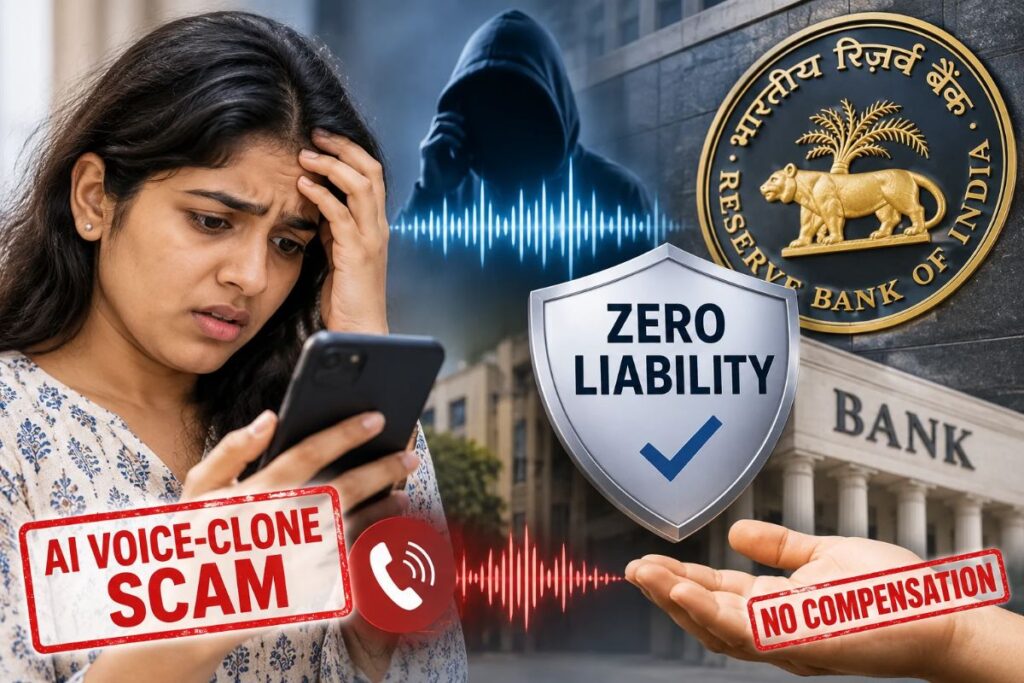
Indian banks routinely deny refunds under the RBI zero liability rule for UPI fraud when victims are tricked by AI voice-clone and deepfake scams, because entering a UPI PIN or sharing a one-time password (OTP) triggers a “customer negligence” clause under Paragraph 7 of the Reserve Bank of India’s July 6, 2017 circular, shifting 100% of the financial loss onto the tricked account holder.
How Does the RBI Zero Liability Rule Apply to UPI Fraud and AI Voice-Clone Scams?
Under Paragraph 7(i) of the Reserve Bank of India’s July 6, 2017 zero-liability circular, entering a UPI PIN or sharing an OTP classifies an AI-coerced transfer as “customer negligence,” making the victim responsible for 100% of the loss until the fraud is reported.
When an attacker uses an AI voice clone to impersonate a relative, police officer, or bank official and persuades a victim to approve a Unified Payments Interface (UPI) transfer, India’s instant real-time mobile payment system operated by the National Payments Corporation of India, the victim authorizes the payment on their own device.
Under Paragraph 6 of RBI Circular DBR.No.Leg.BC.78/09.07.005/2017-18, issued on July 6, 2017, a customer bears zero liability only when an unauthorised electronic banking transaction stems from contributory fraud or negligence on the bank’s part, or from a third-party breach where neither the bank nor the customer is at fault.
Paragraph 7(i) of the same circular governs cases where the loss stems from customer negligence, specifically, where the customer has shared payment credentials. Under this clause, the customer bears the entire loss until they report the unauthorised transaction to the bank.
Consumer commissions have repeatedly enforced that cutoff. In consumer dispute proceedings documented on CaseMine, a Bengaluru bench examining five fraudulent transfers totaling ₹1,35,000 split liability strictly along authentication lines: it ordered the bank to refund ₹85,000 for three transfers where no OTP was shared, while ruling that the account holder had to absorb the loss on the two transactions where he had disclosed the OTP to the caller.
The legal framework treats credential entry as proof of intent, regardless of the synthetic deception used to extract it.
Why Does Banking Law Exclude AI Social-Engineering Scams From “Unauthorised” Refunds?
Indian banking dispute rules treat AI voice-clone scams as Authorised Push Payment (APP) fraud, where a tricked customer personally approves a transfer using valid credentials, rather than an unauthorised security breach.
The Indian Computer Emergency Response Team (CERT-In), India’s national nodal agency for responding to computer security incidents, flagged a surge in AI-driven cyberattacks across financial entities in Advisory CIAD-2026-0058, warning that attackers use generative AI scripts and automated frameworks to execute unauthorized fund transfers through legitimate approval channels. Yet CERT-In’s technical framing of an unauthorized transaction does not match the legal standard enforced during bank dispute resolution.
In banking operations, a payment complaint is evaluated under the Reserve Bank – Integrated Ombudsman Scheme (RB-IOS) 2021, the single-window grievance mechanism established by the Reserve Bank of India to resolve customer complaints against regulated financial entities. According to the RBI Annual Report of the Ombudsman Scheme 2024–25, complaints under RB-IOS rose 13.55% to 1.33 million in FY25 from 1.18 million in FY24, with mobile and electronic banking accounting for 16.86% of total grievances, and among maintainable complaints disposed of by Ombudsman offices, 43.36% were rejected.
Under this framework, banks separate digital payment disputes into two tracks:
- Unauthorised account access: A third party bypasses bank security or hijacks an account without the customer entering a PIN or OTP.
- Authorised push payment (APP) fraud: A criminal deceives the account holder into initiating or approving a transfer using valid credentials.
Because AI voice-clone scams rely on psychological manipulation rather than breaking bank encryption, they fall into the second category. The payment rails functioned as designed; the human user was deceived.
How Do Bank Audit Trails Override Deepfake Evidence During a Fraud Dispute?
Bank fraud teams evaluate UPI disputes through binary technical authentication logs, checking device-binding tokens, SIM-card status, and valid MPIN or OTP timestamps, rather than reviewing audio or video evidence of deepfake coercion.
Under National Payments Corporation of India (NPCI) UPI settlement and dispute rules and NPCI chargeback modification guidelines, remitting and beneficiary banks reconcile disputes through standardized adjustment flags and authentication logs. If those technical markers match the customer’s registered phone and credentials, automated dispute workflows classify the transfer as valid.
As Odisha-based consumer lawyer Advocate Debarchana Samal noted in an analysis of UPI and OTP dispute claims, frontline bank staff routinely apply a blanket “you shared the OTP” rejection without evaluating the deceptive circumstances surrounding the transfer. Legal analyses of digital-arrest and impersonation scams published on LiveLaw confirm that because the victim manually authenticated the payment, banks treat the transfer as authorized and leave victims to chase money-mule accounts through police complaints.
Bank risk specialists maintain an operational rationale for keeping this boundary strict. If banks were required to unconditionally reimburse every transfer authenticated with a valid UPI PIN and registered device based solely on a claim of deception, moral hazard and staged “friendly fraud”, where an account holder fabricates a scam claim to double their funds, could destabilize low-cost instant payment networks.
Consumer advocates counter that a liability standard drafted in 2017 assumes a retail customer can reliably tell a real caller apart from a machine. Generative voice cloning removes the vocal cues users once relied on to spot impersonators, leaving ordinary account holders to absorb a forensic burden they cannot meet.
Why Do UK Banks Refund APP Fraud While India Caps 2027 Coercion Relief at ₹25,000?
Unlike the United Kingdom’s Payment Systems Regulator, which mandates 50:50 bank reimbursement up to £85,000 for Authorised Push Payment scams, India’s upcoming 2027 RBI amendment limits deception compensation to a one-time cap of ₹25,000.
In the United Kingdom, the Payment Systems Regulator (PSR) implemented mandatory reimbursement rules for Authorised Push Payment (APP) fraud on October 7, 2024. Under the PSR’s confirmed reimbursement policy, payment service providers must reimburse victims of APP scams, including impersonation and social-engineering transfers, up to a maximum limit of £85,000, splitting the reimbursement cost 50:50 between the sending bank and the receiving bank unless the customer acted with gross negligence.
India’s regulatory updates have moved more cautiously. The RBI Authentication Mechanisms for Digital Payment Transactions Directions, 2025, which took effect on April 1, 2026, encouraged risk-based checks beyond SMS OTPs without creating a post-fraud refund mandate for coerced payments.
To partially close that gap, the Reserve Bank of India issued the Commercial Banks – Responsible Business Conduct Third Amendment Directions, 2026 (alongside parallel Payments Banks Second Amendment Directions), scheduled to apply to electronic banking transactions from January 1, 2027. Under Paragraph 76T of the new framework, individual victims of small-value fraudulent transfers, including deception and coercion cases, will become eligible for a one-time compensation of 85% of their net loss or ₹25,000, whichever is lower, provided they report the fraud within five days to both their bank and the cybercrime helpline.
For any AI voice-clone scam exceeding that small-value threshold, victims remain outside full reimbursement protection.
When Are Indian Banks Legally Forced to Refund a Fraudulent UPI Transfer?
Under Paragraph 7(i) and Paragraph 12 of the Reserve Bank of India’s July 2017 circular, banks must absorb any financial loss that occurs after a customer reports the fraud, and the bank bears the legal burden of proving customer negligence.
This reporting cutoff makes speed the decisive legal variable. Under the Ministry of Home Affairs’ Citizen Financial Cyber Fraud Reporting and Management System, accessible via the National Cyber Crime Reporting Portal and the toll-free 1930 helpline, cybercrime cells connect directly with banks and payment intermediaries to freeze beneficiary accounts before funds are layered out.
Consumer courts have enforced bank accountability when institutions fail to act after receiving notice or cannot prove customer negligence. In a November 2026 order reported by Hindustan Times, the Chandigarh consumer commission directed State Bank of India to refund a resident for five unauthorised UPI transactions after reaffirming Paragraph 12 of the 2017 RBI circular, which places the burden of proving customer liability squarely on the bank.
As Dvara Research noted in its policy comments on the RBI’s 2026 draft liability directions, limiting coerced-fraud relief to a once-in-a-lifetime ₹25,000 cap while requiring victims to file separate reports with both banks and law enforcement leaves major structural gaps intact. Until Indian regulations hold receiving banks financially liable for hosting mule accounts, or remove the ₹25,000 ceiling on deception-induced transfers, most victims of high-value AI voice-clone scams will continue to absorb losses that their authentication logs treat as voluntary.
Frequently Asked Questions
Does the RBI zero-liability rule cover AI voice-clone or deepfake UPI scams?
No, not in most cases. Under Paragraph 7(i) of the Reserve Bank of India’s July 6, 2017 circular, entering your own UPI PIN or sharing an OTP classifies the payment as “customer negligence,” making you liable for 100% of the loss until you report the scam to your bank.
Why do Indian banks reject fraud claims even when victims prove they were tricked by an AI call?
Bank dispute systems verify technical authentication logs, such as device-binding tokens, SIM-card status, and valid MPIN or OTP timestamps, under National Payments Corporation of India (NPCI) rules rather than reviewing call recordings. Because the victim manually approved the transaction on a registered device, banks classify it as an Authorised Push Payment (APP) rather than an unauthorised account breach.
What is the new RBI compensation rule for UPI scams taking effect in January 2027?
Under Paragraph 76T of the RBI’s Commercial Banks – Responsible Business Conduct Third Amendment Directions, 2026 (effective January 1, 2027), individual victims tricked into approving fraudulent transfers can claim a one-time payout of 85% of their net loss or ₹25,000, whichever is lower. Victims must report the scam within five days to both their bank and the cybercrime helpline (1930) to qualify.
When is an Indian bank required to refund money lost in a UPI fraud?
Under Paragraph 7(i) of the July 2017 RBI circular, the bank must cover any money drained after the customer formally reports the fraud to the bank or the 1930 cybercrime helpline. Under Paragraph 12 of the same circular, a bank must also refund the customer if it fails to produce technical proof that the customer shared credentials or acted negligently.

Praseetha K
Praseetha K is the Managing Editor of Clarity Times. She edits, verifies and publishes the newsroom's articles, and also writes analysis on policy, law, business and technology. Articles she writes are edited by the Editor-in-Chief before publication.