
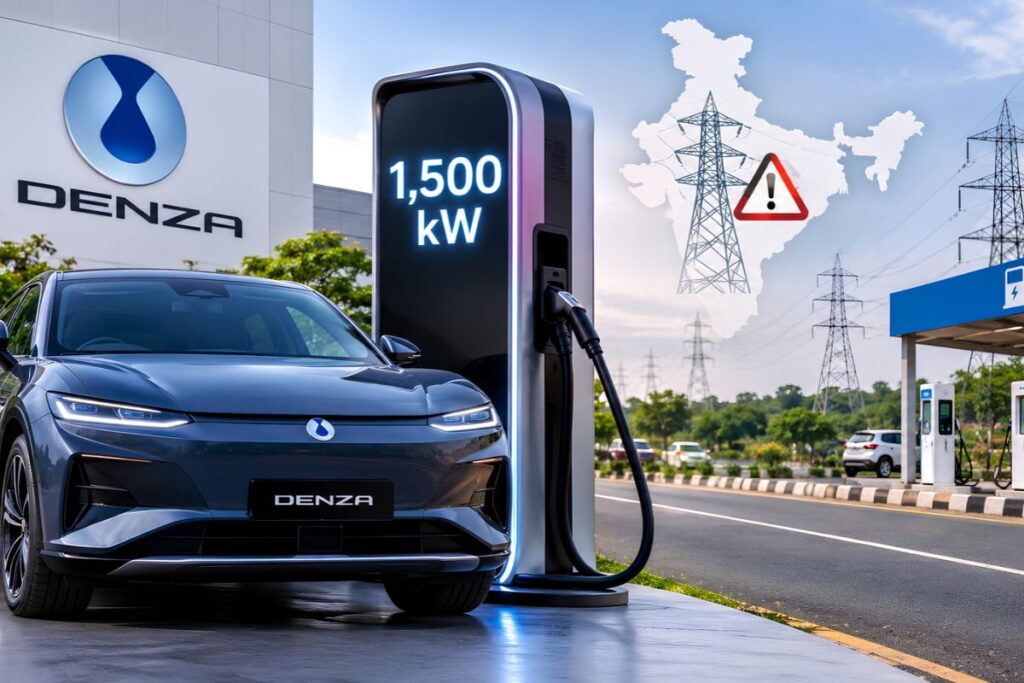
Denza Z9 GT charging time in India cannot match the company’s nine-minute brochure claim because zero 1,500 kW public chargers exist in the country. While Denza advertises a 10% to 97% charge in nine minutes via a 1,500 kW dispenser, India’s 60 kW to 120 kW highway DC fast chargers take roughly 45 to 90 minutes to refill the Z9 GT’s 122.5 kWh battery from 10% to 80%.
Can India’s Public Grid Deliver Denza’s 1,500 kW Flash Charging?
No public charging station in India can deliver Denza’s 1,500 kW flash-charging rate, as deployed Indian highway hardware tops out between 60 kW and 360 kW.
At its November 13, 2026 India launch, BYD’s luxury marque Denza positioned ultra-fast charging as a headline feature of both its Z9 GT shooting brake (₹1.57 crore ex-showroom, 122.5 kWh battery) and its D9 multi-purpose vehicle (₹90 lakh ex-showroom, 115.07 kWh battery). Company specification sheets list a peak direct-current (DC) input of 1,500 kW, a megawatt-scale power flow that replenishes the second-generation Blade battery from 10% to 97% in nine minutes when plugged into BYD’s proprietary liquid-cooled dispensers in China.
India’s public charging infrastructure operates at a fraction of that capacity. According to figures tabled in the Lok Sabha in July 2026 and compiled from Ministry of Heavy Industries disclosures, India has 52,718 public electric-vehicle charging stations nationwide, of which only 16,561 (31.4%) carry fast chargers suitable for passenger cars, while nearly 69% are slow alternating-current (AC) units rated between 3.3 kW and 22 kW.
Even India’s fastest commercial highway hubs run on the Combined Charging System 2 (CCS2) standard, the mandated plug and communication protocol for DC fast charging in India, which tops out between 60 kW and 360 kW in deployed field cabinets, or less than one-quarter of the Z9 GT’s 1,500 kW ceiling.
How Long Does the Denza Z9 GT Actually Take to Charge on Indian Highways?
On a standard 120 kW Indian highway DC fast charger, refilling the Denza Z9 GT from 10% to 80% takes 43 to 50 minutes, while a 60 kW urban DC charger requires 86 to 95 minutes.
Because an electric vehicle’s charging speed is governed by whichever component has the lower power rating, the vehicle’s onboard architecture or the external dispenser, plugging a 1,500 kW-capable car into an Indian highway station caps energy transfer at the charger’s output.
Replenishing a 10% to 80% state-of-charge window requires pushing 85.75 kWh into the Z9 GT’s 122.49–122.5 kWh battery pack and 80.55 kWh into the Denza D9’s 115.07 kWh battery pack. Based on standard electrical power delivery (energy in kWh ÷ charger output in kW), stop durations across India’s active charger tiers break down as follows:
- 60 kW urban DC fast charger: Delivering 85.75 kWh takes 86 to 95 minutes once charger handshake and high-state-of-charge thermal tapering are included.
- 120 kW highway DC fast charger: On an unshared 120 kW dispenser, a 10% to 80% top-up takes 43 to 50 minutes, roughly five times longer than the nine-minute 1,500 kW benchmark.
- 11 kW home AC wallbox: Denza’s Z9 GT supports AC charging up to 11 kW. Charging the 122.5 kWh battery from 10% to 100% (110.25 kWh) on a three-phase 11 kW home unit takes 10 to 11 hours overnight.
Why Do 240 kW and 360 kW Indian Highway Hubs Deliver Less Power Per Car?
India’s flagship 240 kW and 360 kW highway stations rarely deliver their full headline wattage to a single car because cabinet power is split across multiple charging dispensers and constrained by CCS2 cable current limits.
Multi-gun power sharing reduces per-vehicle speed whenever more than one car plugs in. According to network deployment disclosures published by Tata Power and Tata Passenger Electric Mobility Limited (TPEM) across their flagship MegaCharger corridors, the 240 kW hub at 7 Midway Plaza in Suryapet on the Hyderabad–Vijayawada highway (NH-65) splits its capacity across dual dispensers, while the 360 kW MegaCharger hub at iLabs Centre in Hyderabad divides its total output across three 120 kW dispensers serving up to six vehicles simultaneously. Similarly, India’s largest co-branded MegaCharger hub in Mumbai near Terminal 2 of Chhatrapati Shivaji Maharaj International Airport uses eight 120 kW fast DC chargers divided across 16 charging bays.
Physical cable amperage creates a second ceiling. Under CCS2 engineering specifications, standard air-cooled charging cables reach thermal thresholds at 200 to 250 amperes of continuous current. Even on a 1,000-volt CCS2 vehicle inlet, an uncooled 200-to-250-ampere cable physically caps single-gun delivery between 160 kW and 250 kW; reaching 350 kW to 500 kW requires active liquid-cooled CCS2 cables rated for 500 amperes of continuous current.
How Far Can the Denza Z9 GT and D9 Travel Between Highway Charges?
While Denza quotes a 670 km range for the Z9 GT and 730 km for the D9 under the retired New European Driving Cycle (NEDC), stricter Worldwide Harmonized Light Vehicles Test Cycle (WLTP) ratings and Indian highway speeds put realistic intercity range closer to 450 km to 520 km.
How often a driver needs highway DC fast chargers depends on real-world energy consumption rather than laboratory test cycles. Denza’s headline 670 km rating for the three-motor, 1,156 hp Z9 GT and 730 km rating for the 462 hp D9 are measured on the NEDC, a laboratory protocol discontinued in Europe in 2017 that consistently overstates highway range.
When measured on the stricter WLTP standard, the Z9 GT’s certified range drops to 598 km, while the Denza D9’s international WLTP rating stands at up to 520 km, an 11% to 28% reduction from NEDC brochure figures before factoring in 100 km/h expressway speeds and continuous air-conditioning loads in Indian ambient heat.
How Will Denza Owners Charge in Practice Across India’s Six Launch Cities?
Most Denza buyers in India will rely on overnight 11 kW home charging across the six launch metros rather than public highway dispensers, as Charge Point Operators cannot yet justify the grid upgrades required for megawatt-scale stations.
Denza’s initial Indian retail network is restricted to standalone luxury showrooms in six metropolitan hubs, Gurugram (Delhi-NCR), Mumbai, Ahmedabad, Bengaluru, Chennai, and Hyderabad, supported by a six-year/1,50,000 km vehicle warranty and an eight-year/1,50,000 km powertrain warranty.
For buyers using the ₹90 lakh D9 or ₹1.57 crore Z9 GT as chauffeur-driven urban vehicles, overnight charging at home on a three-phase 11 kW unit replenishes daily city mileage at residential electricity tariffs of ₹4 to ₹10 per kWh, compared to ₹15 to ₹26 per kWh at public DC stations. Owning a 1,500 kW-capable electrical platform also provides hardware longevity as the Ministry of Heavy Industries’ ₹2,000 crore PM E-DRIVE public charging allocation funds higher-capacity highway corridors through March 31, 2028.
For private Charge Point Operators, however, installing 500 kW to 1,500 kW dispensers remains commercially unviable today. According to 2026 commercial installation benchmarks from Euler Motors, setting up a standard 120 kW to 150 kW high-power hub already costs ₹25 lakh to over ₹1 crore once distribution-company (DISCOM) transformer upgrades and high-tension grid connections are included, capital expenses operators cannot recover while India’s electric car fleet is dominated by 30 kWh to 60 kWh mass-market models.
Frequently Asked Questions
How long does the Denza Z9 GT take to charge in India?
Because India has zero 1,500 kW public chargers, the Denza Z9 GT cannot achieve its claimed nine-minute charge on Indian roads. Recharging its 122.5 kWh battery from 10% to 80% takes roughly 43 to 50 minutes on an unshared 120 kW highway DC fast charger, 86 to 95 minutes on a 60 kW urban DC charger, and 10 to 11 hours from 10% to 100% on an 11 kW home AC wallbox.
Why can’t Indian highway fast chargers deliver 1,500 kW to the Denza Z9 GT?
India’s public DC fast-charging network operates on the Combined Charging System 2 (CCS2) standard, where deployed commercial stations top out between 60 kW and 360 kW. Furthermore, flagship 240 kW and 360 kW hubs, such as Tata Power’s MegaCharger stations, split cabinet output across multiple dispensers and three to six charging guns, while uncooled 200-to-250-ampere CCS2 cables physically limit single-plug power transfer.
What is the real-world driving range of the Denza Z9 GT and Denza D9?
While Denza advertises 670 km for the Z9 GT and 730 km for the D9 under the legacy NEDC laboratory test cycle, stricter WLTP testing rates the Z9 GT at 598 km and the D9 at up to 520 km. At Indian highway speeds with continuous air-conditioning use, real-world intercity range works out closer to 450 km to 510 km.
Where are Denza showrooms located in India?
Denza operates through standalone luxury dealerships separate from mass-market BYD showrooms across six Indian cities: Gurugram (Delhi-NCR), Mumbai, Ahmedabad, Bengaluru, Chennai, and Hyderabad.

Praseetha K
Praseetha K is the Managing Editor of Clarity Times. She edits, verifies and publishes the newsroom's articles, and also writes analysis on policy, law, business and technology. Articles she writes are edited by the Editor-in-Chief before publication.