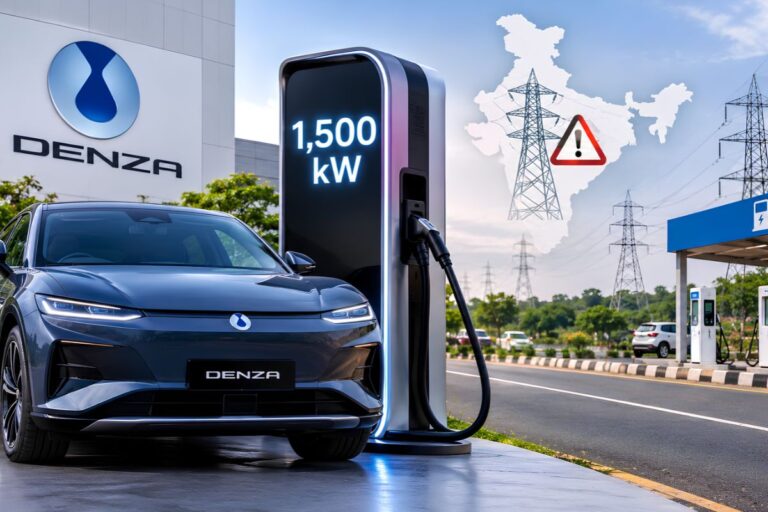
Independent economic modeling of the India-EU trade deal projects European exports to India to grow 65%, compared with a 41% increase in Indian shipments to Europe. Combined with India’s ~25% historical trade-deal utilization rate, the agreement threatens to trigger an import surge in auto parts, machinery, and chemicals once tariff cuts start in 2027.
Does the India-EU Free Trade Agreement Favor European Exporters?
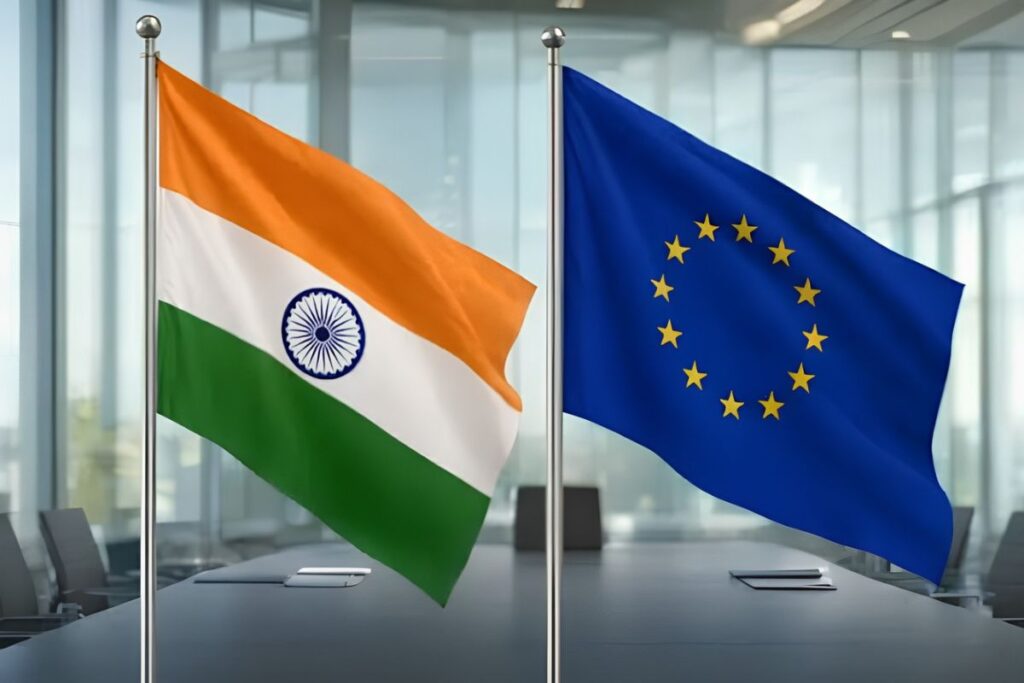
Independent econometric modeling shows the India-EU Free Trade Agreement favors European goods exporters by a 24-percentage-point growth margin. While public discussion in India links the January 2026 conclusion of the pact directly to New Delhi’s push toward $1 trillion in annual exports, trade economists who modeled the finalized terms found an asymmetric flow underneath the headline numbers.
In Policy Brief No. 202, published in January 2026, researchers at the Germany-based Kiel Institute for the World Economy simulated the long-run effects of the India-EU Free Trade Agreement (FTA), a bilateral pact eliminating customs duties across most traded goods, against a baseline scenario. According to the Kiel Institute study, European Union exports to India are projected to expand by 65%, while Indian exports to the European Union grow by 41%.
That expansion starts from an existing goods trade imbalance in India’s favor: according to 2024–2025 baseline figures cited in an EconStor economic assessment of the EU–India FTA, the European Union imported €71 billion in goods from India while exporting €49 billion back. A 65% jump on €49 billion adds roughly €31.9 billion in European shipments, nearly matching the €29.1 billion added by a 41% rise on India’s €71 billion base.
Despite the asymmetric goods flows, the Kiel Institute model estimates nearly identical aggregate economic gains for both sides, lifting long-run gross domestic product by 0.12% to 0.13%. Supporters of the pact point out that broader modeling, such as an analysis by the European Centre for International Political Economy (ECIPE), projects €69.6 billion in cumulative Indian GDP gains alongside expanded access across 144 European Union services sub-sectors.
Yet the goods-trade math leaves domestic Indian factories facing an immediate question: why have past trade deals produced a similar lopsided flow into the Indian market?
Why Does India’s 25% FTA Utilization History Warn of One-Sided Gains?
Indian exporters utilize only 20% to 30%, roughly 25% on average, of available preferential tariff lines under existing trade deals, according to audits by government policy think tank NITI Aayog, the Ministry of Commerce and Industry, and the New Delhi-based Global Trade Research Initiative (GTRI). Exporters in partner economies utilize 70% to 80% of India’s tariff concessions under those same pacts, per GTRI’s June 2026 trade assessment.
That compliance gap widened India’s trade deficits across East Asia over more than a decade:
- Association of Southeast Asian Nations (ASEAN): Between the pre-FTA period of 2007–09 and 2023–25, India’s average annual trade deficit with the ten-nation bloc widened by 381.4%, rising from $6.8 billion to $33 billion, per GTRI’s compilation of official Directorate General of Commercial Intelligence and Statistics (DGCI&S) trade data.
- Japan and South Korea: Over the same period, India’s annual trade deficit with South Korea grew 267.9% (from $4 billion to $14.7 billion), while its deficit with Japan rose 317.9% (from $3.4 billion to $14.2 billion) as foreign manufacturers cleared customs paperwork faster than Indian small and mid-sized enterprises (SMEs).
Two structural hurdles explain why Indian firms leave tariff discounts unused. First, proving that a product meets “rules of origin”, the minimum percentage of local manufacturing value required to qualify for duty-free entry, demands detailed factory-level supply chain audits that many smaller Indian suppliers lack. Second, an “inverted duty structure”, a tax anomaly in which India taxes imported raw materials at higher rates than finished goods, leaves domestic assemblers uncompetitive even when import duties fall to zero.
Recognizing that bottleneck, Commerce Secretary Rajesh Agarwal announced the launch of a dedicated “FTA Utilisation Cell” in October 2026 to help businesses meet origin rules through district-level workshops. Whether that administrative fix works fast enough will determine how Indian industry absorbs the India-EU FTA tariff cuts scheduled to begin in 2027.
Which Indian Manufacturing Sectors Face the Steepest Tariff Cuts in 2027?
India’s domestic passenger vehicle, auto-component, industrial machinery, chemical, and alcoholic beverage sectors face the steepest tariff reductions under the India-EU trade deal. Under the agreed tariff schedules summarized in the Indian government’s official FTA FAQ release and legal breakdowns of the pact, India will eliminate or reduce duties across 92.1% of its tariff lines, cutting 49.6% to zero on the first day the deal enters into force, and phasing out another 39.5% over five to ten years.
Those reductions target core industrial categories where European manufacturers hold strong global market share:
- Passenger vehicles: Indian import duties, currently as high as 110%, will glide down to 10% within an annual tariff-rate quota (a volume cap beyond which higher duties apply) of 250,000 European vehicles.
- Auto components: Tariffs on European auto parts, currently 7.5% to 15%, will drop to zero over five to ten years, opening India’s $78.7 billion component market to European precision suppliers, according to a supply-chain analysis by Tensor Advisory.
- Industrial machinery: Duties on 50% of machinery tariff lines will fall to zero immediately upon entry into force, with the remainder phased out over ten years.
- Chemicals: Indian tariffs of up to 22% on chemical imports will be eliminated largely on Day One.
- Wines, spirits, and processed foods: Steep duty cuts will open India’s premium beverage and packaged food shelves to European labels.
Trade economists and industry advocates note that cheaper European machinery and specialty chemicals can lower production costs for downstream Indian manufacturers, helping cure inverted duty structures and integrate Indian factories into global supply chains. Speaking to the Economic Times, Basic Chemicals, Cosmetics and Dyes Export Promotion Council (Chemexcil) Chairman Satish Wagh projected that zero-duty access in Europe could help double Indian specialty chemical exports to the bloc within four to five years.
Similarly, the Automotive Component Manufacturers Association of India (ACMA) welcomed the pact as a strategic step while emphasizing that a calibrated tariff phase-down and regulatory alignment will be critical for domestic Tier-2 suppliers competing against duty-free European precision parts.
Why Won’t Zero EU Tariffs Give Indian Exporters an Equal Boost?
Zero European Union tariffs will not give Indian exporters an equal boost because most tariff cuts merely prevent a scheduled tax hike, while strict European border rules remain intact. While India’s tariff cuts immediately lower the landed price of European industrial goods, Indian exporters face two structural barriers in Europe.
First, much of India’s headline “zero-duty” win under the pact simply replaces an expiring unilateral trade preference rather than creating a new price advantage. According to baseline calculations in Kiel Policy Brief No. 202, up to 87% of Indian exports to the European Union were scheduled to graduate out of the bloc’s Generalized System of Preferences (GSP), a unilateral program that grants developing countries reduced tariffs until their export share grows too large. The trade pact locks in zero duties across 97% of European Union tariff lines, protecting roughly $33 billion in labor-intensive textiles, leather, marine products, and gems, but for most goods, it restores eroding access rather than undercutting rival suppliers.
Second, European border regulations act as non-tariff barriers that tariff elimination does not remove:
- Carbon levies: Under the European Union’s Carbon Border Adjustment Mechanism (CBAM), a border tax on the carbon emissions embedded in imported steel, aluminum, and industrial inputs, Indian metal and engineering exporters still face reporting costs and carbon charges even when customs duties drop to zero.
- Product-specific rules of origin: The India–EU origin rules set strict thresholds for local processing in textiles, chemicals, and machinery, explicitly disqualifying minor assembly, packaging, or labeling from duty-free status, per the Ministry of Commerce and Industry’s origin guidelines.
- Food and chemical standards: The European Commission confirmed in its September 2026 trade agreement briefing that Brussels will reinforce border controls and inspections on imported food, animal, and plant products, maintaining strict pesticide and health thresholds that tariff cuts do not waive.
How Can India Protect Domestic Factories When the Deal Takes Effect in 2027?
India can protect domestic factories from sudden import spikes using the Bilateral Safeguard Mechanism written into the agreement text. Neither side’s tariff cuts are active yet: following the European Commission’s September 11, 2026 proposal to the Council of the European Union, Brussels and New Delhi are moving toward formal signature and ratification, with full entry into force targeted for early 2027 after European Parliament consent and Indian Cabinet approval.
Under the Ministry of Commerce and Industry’s trade-remedies terms, if a sharp spike in European imports causes or threatens to cause serious injury to a domestic Indian industry during a 22-year transition window, New Delhi can suspend tariff reductions and restore most-favored-nation duties, standard World Trade Organization tariff rates applied equally to all trading partners, for up to two years, extendable to four years after a review investigation.
In practice, triggering trade remedies requires formal investigation and strict enforcement. As trade and corporate counsel at Vis Legis Law Practice noted in an August 2026 legal review of the pact, the agreement’s layered safeguards and review clauses are legally binding, “but their effectiveness will depend on timely and active enforcement by Indian authorities”.
Until those safeguards are tested, and until India’s new FTA Utilisation Cell proves it can lift exporter compliance above 25%, the early 2027 rollout will test whether Indian factories gain more from European buyers than they lose to European competitors at home.
Frequently Asked Questions
When do the India-EU trade deal tariff cuts take effect?
Tariff cuts under the India-EU Free Trade Agreement are targeted to take effect in early 2027. Following the European Commission’s September 11, 2026 proposal to the Council of the European Union, the agreement still requires formal signature, European Parliament consent, and Indian Cabinet approval before entering into force.
Why are European exports to India projected to grow faster than Indian exports to Europe?
According to Kiel Institute Policy Brief No. 202, European exports to India are projected to grow 65% compared with 41% for Indian exports because India is cutting steep industrial tariffs on 92.1% of its tariff lines, while up to 87% of Indian exports to Europe were already receiving unilateral Generalized System of Preferences (GSP) duty reductions. Additionally, Indian exporters still face European non-tariff barriers including the Carbon Border Adjustment Mechanism (CBAM) and strict product-specific rules of origin.
Which Indian industries face the biggest tariff reductions under the India-EU FTA?
India’s domestic passenger vehicle, auto-component, industrial machinery, chemical, and wine and spirit sectors face the sharpest tariff cuts. Under the agreed schedule, duties on up to 250,000 European passenger vehicles will drop from 110% to 10%, chemical tariffs of up to 22% will be eliminated largely on Day One, and tariffs on auto parts and industrial machinery will phase down to zero over five to ten years.
What is India’s FTA utilization rate and why does it matter for the EU deal?
India’s Free Trade Agreement utilization rate is roughly 25% (between 20% and 30%), compared with 70% to 80% among partner economies, according to audits by NITI Aayog and the Global Trade Research Initiative (GTRI). If Indian small and mid-sized manufacturers struggle with rules-of-origin audits and inverted duty structures as they did under the ASEAN, Japan, and South Korea pacts, European suppliers will capture Indian tariff concessions faster than Indian exporters capture European ones.

Praseetha K
Praseetha K is the Managing Editor of Clarity Times. She edits, verifies and publishes the newsroom's articles, and also writes analysis on policy, law, business and technology. Articles she writes are edited by the Editor-in-Chief before publication.