
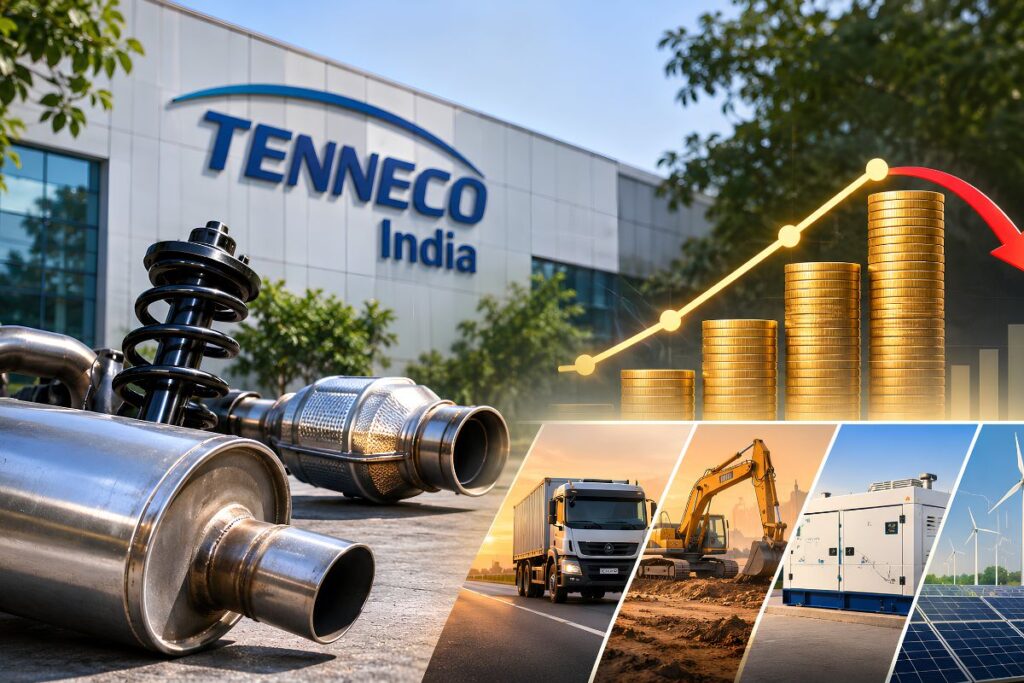
Tenneco India is moving into aerospace, defense, and railway manufacturing because its core automotive business has hit an earnings wall. Following the nationwide rollout of Bharat Stage VI Stage II emissions rules, the revenue value of exhaust systems per vehicle has flatlined, leaving the company without a regulatory engine to expand unit margins.
Why Did Auto Exhaust Revenue Per Vehicle Stop Growing?
Automotive exhaust content-per-vehicle growth halted across India once vehicle manufacturers complied with Real Driving Emissions rules in 2023, leaving suppliers with no further mandatory hardware additions to bill to carmakers. Content per vehicle refers to the total monetary value of all parts a component manufacturer supplies for a single automobile.
Between 2017 and 2023, central emissions mandates drove two successive rounds of capital expenditure across the automotive component sector. Transitioning from Bharat Stage IV (BS-IV) to BS-VI Stage I required adding selective catalytic reduction units, particulate filters, and advanced catalytic converters to internal combustion engines. For suppliers like Tenneco Clean Air India Private Limited, that regulatory shift increased the content-per-vehicle realization on exhaust systems by 200% to 300%.
Then came BS-VI Stage II Real Driving Emissions (RDE) norms, codified by the Ministry of Road Transport and Highways (MoRTH). These rules mandated onboard diagnostic equipment to monitor real-world vehicle emissions continuously across operating temperatures.
That regulatory milestone exhausted the pipeline of required exhaust hardware additions.
Since the RDE rollout took full effect, component value growth per vehicle has flattened to sub-GDP levels across passenger and commercial vehicle platforms. Auto-component equity research and regulatory disclosures tracking listed exhaust system manufacturers such as Sharda Motor Industries confirm that without an upcoming regulatory step like BS-VII on the immediate horizon, Tier-1 exhaust suppliers can no longer rely on state mandates to raise prices on standard assemblies.
Growth in automotive exhaust now tracks vehicle assembly volume point-for-point.
How Does India’s Falling Diesel Market Share Hurt Component Margins?
The contraction of diesel passenger vehicles directly reduces exhaust supplier revenue because simpler petrol and gas engines require significantly fewer expensive exhaust-treatment components.
Over the past decade, diesel’s share of the Indian passenger vehicle market dropped from over 50% to under 15%, according to monthly dispatch data from the Society of Indian Automobile Manufacturers (SIAM).
That decline directly alters component balance sheets.
Diesel exhaust systems require multi-stage after-treatment hardware: diesel oxidation catalysts, diesel particulate filters, and selective catalytic reduction systems with urea dosing to neutralize nitrogen oxides. A standard petrol or compressed natural gas (CNG) setup, by contrast, relies on a three-way catalytic converter, a significantly simpler assembly.
According to cost-structure analyses by the Automotive Component Manufacturers Association of India (ACMA), a full BS-VI Stage II passenger diesel after-treatment unit carries an original equipment manufacturer (OEM) bill-of-materials cost of roughly ₹45,000 to ₹65,000, compared to ₹12,000 to ₹18,000 for a comparable petrol or CNG exhaust setup.
As Indian buyers migrate toward petrol, factory-fitted CNG, and mild hybrids, the addressable value pool for complex emission hardware shrinks. Even as overall vehicle dispatches grow, the proportion of vehicles requiring the most expensive exhaust assemblies is steadily declining.
What Does the ₹16,500 Crore Tenneco Order Book Actually Represent?
The ₹16,500 crore Tenneco Clean Air India order book represents multi-year recurring production runs for existing vehicle platforms rather than guaranteed, high-margin revenue expansion.
Auto-component supply agreements are typically tied to multi-year vehicle production schedules spanning five to seven years. Annual revenue realization depends entirely on whether vehicle manufacturers meet their projected assembly targets.
Statutory annual filings of Tenneco Clean Air India Private Limited lodged with the Ministry of Corporate Affairs (MCA) indicate that the bulk of committed order volumes corresponds to existing platform replenishments and recurring long-term supply arrangements with domestic OEMs, rather than margin-accretive new platform wins.
These contracts also incorporate indexed raw-material pricing clauses. When steel or precious metal costs fluctuate, top-line contract values adjust, protecting nominal margins while restricting unexpected profit windfalls.
The business remains a steady generator of operating cash flow, but it operates under rigid commercial caps. It does not offer the compounding pricing power that global private equity sponsors target.
Why Are Aerospace and Rail More Lucrative Than Auto Components?
Non-automotive precision engineering contracts provide operating margins 800 to 1,200 basis points higher than mature automotive exhaust manufacturing because pricing is not compressed by annual OEM price-reduction demands.
Precision components for railway bogies, rolling-stock suspension systems, and aerospace structures operate on lower production volumes than mass-market passenger cars, but they command significantly higher gross margins.
Public segment disclosures and investor presentations from diversified Indian engineering suppliers such as Bharat Forge show that defense and aerospace precision machining units consistently deliver operating margins 800 to 1,200 basis points higher than mature automotive powertrain divisions.
For Tenneco India, deploying its balance sheet into precision engineering targets is less about speculative growth and more about margin replacement. Buying specialized capabilities in rail and defense allows the company to repurpose fabrication expertise into sectors where procurement contracts are not subject to the aggressive annual cost-down demands common among automotive OEMs.
Tenneco’s management points out that heavy commercial vehicles, off-highway machinery, and potential future fuels like hydrogen internal combustion engines will continue to require complex after-treatment systems for years to come. That demand provides a stable baseline. But in passenger mobility, the period of rapid content-per-vehicle expansion has closed, and the capital is moving accordingly.
Frequently Asked Questions
Why is Tenneco India diversifying outside the automotive industry?
Tenneco India is diversifying into defense, aerospace, and railways because content-per-vehicle realizations in automotive exhaust systems have plateaued after BS-VI Stage II norms. Without an upcoming emissions mandate like BS-VII to force expensive hardware upgrades, exhaust revenue growth is capped to overall vehicle volume growth.
How does the drop in diesel car sales affect auto exhaust suppliers?
Diesel exhaust units require complex multi-component systems, including particulate filters and selective catalytic reduction units, costing ₹45,000 to ₹65,000 per vehicle. As diesel’s passenger car market share fell below 15% in India, demand shifted toward simpler petrol and CNG setups costing only ₹12,000 to ₹18,000, shrinking the component value pool.
What kind of margins do defense and aerospace precision parts offer compared to auto components?
Disclosures from engineering peers like Bharat Forge indicate that defense and aerospace precision machining segments yield operating margins 800 to 1,200 basis points higher than automotive powertrain divisions, compensating for smaller production runs with significantly higher unit pricing power.

Praseetha K
Praseetha K is the Managing Editor of Clarity Times. She edits, verifies and publishes the newsroom's articles, and also writes analysis on policy, law, business and technology. Articles she writes are edited by the Editor-in-Chief before publication.