
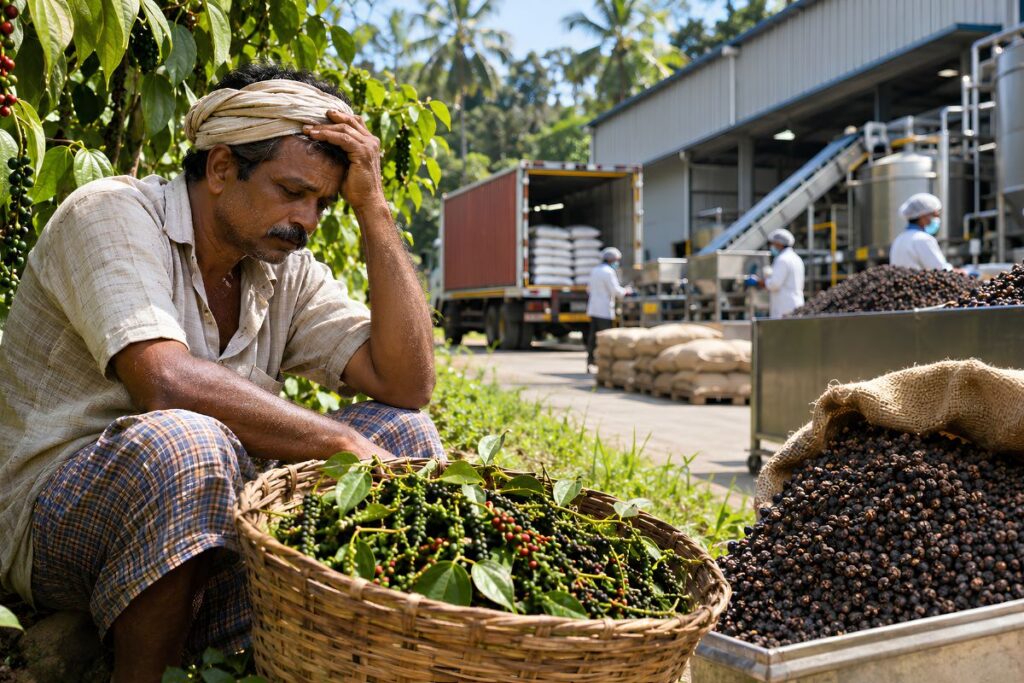
Kerala’s multi-billion-rupee spice extraction industry relies almost entirely on imported black pepper rather than local farms. Driven by the economics of Kerala spice extractors, pepper imports bypass regional growers by utilizing duty-exempt re-export schemes to import cheaper, higher-density berries from Vietnam and Sri Lanka, leaving traditional Kerala cultivation to decline independently of the industrial sector’s commercial expansion.
How Do Spice Processors Bypass Import Duties on Black Pepper?
The growth of the spice oleoresin industry sourcing is largely detached from the state’s agricultural harvest. Spice oleoresin, a concentrated liquid extract containing both volatile essential oils and non-volatile resinous flavor compounds, serves as a core ingredient for global processed foods. Processing facilities in Ernakulam district run primarily on raw berries shipped in through Cochin Port rather than produce trucked from the plantations of Idukki or Wayanad.
The primary mechanism enabling this detachment is the DGFT Advance Authorisation Scheme administered by the Directorate General of Foreign Trade under India’s Ministry of Commerce and Industry. Under this framework, export-oriented industrial processors import raw black pepper at zero customs duty, provided the imported volume is physically processed into value-added derivatives, such as oleoresins and essential oils, and re-exported under a standard minimum 15% value addition mandate.
For industrial extractors, domestic price protection rules do not apply to these shipments. While the central government enforces a Minimum Import Price notification of ₹500/kg on black pepper under Chapter 09 to protect domestic growers from cheap imports, parliamentary filings and trade rules confirm that consignments imported under Advance Authorisation licenses are exempt from both standard customs duties and the Minimum Import Price black pepper threshold.
The financial incentive is structural. While spot prices in primary domestic markets regularly fluctuate between ₹650 and ₹720 per kilogram, international landed costs for Vietnamese Fair Average Quality (FAQ) pepper trade at a distinct discount. According to import metrics published by market monitoring agencies and Spices Board trade data, domestic industrial demand pushed annual national black pepper imports to a record 48,085 tonnes in 2024–25, up from 34,211 tonnes in 2023–24, even as domestic production contracted. By utilizing the Advance Authorisation Scheme pepper exemption, processors insulate operational margins from the volatile domestic spot market.
Why Do Industrial Extraction Plants Prefer Vietnamese Black Pepper Over Local Berries?
Industrial processors choose Vietnamese black pepper because uniform berry density and predictable moisture deliver higher extraction yields per metric ton than variable domestic lots.
Modern industrial extraction units require uniform chemical and physical baselines to maximize the yield of piperine, the alkaloid responsible for the characteristic pungency of black pepper, and volatile essential oils. Industrial solvent recovery lines calculate purchasing efficiency strictly on the percentage of active compounds extracted per metric ton of raw input.
Bulk commercial berries imported from Vietnam arrive with standardized bulk density, consistently grading at 550 to 600 grams per liter, alongside controlled moisture profiles and uniform berry size. Conversely, field-run Malabar pepper sourced across fragmented smallholder plots in Kerala exhibits wide variances in berry maturity, moisture retention, and bulk density.
Agronomic factors compound this commercial gap between Indian black pepper prices and Vietnamese crops. Research documentation from the ICAR-Indian Institute of Spices Research (IISR) notes that while indigenous cultivars like Karimunda and Kottanadan naturally boast high oleoresin concentrations, smallholder harvesting practices often lead to premature picking and uneven sun-drying. In contrast, large-scale plantations in Vietnam and corporate estates in Karnataka utilize high-density trellis systems and mechanized post-harvest infrastructure. When industrial solvent extractors evaluate total processing throughput, standardized global consignments yield a lower net cost per unit of refined oleoresin.
What Caused the Historic Decline in Kerala’s Black Pepper Cultivation?
A combination of persistent fungal diseases, climate volatility, and cheaper production in neighbouring states triggered the Kerala black pepper production decline over the past twenty years.
Long-term crop statistics compiled by the Spices Board of India show that Kerala, which accounted for more than 90% of national black pepper output through the late twentieth century, has lost its domestic lead. A compounding combination of foot-rot disease (Phytophthora capsici), slow-wilt fungus, and erratic monsoon patterns has steadily degraded productivity across traditional growing belts in Wayanad and Idukki.
Production moved elsewhere across southern India. Agricultural output shifted decisively toward Karnataka’s coffee-growing districts in Kodagu, Hassan, and Chikmagalur, where pepper vines thrive as an intercrop on shade trees at significantly lower overhead costs. According to agricultural census data, Karnataka now commands roughly 50% or more of India’s domestic harvest, yielding over 80,000 tonnes in peak seasons, while Kerala’s annual crop struggles between 20,000 and 22,000 tonnes.
Grower associations assert that duty-exempt re-export flows directly suppress regional farmgate realization.
“When local crop arrivals enter primary markets during harvest season, large extraction plants stay away from the auctions,” notes representation submitted by the Indian Pepper and Spice Traders, Farmers, Producers and Planters Association (IPSTFPPA). “Processors maintain continuous operations using duty-free overseas inventory under Advance Authorisation, effectively putting an artificial ceiling on what Kerala planters can demand at the auction yard”.
Why Do Extractors Expand Global Procurement Over Local Farm Support?
Global regulatory compliance and domestic supply deficits force extraction companies to scale international supply chains rather than relying on regional farms.
According to corporate disclosures from major extraction leaders like Synthite Industries and Plant Lipids, Indian processors control an estimated 50% to 60% of the world’s value-added spice oleoresin market, supplying multinational food conglomerates across more than 90 countries. The aggregate industrial processing requirement of these plants far exceeds India’s entire annual pepper harvest, which Spices Board estimates are pegged at 77,533 tonnes in 2024–25 and down to near 55,000–58,000 tonnes in 2025–26.
Supply chain directors point out that without duty-free imports under the Advance Authorisation Scheme, Indian extraction facilities would lose processing volume to emerging value-addition plants in Vietnam, Indonesia, and China.
Furthermore, industrial processors face strict Maximum Residue Limits (MRLs), the highest legal level of pesticide concentration permitted in food products, enforced by the European Food Safety Authority and the United States Food and Drug Administration. Processors argue that fragmented domestic smallholders cannot reliably guarantee batch-level pesticide traceability, forcing corporate extractors to either maintain direct farm-integration programs or import containerized, pre-certified shipments from international brokers.
The result is an entrenched economic divergence: a ₹3,000-crore industrial extraction enclave continuing its global expansion, entirely unmoored from the shrinking farms of the spice coast that originated it.
Frequently Asked Questions
Why are Kerala’s spice oleoresin companies importing pepper instead of buying locally?
Kerala processors import overseas pepper primarily because imported Vietnamese berries arrive with standardized bulk density (550 to 600 grams per liter) and trade at lower price points than domestic crops. Additionally, processors use the Advance Authorisation Scheme to import raw pepper duty-free, insulating their export margins from the ₹500/kg domestic Minimum Import Price.
How does the Advance Authorisation Scheme affect Kerala’s pepper farmers?
The scheme permits industrial extractors to bypass customs duties and the domestic Minimum Import Price for raw goods destined for value-added re-export. Because extractors fulfill their inventory needs using foreign consignments, they avoid purchasing at domestic primary auctions during peak harvest, which local grower groups argue caps regional farmgate prices.
How much black pepper does India import for industrial processing?
According to Spices Board trade data, national black pepper imports climbed to a record 48,085 tonnes in the 2024–25 financial year, rising from 34,211 tonnes in 2023–24. The majority of these inbound shipments are routed through ports like Kochi to supply high-capacity extraction plants.
Did Kerala lose its position as India’s top pepper-producing state?
Yes. Long-term production data from the Spices Board confirms that Kerala, which once produced over 90% of India’s black pepper, now harvests between 20,000 and 22,000 tonnes annually. Karnataka has taken the lead, producing over 80,000 tonnes in peak seasons by cultivating pepper vines on coffee estate shade trees

Praseetha K
Praseetha K is the Managing Editor of Clarity Times. She edits, verifies and publishes the newsroom's articles, and also writes analysis on policy, law, business and technology. Articles she writes are edited by the Editor-in-Chief before publication.