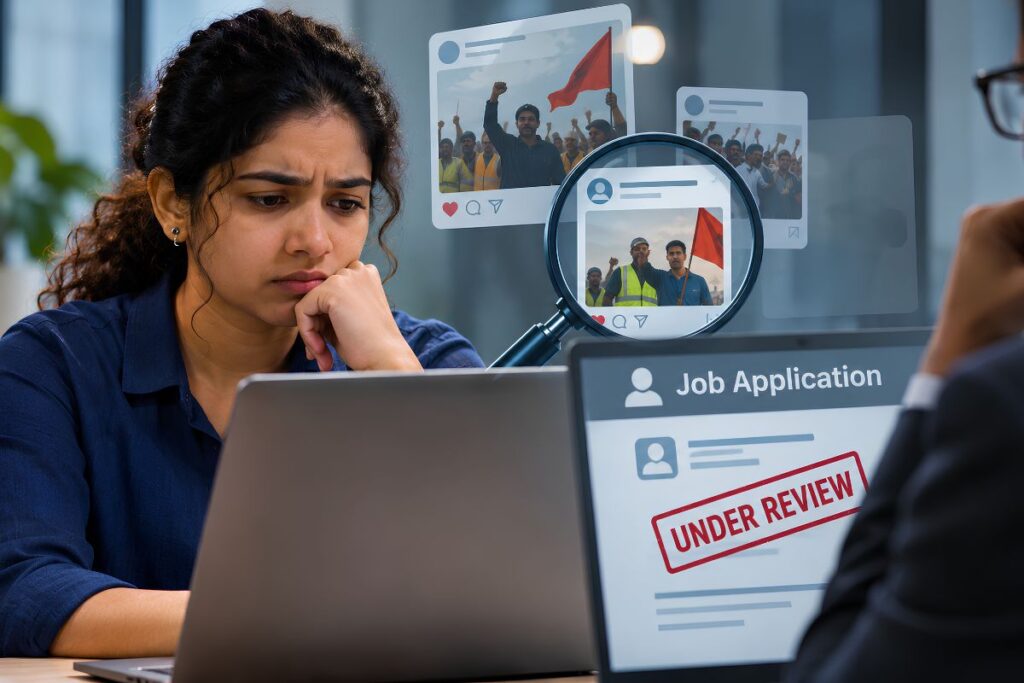
Federal law prohibits employers from rejecting you because you discussed working conditions or supported a union online. Yet companies regularly bypass this rule: during a social media screening job search evaluation, third-party software silently flags labor speech under non-legal labels like toxicity, leaving disqualified candidates without the documentation required to prove their federal rights were violated.
Social media screening is the automated or manual review of an applicant’s public online presence to evaluate hiring risk before an employment offer is extended.
HOW PROTECTED SPEECH TURNS INTO A HIRING REJECTION
Applicant’s Public Post Algorithmic Parser
┌─────────────────────────┐ ┌──────────────────────┐
│ “Management cut shifts │ ─────────────► │ Keyword match: │
│ without notice.” │ Ingests post │ “shift cuts”, │
└─────────────────────────┘ │ “management conflict”│
└──────────┬───────────┘
│
▼
Hiring Manager Categorized Risk Flag
┌─────────────────────────┐ ┌──────────────────────┐
│ Candidate disqualified │ ◄───────────── │ “Workplace Hostility │
│ via low composite score │ Delivers score │ / Brand Toxicity” │
└─────────────────────────┘ └──────────────────────┘
How Does Automated Social Screening Turn Protected Speech into a Risk Flag?
Automated screening engines transform federally protected labor discussions into generic behavioral liabilities by evaluating posts using sentiment analysis rather than legal definitions.
When job applicants are eliminated during automated background reviews, the rejection notice never mentions labor organizing. Instead, applicant tracking dashboards register broad behavioral warnings.
Commercial background tools, such as the social media screening suites offered by Fama Technologies and Ferretly, crawl an applicant’s public digital history across social networks, video platforms, and web forums. These engines flag specific behavior buckets, scanning for profanity, explicit content, and reputational hazards.
Section 7 concerted activity is the legal right of employees under federal law to join together to discuss or improve wages, hours, and working conditions. A public post discussing mandatory overtime, unpaid wages, or an ongoing union drive carries federal protection under the National Labor Relations Act (NLRA).
In automated hiring pipelines, natural language processing models grade candidate text against keyword taxonomies. A worker posting about walking out over safety conditions is classified not as a labor organizer, but as an applicant with a recorded history of workplace friction.
The applicant receives a standard automated notification citing a high volume of qualified applicants. Because the evaluation occurs inside closed software suites before an interview takes place, candidates rarely learn which post triggered the system.
Under the Fair Credit Reporting Act (FCRA), applicants have the right to request a Fair Credit Reporting Act adverse action notice when a third-party consumer report informs an employment rejection. Exercising that right requires knowing that an automated consumer report was generated in the first place.
Does the National Labor Relations Act Protect Job Applicants?
Yes, the National Labor Relations Act protects job applicants from anti-union discrimination before an offer is made, granting them statutory standing under federal law.
The legal protection covering applicants is longstanding. In Phelps Dodge Corp. v. NLRB, the Supreme Court of the United States ruled that the NLRA prohibits anti-union discrimination against job applicants, establishing that an applicant holds statutory standing under Section 2(3) of the Act.
An employer that systematically filters out applicants who exercise rights protected under Section 7 violates federal labor law. National Labor Relations Board (NLRB) General Counsel Jennifer Abruzzo addressed this friction directly in Memorandum GC 23-02, which warned that automated surveillance systems and algorithmic management tools violate the Act when they interfere with, track, or chill organizing efforts.
The breakdown occurs at the point of discovery. An existing employee who is fired after discussing wages can point to an abrupt change in employment status and file a claim. An applicant faces an evidentiary wall: employers are under no obligation to record why a resume was discarded during preliminary automated screening.
Without an internal audit trail or an explicit paper disclosure connecting the automated flag to the candidate’s labor speech, NLRB applicant protections remain largely theoretical for job seekers discarded at the screening gate.
How Do Background Check Algorithms Classify Labor Organizing as Toxicity?
Screening platforms classify labor speech as toxic because their language classifiers measure linguistic conflict rather than legal context.
Screening vendors market automated online audits as an objective way to protect corporate reputation. These tools parse years of historical posts, applying machine-learning classifiers to sort content into standardized risk categories:
- Workplace hostility or aggression
- Brand reputation damage
- Public grievance behavior
When automated background check algorithms evaluate candidate speech, they classify text by semantic proximity rather than statutory definitions. A post stating “management cut our shifts without notice” shares linguistic markers with interpersonal hostility and chronic workplace conflict.
The software records the statement as an indicator of friction, lowering the candidate’s composite suitability score. The hiring manager never reads the underlying post about shift cuts; they see an aggregated score indicating elevated behavioral risk. The labor context disappears, leaving behind only a numeric disqualification.
Why Are Refusal-to-Hire Unfair Labor Practice Claims So Rare?
Refusal-to-hire claims are rare at the administrative level because rejected candidates cannot access the internal vendor logs required to prove an employer acted with anti-union animus.
The NLRB’s regional offices process thousands of disputes each year via the public Case Directory, yet pre-employment social screening disputes remain rare compared to post-hire terminations.
Proving discriminatory refusal-to-hire under Section 8(a)(1) and Section 8(a)(3) of the Act requires establishing that the employer had direct knowledge of the protected activity and acted out of anti-union animus.
Automated screening fragments that chain of liability. The screening vendor operates as an independent software provider delivering structured data, while the employer asserts it acted on a cumulative risk score rather than the specific labor speech embedded within the report. Because rejected candidates cannot subpoena internal applicant logs without an open investigation, most automated exclusions never reach an administrative law judge.
Why Do Employers Insist on Conducting Pre-Employment Social Screening?
Companies conduct social media reviews to insulate themselves from civil negligent hiring lawsuits and to comply with federal workplace safety standards.
Management-side employment attorneys point out that companies deploy pre-employment social screening to satisfy legal duties that exist alongside labor statutes.
Under common-law doctrines of negligent hiring, an employer faces direct civil liability if a worker causes foreseeable harm to coworkers, customers, or third parties. Failing to conduct reasonable pre-hire due diligence on a candidate with a public record of harassment or violence leaves the company exposed to substantial tort damages.
Furthermore, employers must satisfy federal compliance standards under Title VII of the Civil Rights Act of 1964, which mandates proactive measures to prevent discriminatory harassment and hostile work environments. The Society for Human Resource Management emphasizes that candidate screening helps identify patterns of threats, hate speech, and physical safety risks before an applicant enters the facility. From the employer’s perspective, screening is a workplace safety measure designed to protect employees, not an effort to monitor collective bargaining.
How Are Federal Regulators Challenging Algorithmic Hiring Filters?
Federal agencies are coordinating enforcement across traditional jurisdictional lines to bring automated candidate screening under consumer protection and labor oversight.
To address gaps that fall between statutory boundaries, the NLRB formed a formal coordination pact through the FTC-NLRB Memorandum of Understanding and an enforcement alliance via the CFPB-NLRB Partnership to Protect Workers. These initiatives share evidence regarding automated surveillance, algorithmic bias, and digital background tracking.
The Consumer Financial Protection Bureau (CFPB) has issued formal guidance confirming that background screening vendors compiling digital dossiers are consumer reporting agencies subject to the Fair Credit Reporting Act. Under these rules, automated tools must follow reasonable procedures to assure maximum possible accuracy, and employers must send formal adverse-action notices when algorithmic scores lead to rejections.
The challenge now rests on disclosure. As long as automated systems compress protected workplace advocacy into generic behavioral risk scores, candidates who speak out about employment conditions will continue to absorb an unmonitored penalty before an interview is ever scheduled.
Related reporting: Read our analysis on youth civic and political participation trends and how forced review quotas disguise structural layoffs.
Frequently Asked Questions
Can an employer reject you for supporting a union on social media?
No. Under the National Labor Relations Act and the Supreme Court precedent in Phelps Dodge Corp. v. NLRB, it is illegal for an employer to refuse to hire an applicant because they engaged in union organizing or discussed working conditions. However, proving this occurred during automated pre-hire screening is difficult because employers rarely disclose why an applicant was filtered out.
What risk categories do social media screening tools look for?
Most commercial screening vendors sort candidate data into categories including workplace hostility, explicit content, brand reputation risk, and harassment. Because natural language processing models focus on sentiment and conflict keywords, public complaints about wage theft, safety issues, or shift cuts are frequently classified as behavioral hostility.
Do you have the right to know if a company checked your social media?
If an employer hires an outside vendor to conduct an automated social audit, that audit qualifies as a consumer report under the Fair Credit Reporting Act. If the report leads to a rejection, the employer is legally required to send you a pre-adverse action notice along with a copy of the report, allowing you to dispute inaccuracies.
How does General Counsel Memo GC 23-02 apply to hiring algorithms?
Issued by the National Labor Relations Board, Memorandum GC 23-02 establishes that employer monitoring practices, including electronic tracking and automated hiring tools, violate federal labor law if they interfere with, chill, or surveil protected Section 7 organizing across the employment lifecycle.

Praseetha K
Praseetha K is the Managing Editor of Clarity Times. She edits, verifies and publishes the newsroom's articles, and also writes analysis on policy, law, business and technology. Articles she writes are edited by the Editor-in-Chief before publication.