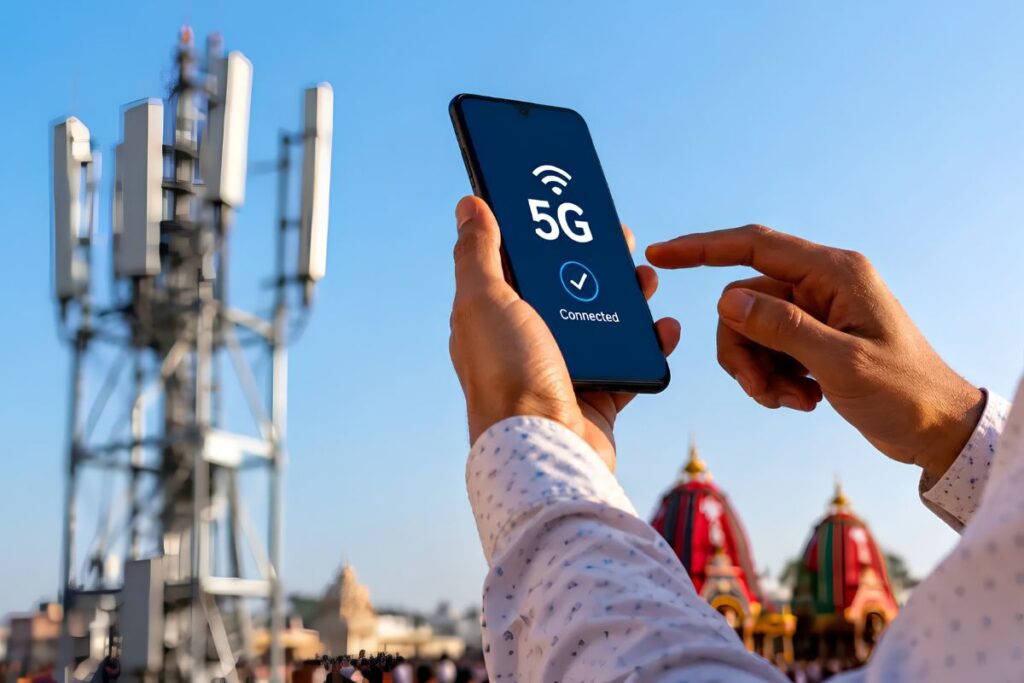
Your 5G mobile data slows down in the evening because telecom towers share the same mid-band radio frequencies between mobile handsets and fixed home wireless routers. When neighborhood households power on television streams between 8 PM and 11 PM, local base stations automatically prioritize static home broadband routers over smartphones to prevent living-room video buffering.
Why Does 5G Mobile Data Slow Down Between 8 PM and 11 PM?
Mobile 5G download throughput drops between 20% and 35% in dense residential sectors every evening because home broadband traffic floods the same cellular frequencies used by nearby smartphones. Diurnal tracking by Opensignal analyzing India’s 5G network performance documented steep declines in average download speeds between 9:00 PM and midnight across high-density markets like Delhi and Mumbai. At the same time, monthly performance monitoring filings from the Telecom Regulatory Authority of India (TRAI) record localized spikes in latency, the round-trip duration measured in milliseconds for data packets to reach a user, as evening cell loads mount.
The slowdown matches the exact hours families stream high-resolution video inside their homes. As living rooms switch on sustained high-bitrate sessions, neighborhood base stations see an immediate surge in persistent data transmission requests.
For smartphone users walking along neighborhood streets or sitting in transit nearby, signal bars remain full. The physical connection looks intact. Yet web pages take seconds to load, and video streams drop to lower resolutions.
The radio signal strength has not weakened. The transmission airtime has simply been redirected to stationary rooftop receivers.
How Does Shared 3.5 GHz Spectrum Trigger Mobile and Home Contention?
Mobile handsets and fixed wireless routers compete directly for identical transmission capacity because both services operate over the same 100 MHz block of 3.5 GHz mid-band frequencies, known as band n78. Fixed Wireless Access (FWA), a technology that delivers fixed home internet over cellular radio channels instead of underground physical glass cables, shares the same massive MIMO antennas mounted on local cellular masts.
A massive MIMO antenna is a multi-element radio array that uses beamforming to direct focused signals toward individual devices. While these antennas isolate individual signals, the total number of physical resource blocks, the baseline frequency-time slots that carry digital bits, remains fixed per antenna sector.
The structural problem lies in how differently the two customer types consume data.
According to data usage reports from the Telecom Regulatory Authority of India (TRAI), an average mobile smartphone subscriber consumes roughly 25 to 30 gigabytes of data each month. A home broadband subscriber, by comparison, consumes between 300 and 400 gigabytes over the same period, an increase of more than tenfold.
Calculated against standard 3GPP spectral efficiency models documented in Ericsson’s engineering analyses of Fixed Wireless Access, supporting a single 4K video stream to a home FWA router requires as much continuous radio airtime as servicing 10 to 12 active mobile handsets simultaneously browsing or streaming social media. When ten nearby homes run simultaneous evening streams on a single sector, they consume the majority of that sector’s transmission capacity.
What Do Broadband Speed Test Awards Omit About Mobile Quality?
Broadband benchmark awards omit the reciprocal slowdown experienced by mobile users because testing agencies measure fixed home routers and smartphones in completely separate testing categories. In November 2026, mobile analytics firm Opensignal awarded Bharti Airtel top honors across all five categories in its India Fixed Broadband Experience report, citing high reliability scores and average download speeds of 32.4 Mbps for FWA. Mainstream coverage treated these scores as proof of an uncompromised network.
Benchmark tests of this kind measure performance exclusively on active fixed routers operating in static indoor locations. They calculate what a home subscriber receives under optimal line-of-sight conditions.
What those benchmarks omit is the reciprocal cost borne by moving subscribers outside. Because crowdsourced broadband reports evaluate fixed routers and mobile devices in separate studies, they do not show how protecting home throughput alters the mobile experience in that same neighborhood.
How Do Base Station Schedulers Prioritize Home Routers Over Smartphones?
Cellular towers deprioritize mobile phones during evening peaks through automated software schedulers configured to fulfill fixed broadband service agreements before serving best-effort phone traffic. Under standard 3GPP cellular network specifications, base stations use Quality of Service Class Identifiers, known as 5QI profiles, which are numerical tags assigned to data packets to dictate their transmission priority, to decide which packets to send first when capacity is constrained.
Home FWA plans are sold with explicit throughput expectations, such as 30 Mbps or 100 Mbps baselines. Smartphone plans, however, are sold as best-effort services with daily data caps but no guaranteed floor.
When a sector approaches peak capacity, the radio scheduler fulfills the traffic demands of the high-priority FWA connections first. Mobile phone packets are placed into secondary queues, experiencing millisecond delays that accumulate into noticeable buffering.
The operator does not actively shut off mobile connections. The software scheduler simply allocates available physical resource blocks to keep fixed living-room video buffers full, leaving smartphone users to share whatever capacity remains.
Why Haven’t Millimeter-Wave and Small Cells Fixed the Evening Slowdown?
Hardware manufacturing costs and delayed municipal clearances have prevented telecom operators from offloading home broadband traffic onto dedicated high-capacity millimeter-wave spectrum. Bharti Airtel and Reliance Jio Infocomm have both argued that deploying 5G over shared mid-band spectrum allows them to rapidly connect homes in areas where laying underground physical fiber is delayed by municipal permits and high right-of-way fees.
The operators point out that beamforming technology allows towers to isolate signals toward specific rooftops without blanketing entire neighborhoods in interference. Architectural blueprints published by the Bharat 6G Alliance on FWA deployments emphasize that as more fiber-fed street-level small cells are deployed, localized traffic can gradually be offloaded from main macro towers.
Relief remains limited by hardware economics.
While Indian telcos purchased high-frequency millimeter-wave spectrum (26 GHz), which offers massive capacity that could easily isolate home broadband, consumer equipment for those frequencies remains expensive. Dual-band home routers capable of receiving 26 GHz signals cost significantly more to manufacture than standard 3.5 GHz units, stalling wide-scale deployment.
At the same time, municipal right-of-way clearances for street furniture and utility poles move slowly across tier-2 and tier-3 cities, keeping the burden centered on macro cell towers.
Until physical glass fiber reaches the home or millimeter-wave hardware prices drop, the physical trade-off remains fixed. Every new wireless broadband customer added to a neighborhood tower reduces the bandwidth available to the phones walking past it.
Related reporting: Read our analysis on why daily 2.5GB annual telecom plans cost users 50% more and the capital expenditure behind private 5G deployments.
Frequently Asked Questions
Why does 5G mobile data slow down in the evening?
5G mobile data slows down at night because telecom towers share the same 3.5 GHz radio channels between mobile handsets and fixed home wireless routers. Between 8 PM and 11 PM, heavy household streaming forces cellular towers to allocate transmission airtime to stationary home routers, leaving fewer radio resources for smartphones.
Do 5G home internet routers get priority over mobile phones?
Yes. Under 3GPP network standards, base stations use automated 5QI software schedulers to prioritize home routers that have expected speed thresholds over smartphones, which are sold under best-effort data plans without guaranteed minimum speeds.
How much data does a 5G home router consume compared to a smartphone?
According to reports from the Telecom Regulatory Authority of India (TRAI), a typical smartphone user consumes 25 to 30 GB per month, whereas a home broadband connection consumes 300 to 400 GB. A single active 4K home stream absorbs as much continuous radio capacity as 10 to 12 active smartphones.
Why don’t telecom operators move home broadband to separate frequencies?
Operators hold high-frequency millimeter-wave (26 GHz) spectrum that could isolate home internet traffic, but the dual-band router equipment required to receive those signals remains too expensive for mass-market deployment. As a result, telcos continue to run both services on the shared 3.5 GHz band.

Praseetha K
Praseetha K is the Managing Editor of Clarity Times. She edits, verifies and publishes the newsroom's articles, and also writes analysis on policy, law, business and technology. Articles she writes are edited by the Editor-in-Chief before publication.