
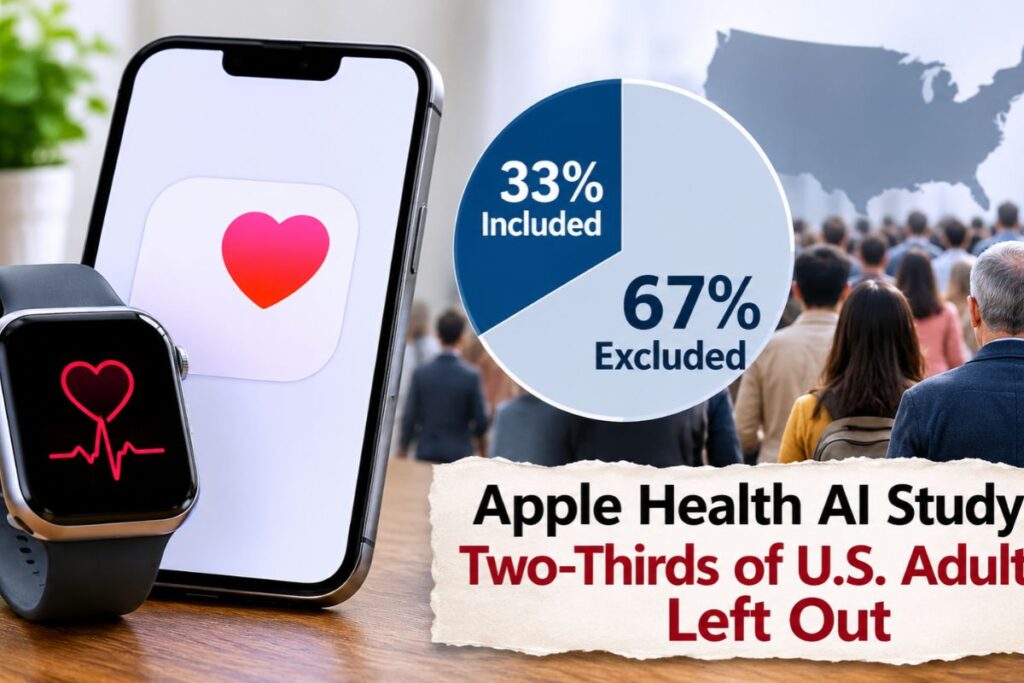
Requiring an iPhone 15 Pro or newer excludes roughly two-thirds of U.S. adults, and an even higher share of older, lower-income, and chronically ill Americans, from the Apple Health AI Usage Study, turning a 200,000-person medical trial into an unrepresentative convenience sample skewed toward affluent early adopters.
How Many Americans Are Eligible for the Apple Health AI Usage Study?
Only 29% to 33% of U.S. adults, roughly 75 million to 85 million people, own an iPhone capable of running the Apple Health AI Usage Study app. To join, a participant must be at least 21 years old, live in the United States, and own a device supporting Apple Intelligence, Apple’s suite of on-device generative artificial intelligence models restricted to the iPhone 15 Pro, iPhone 15 Pro Max, iPhone 16 and iPhone 17 lineups, iPhone 16e, or the newer iPhone 18 Pro and iPhone Duo models.
Those eligibility rules filter the U.S. population down through four consecutive steps before a single medical question gets asked:
- Total U.S. adults: According to U.S. Census Bureau population estimates, the United States has roughly 343 million residents, including approximately 260 million adults aged 21 and older.
- Smartphone owners: According to the Pew Research Center 2026 Mobile Fact Sheet, 91% of U.S. adults own a smartphone, eliminating about 23 million adults who rely on basic cellphones or have no mobile phone.
- U.S. iPhone users: Data from StatCounter Global Stats places Apple’s iOS at 51.96% of the U.S. mobile operating system market as of October 2026 (compared with 48.02% for Google Android), narrowing the eligible pool to roughly 123 million adult iPhone owners.
- Apple Intelligence-capable iPhones: Data compiled from Consumer Intelligence Research Partners (CIRP) buyer surveys shows that 39% of U.S. iPhone buyers in the June 2026 quarter kept their previous phone for three years or longer, while used devices accounted for 12% of sales. Because Apple Intelligence excludes the standard iPhone 15 and every iPhone 14 or older model, roughly one-third to two-fifths of active U.S. iPhones fall below the hardware cutoff.
Which Demographic Groups Are Most Excluded by the iPhone 15 Pro Requirement?
Older adults and lower-income households face the steepest hardware barriers to joining the study, even though both groups carry the highest burden of chronic illness.
According to the Pew Research Center 2026 Mobile Fact Sheet, smartphone ownership drops from 97% among U.S. adults aged 18 to 49 down to 79% among adults aged 65 and older, with 14% of seniors still using non-smartphone cellphones. Older buyers also replace devices less frequently, leaving fewer seniors with Pro-tier or recent-generation iPhones.
Household income widens that divide. In Pew Research Center 2026 mobile ownership data, 80% of adults in households earning less than $30,000 a year own a smartphone, compared with 98% in households earning $100,000 or more. Lower-income consumers rely more heavily on older or second-hand handsets rather than flagship Pro models, even though Pew Research Center digital divide reporting finds that roughly one-third of adults earning under $30,000 depend solely on smartphones for internet access because they lack home broadband.
Meanwhile, chronic disease surveillance from the Centers for Disease Control and Prevention (CDC) shows that more than 90% of U.S. adults aged 65 and older live with at least one chronic condition, compared with 60% of adults aged 18 to 34. Separate National Health Interview Survey (NHIS) data from the National Center for Health Statistics links lower household income to higher rates of chronic illness and cost-related medical care deferral. The Americans with the heaviest healthcare needs are the least likely to own the phone required to enter Apple’s study.
Why Does Apple Require an Apple Intelligence iPhone for the Health AI Study?
Apple requires an Apple Intelligence-compatible iPhone, so the app can run local artificial intelligence models on the phone to strip personally identifiable information before sending health questions to the cloud. Launched in November 2026 in partnership with clinical artificial intelligence platform OpenEvidence, a medical search engine trained on peer-reviewed journals, the Apple Health AI Usage Study aims to enroll up to 200,000 U.S. adults for more than 12 months.
Participants submit health questions inside a dedicated app, optionally sharing Apple HealthKit records such as lab results, sleep logs, and heart rate, to help researchers measure how consumers understand and trust AI-generated medical answers. According to Apple’s launch announcement and reporting by CNET, the app uses on-device Apple Foundation Models to categorize question types and remove personal details before routing queries through cloud contractor UST Global to OpenEvidence.
How Does Hardware Selection Bias Affect Medical Research Validity?
Restricting enrollment to newer iPhones preserves internal validity, whether findings hold true inside the studied group, but weakens external validity, or whether those results apply to the general public. In clinical epidemiology, a large recruitment cap does not correct a non-random sample.
“For researchers interpreting eventual findings, those device, age and geographic requirements define the population being studied. A large recruitment target would not by itself make results representative of younger people, people outside the United States or users of other devices.” , CASRAI research analysis of the Apple Health AI Usage Study
Apple’s own research record illustrates how hardware requirements skew a participant pool. In the 2019 Apple Heart Study, published in the New England Journal of Medicine by Dr. Marco Perez and colleagues, Apple and Stanford University researchers recruited 419,297 participants, more than double the target of the 2026 AI study.
A secondary demographic analysis of the Apple Heart Study found that because participation required both an iPhone and an Apple Watch, enrollees had an average age of 41, 57% were men, and 72.7% identified as White. Only 21% had hypertension, and 4.9% had diabetes, well below the prevalence in older populations most at risk for atrial fibrillation. A 2025 comparative study of digital clinical trials in NPJ Digital Medicine confirmed that passive, app-based enrollment without targeted recruitment systematically under-represents older and non-White patients.
How Could an Affluent Study Cohort Skew Future Health AI Safety?
Calibrating medical AI guardrails on insured, higher-income iPhone owners risks building care-escalation rules that misfire for cost-constrained patients who use chatbots because they cannot afford a doctor. Apple has stated that findings from the 12-month study will guide future consumer health features.
Medical AI tools rely on automated escalation guardrails, software rules that decide when an answer instructs a user to seek urgent medical care versus managing minor symptoms at home. How patients describe symptoms, and whether they act on advice to see a clinician, depends heavily on health insurance status and access to primary care.
According to the KFF Tracking Poll on Health Information and Trust (March 2026), 19% of U.S. adults who used AI for physical health advice, and 27% of those who used it for mental health, said a major reason was that they could not afford a provider visit. Another 18% cited lacking a regular doctor or being unable to get an appointment. In KFF’s June 2026 follow-up survey, uninsured adults were twice as likely as insured adults (32% vs. 16%) to report that cost or lack of a regular provider drove them to digital health tools.
A 2026 emergency medicine triage study in Nature Medicine found that AI triage systems undertriaged 52% of gold-standard medical emergencies, with accuracy shifting based on how users phrased or downplayed symptoms. If Apple and OpenEvidence tune comprehension metrics and doctor-visit prompts primarily around affluent iPhone 15 Pro owners, those safety thresholds remain untested on uninsured patients who treat AI as a clinic substitute.
Frequently Asked Questions
Which iPhones are eligible for the Apple Health AI Usage Study?
The study requires an iPhone capable of running Apple Intelligence on iOS 26 or later. Eligible models include the iPhone 15 Pro, iPhone 15 Pro Max, the entire iPhone 16 and iPhone 17 lineups, the iPhone 16e, and the newer iPhone 18 Pro and iPhone Duo models, excluding the standard iPhone 15 and all older handsets.
How many Americans are excluded from the Apple Health AI Usage Study?
Roughly two-thirds of U.S. adults, about 175 million to 185 million people, cannot participate due to smartphone ownership, operating system, and hardware limits. Out of approximately 260 million U.S. adults aged 21 and older, only 75 million to 85 million own an Apple Intelligence-compatible iPhone.
Why did Apple restrict the Health AI Usage Study to newer iPhones?
Apple states that the app uses on-device Apple Foundation Models to categorize health questions and strip personally identifiable details locally before routing queries through cloud contractor UST Global to OpenEvidence. Older iPhones lack the neural processing hardware required to run Apple’s on-device models.
How does the iPhone 15 Pro requirement affect the study’s scientific results?
While the study can accurately measure usability and comprehension among affluent early adopters (internal validity), biostatistical and clinical trial research shows the findings cannot be generalized to older, lower-income, or uninsured Americans (external validity) who face higher rates of chronic disease and cost-related care barriers.

Praseetha K
Praseetha K is the Managing Editor of Clarity Times. She edits, verifies and publishes the newsroom's articles, and also writes analysis on policy, law, business and technology. Articles she writes are edited by the Editor-in-Chief before publication.