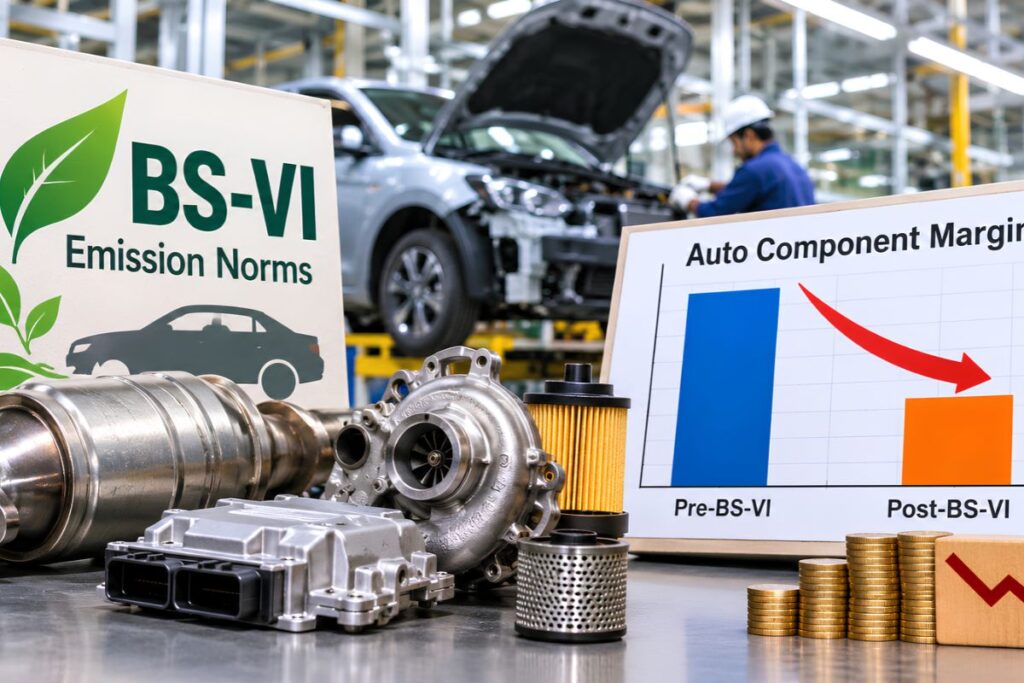
During India’s 2017–2021 shift from BS-IV to BS-VI emission norms, stricter regulations delayed Indian auto component localization rather than producing immediate supplier windfalls. Front-loaded tooling capital, imported precision sub-assemblies, and slow vehicle volume ramp-ups compressed Tier-1 supplier return ratios for two to three years before domestic production scaled enough to make local engineering profitable.
How Did the BS-VI Shift Affect Tier-1 Supplier Return Ratios in India?
Return on Capital Employed (ROCE) compressed across leading Indian Tier-1 suppliers between FY18 and FY22 because upfront regulatory capital expenditure hit balance sheets years before domestic vehicle volumes scaled.
When India moved directly from Bharat Stage IV (BS-IV) to Bharat Stage VI (BS-VI) exhaust standards in April 2020, major Tier-1 component suppliers, companies that engineer and ship complete vehicle subsystems directly to automakers, committed heavy upfront capital to meet tighter emissions and electronics rules. Even as component value per vehicle climbed, Return on Capital Employed (ROCE), a financial ratio measuring how efficiently a company generates operating profit from its total invested capital, fell across major domestic manufacturers.
Audited filings capture that compression across the sector. At Samvardhana Motherson International Limited (then operating as Motherson Sumi Systems Limited), consolidated ROCE stood at 24% in FY20, well below its 40% Vision 2025 target, as global and Indian plants absorbed new program launches, according to equity research tracking Motherson’s FY20–FY25 cycle and SAMIL’s FY25 Annual Report. At Bosch Limited, India’s largest powertrain systems supplier, operating profit before exceptional items fell 36% in the first half of FY20 while the company initiated voluntary retirement restructuring to adjust to mobility shifts, per Bosch Limited’s Q2 FY20 investor disclosures and its FY20 Annual Report.
Peer component makers recorded similar capital-efficiency pressure during the same transition window. Per Uno Minda Limited’s Integrated Annual Report, consolidated ROCE stood at 15.76% in FY22 with fixed-asset turnover at 3.30 times, both weighed down by multi-year capacity additions ahead of volume recovery, while Sona BLW Precision Forgings Limited’s investor filings document a multi-year pivot away from internal-combustion components, which dropped from 25% of revenue in FY21 to 10% by 9M FY24.
Why Did Stricter Emission Norms Initially Spike Component Imports?
Stricter emission rules initially widened India’s component trade deficit because local Tier-2 sub-suppliers lacked the specialized metallurgy and tooling to produce precision sensors, catalytic substrates, and fuel-injection parts before statutory deadlines.
Before domestic factories can manufacture newly mandated hardware from Indian raw materials, supply chains rely on imported sub-assemblies from overseas parent companies or foreign technology partners. Industry trade data reflects that initial gap: according to the Automotive Component Manufacturers Association of India (ACMA) and a McKinsey sector report, India ran an auto-component trade deficit of USD 2.5 billion in 2019 as specialized hardware imports outpaced local output.
Trade breakdowns from ACMA’s Export-Import Analysis show that even as exports recovered post-lockdown, component imports rose 33% in FY22 to USD 18.3 billion, led by drive transmission, engine parts, and electricals and electronics. At the company level, Bosch Limited’s FY21 Annual Report recorded raw material consumption climbing from 53.9% of product sales in FY20 to 59.4% in FY21 as imported BS-VI powertrain content scaled faster than domestic Tier-2 sourcing.
How Does Tooling Amortization Squeeze Operating Margins During a Tech Transition?
Tooling amortization squeezes supplier margins during a regulatory transition because depreciation charges and foreign licensing fees hit profit-and-loss statements immediately upon commissioning, even when automaker production volumes fall short of forecasts.
Ahead of the April 2020 BS-VI cutoff, suppliers invested heavily in progressive stamping dies, high-precision multi-stage metal-forming tools, alongside automated testing rigs and technical licensing agreements. Once those production lines entered service, fixed depreciation expenses began accruing regardless of how many vehicles rolled off automaker assembly lines.
Because domestic vehicle production softened in FY20 and dropped sharply during the 2020 pandemic shutdowns, fixed tooling costs were spread across smaller batch runs. Data compiled from Society of Indian Automobile Manufacturers (SIAM) production records and ACMA’s quarterly industry sales review shows total Indian vehicle production fell 18% in FY20, from 33.8 million units in FY19 to 27.1 million in FY20, while passenger vehicle output dropped 40% in FY21.
Over that exact stretch, Uno Minda’s consolidated financial statements show annual depreciation more than doubling from ₹165 crore in FY18 (3.7% of sales) to ₹375 crore in FY21 (5.9% of sales) as annual sales growth slowed from 32% in FY19 to 2% in FY21, compressing operating margins from 12% to 11%. Similarly, Bosch Limited’s FY21 financial disclosures show gross fixed assets expanding to ₹3,704.1 crore by March 2021 even as domestic mobility sales grew 1.2%.
How Does Motherson’s 2026–2030 Expansion Compare to the BS-VI Capex Cycle?
Samvardhana Motherson International Limited (SAMIL) enters its current domestic expansion with elevated capital spending and slight near-term ROCE moderation, though management and industry bodies point to larger booked order backlogs and federal Production Linked Incentive (PLI) co-funding than existed during the BS-VI cycle.
In recent interviews, SAMIL Whole-time Director Pankaj Mital and Group Chief Financial Officer Gandharv Tongia pointed to stricter Indian emission standards, vehicle safety rules, and premiumisation as catalysts for deploying newly acquired foreign technologies across India, including electric and hybrid motor components from Japan’s Yutaka Giken and high-voltage wiring harnesses from Nexans Autoelectric.
The company’s balance sheet reflects the early capital intensity of that rollout. According to SAMIL’s FY26 Annual Report and Q2 FY27 financial results, the group invested ₹59.1 billion in capital expenditure during FY26 and spent ₹3,585 crore in H1 FY27 (56% of H1 EBITDA) against full-year FY27 capex guidance of ₹6,000 crore (plus or minus 10%). Over the same period, consolidated ROCE moderated from 17.2% in FY25 to 16.1% in FY26, while Q2 FY27 consolidated EBITDA margins narrowed by 20 basis points to 8.8% as recent acquisitions entered integration.
Company leadership and industry groups maintain that today’s expansion rests on firmer structural footing than the 2018–2020 BS-VI cycle. Unlike the abrupt BS-VI transition, which skipped BS-V entirely and collided with pandemic factory closures, modern Tier-1 suppliers operate with deeper Indian engineering teams, federal subsidies through Production Linked Incentive (PLI) schemes, and multi-year global order books. As documented in SAMIL’s Q2 FY27 earnings release, the group’s booked business reached an all-time high of USD 106 billion (up from USD 96 billion in FY26 and USD 59 billion in FY23), while ACMA’s 66th Annual Session data notes that India’s auto PLI scheme had catalyzed ₹45,477 crore in approved domestic investments by mid-2026.
How Long Does Indian Auto Component Localization Take to Turn Profitable?
Historical data from the BS-VI cycle shows that Indian auto component localization requires 24 to 36 months after a regulatory mandate to turn trade-positive and lift supplier return ratios, once domestic vehicle platforms cross minimum annual batch volumes.
Between 2019 and 2024, India’s auto-component sector swung from a USD 2.5 billion trade deficit to a USD 450 million trade surplus, according to ACMA–McKinsey sector reporting. That turnaround took roughly two to three years after the April 2020 BS-VI cutoff, occurring only after domestic vehicle production recovered past threshold batch sizes and Tier-2 sub-suppliers completed automaker quality qualification to replace imported sub-assemblies.
Once volumes crossed those scale thresholds, Tier-1 capital efficiency rebounded across the sector. Per Uno Minda’s Integrated Annual Report, consolidated ROCE recovered from 15.76% in FY22 to 19.16% in FY23 and 19.81% in FY24 as fixed-asset turnover climbed from 3.30 times to 4.25 times and depreciation eased back to 3.7% of sales. At Sona BLW Precision Forgings, scaling battery-electric vehicle programs lifted EBITDA margins to 28.4% by 9M FY24 as 10 programs reached full serial production.
Yet the same trade cycle offers a cautionary marker for Motherson’s current push: by FY26, rising domestic demand for electric vehicles and software-defined electronics pulled India’s auto-component trade balance back into a USD 1.4 billion deficit (USD 24 billion in exports against USD 25.4 billion in imports, per ACMA’s FY26 industry disclosures), proving that every new wave of imported vehicle technology resets the multi-year localization clock before domestic margins catch up.
Frequently Asked Questions
How did India’s BS-VI transition affect Tier-1 auto-component supplier profit margins and returns? During the FY18–FY22 BS-VI rollout, upfront tooling investments and slower vehicle volumes compressed Tier-1 return ratios for two to three years. For example, Uno Minda’s depreciation-to-sales ratio rose from 3.7% in FY18 to 5.9% in FY21 while consolidated ROCE stood at 15.76% in FY22, and Bosch India’s operating profit before exceptional items fell 36% in H1 FY20.
Why did Indian auto-component imports rise during the BS-VI emission shift? Tier-1 manufacturers had to import electronic sensors, catalytic substrates, fuel-injection hardware, and precision castings from overseas technology partners before domestic Tier-2 vendors could qualify local tooling. According to ACMA–McKinsey data, India ran a USD 2.5 billion component trade deficit in 2019, and imports jumped 33% in FY22 to USD 18.3 billion before local sourcing caught up.
How long did it take for BS-VI localization to pay off for Indian component makers? According to ACMA–McKinsey sector data and corporate filings, India’s auto-component trade balance took 24 to 36 months after the April 2020 BS-VI mandate to swing from a USD 2.5 billion deficit in 2019 to a USD 450 million surplus by 2024, coinciding with Uno Minda’s ROCE recovering from 15.76% in FY22 to 19.81% in FY24.
How does Samvardhana Motherson’s FY27 capex cycle compare to the BS-VI transition? SAMIL invested ₹59.1 billion in FY26 capex and guided for ₹6,000 crore in FY27 while consolidated ROCE eased from 17.2% in FY25 to 16.1% in FY26. Unlike the 2018–2020 BS-VI cycle, however, SAMIL enters expansion backed by USD 106 billion in booked business as of Q2 FY27 and federal Production Linked Incentive (PLI) co-funding

Praseetha K
Praseetha K is the Managing Editor of Clarity Times. She edits, verifies and publishes the newsroom's articles, and also writes analysis on policy, law, business and technology. Articles she writes are edited by the Editor-in-Chief before publication.