
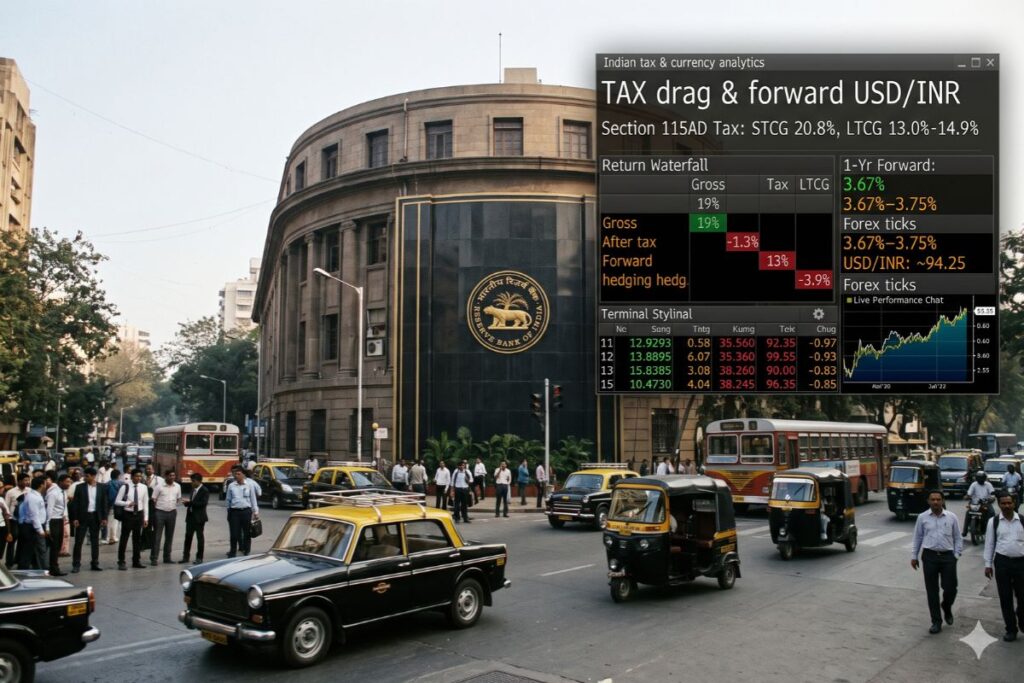
Even if Indian stocks match Goldman Sachs’s projected 19% rally in 2027, the currency slide and Indian capital gains tax on foreign investors will strip away 3.5 to 6.5 percentage points of gross gains. A US-based foreign fund would keep 12.2% to 13.8% in net dollar returns, while a domestic Indian mutual fund investor realizing gains would keep 15.2% to 16.6%.
What is the net take-home return from a 19% Indian stock rally?
A 19% gross gain in rupee-denominated Indian equities leaves an offshore dollar investor with 12.2% to 13.8% in net returns and a domestic Indian investor with 15.2% to 16.6% after statutory deductions.
Headline brokerage forecasts measure index gains before friction. For an actual buyer, two deductions sit between a 19% rally on paper and cash in hand: the exchange rate between the US dollar and the Indian rupee, and India’s post-July 2024 capital gains tax rates.
Applying statutory Indian equity tax rates under the Finance (No. 2) Act, 2024, 20% on short-term gains held 12 months or less under Section 111A and 12.5% on long-term gains above ₹1.25 lakh under Section 112A of the Income-tax Act, 1961, alongside forward currency pricing alters the math for both offshore and local buyers:
- Foreign Portfolio Investor (FPI) buying in US dollars: A Foreign Portfolio Investor (FPI) is an overseas fund registered with the Securities and Exchange Board of India (SEBI) to buy local shares. With 1-year USD/INR forward premia trading near 3.67% to 3.75% in 2026 per Investing.com market data, a 19% gross gain in rupees shrinks to 14.7% in pre-tax US dollars once converted at the forward rate. After deducting Indian capital gains taxes under Section 115AD of the Income-tax Act, 1961, which reach an effective rate of 13.00% to 14.95% on long-term gains and 20.80% to 23.92% on short-term gains once surcharge and the 4% health and education cess are added, according to KPMG India’s FPI tax schedule, the investor’s net take-home return drops from 19% to between 12.2% and 13.8% in dollars.
- Domestic Indian mutual fund investor realizing gains: Facing zero currency conversion loss, a local investor still pays 12.5% long-term capital gains tax on profits exceeding the ₹1.25 lakh annual exemption, or 20% on short-term redemptions. That reduces a 19% gross gain to 16.6% for long-term holders and 15.2% for short-term sellers.
That gap explains why the headline number looks different depending on where an investor sits.
What does Goldman Sachs’s 2027 Asia ex-Japan forecast actually assume?
Goldman Sachs’s 19% projection models pre-tax US-dollar price returns for the MSCI Asia excluding Japan index rather than after-tax investor payouts.
In its November 2026 Asia-Pacific portfolio strategy outlook led by Chief Asia-Pacific Equity Strategist Timothy Moe, Goldman Sachs upgraded Indian equities to overweight and projected a 19% US-dollar price return for the MSCI Asia excluding Japan index in 2027, according to Briefs.co summaries of the strategy note.
Institutional strategy notes model pre-tax index returns because every client operates under a different tax domicile and currency mandate. Goldman Sachs’s constructive case rests on corporate profit growth rather than valuation expansion, and if strong foreign inflows strengthen the rupee or weaken the US dollar in 2027, currency drag could fall below forward-market pricing.
Even under a benign macro scenario, offshore funds still face structural currency friction when moving money into and out of rupees.
How much does rupee depreciation cut foreign stock returns in India?
Annual rupee depreciation of 3.3% to 3.75% strips roughly 4.3 percentage points off a 19% rupee equity gain before any taxes are deducted.
Every dollar a foreign fund invests in Mumbai must first be converted into rupees, exposing the position to exchange-rate drift over the holding period. Between January 2016 and November 2026, the Indian rupee depreciated by 42.5% cumulatively against the US dollar, moving from ₹66.15 per dollar to ₹94.25 per dollar, an annualized depreciation pace of 3.3% per year according to Reserve Bank of India (RBI) reference rate records.
Foreign funds have two choices: leave the currency exposure unhedged and absorb spot rupee movement, or lock in an exchange rate through a USD/INR forward contract tracked by the Clearing Corporation of India Limited (CCIL). A USD/INR forward contract is an agreement to exchange dollars for rupees at a fixed rate on a future date, eliminating currency risk for a fixed fee. Hedging removes currency surprise, but the 1-year USD/INR implied yield, which climbed to 3.67% following Reserve Bank of India forward-market curbs in April 2026 and reached 3.75% during October 2026 volatility, directly subtracts from equity returns.
Currency loss is only half of the offshore deduction, because Indian tax law calculates profits before the money is converted back into dollars.
How does Indian capital gains tax on foreign investors create a phantom gain penalty?
Under Section 115AD of the Income-tax Act, India computes foreign portfolio investors’ capital gains in rupees without adjusting for exchange-rate loss, forcing funds to pay tax on nominal gains caused solely by rupee depreciation.
In July 2024, the Indian government raised taxes on listed equity investments under Sections 111A and 112A of the Income-tax Act, 1961. Short-term capital gains rose by a third, from 15% to 20%, while long-term capital gains rose by a quarter, from 10% to 12.5%.
While New Delhi exempted foreign portfolio investors from capital gains and interest taxes on Indian government bonds effective April 1, 2026, under the Income-tax (Amendment) Ordinance, 2026, Parliament left listed equity taxes unchanged, even as FPIs pulled ₹3.04 lakh crore out of Indian stocks through October 2026, according to National Securities Depository Limited (NSDL) data cited by BW Businessworld.
Unlike standard non-resident investors who compute gains in foreign currency under the first proviso to Section 48, FPIs are governed by Section 115AD, which computes equity gains strictly in rupees without foreign-exchange fluctuation adjustment, a structural tax friction analyzed by venture capital firm 3one4 Capital.
Consider the mechanics: if an Indian stock rises 19% in rupees while the rupee falls 3.75% against the dollar, the investor’s real dollar gain before tax is 14.7%. Yet Indian tax authorities assess capital gains tax on the full 19% nominal rupee rise, meaning the foreign fund pays Indian tax on the 3.75% currency slide that merely kept its original dollar principal whole.
That tax structure puts India at a net-yield disadvantage against several neighboring markets inside the same Goldman Sachs regional basket.
Why does a 19% rally in India yield less net return than in Singapore or Taiwan?
Singapore and Taiwan exempt qualifying foreign institutional investors from local capital gains taxes on listed shares, allowing offshore funds to keep 2.5 to 4.5 percentage points more of a 19% rally than they keep in India.
Goldman Sachs’s 19% forecast covers Asia ex-Japan as a regional group, where India competes directly for foreign institutional capital against markets like Singapore, Taiwan, and South Korea. While gross index targets treat every percentage point of return equally, local tax regimes do not.
In Singapore, listed equity capital gains are tax-exempt for portfolio investors, according to PwC’s Worldwide Tax Summaries for Singapore. In Taiwan, non-resident institutional investors without a fixed place of business or business agent in the territory are exempt from income tax on listed securities gains, as detailed in PwC’s Taiwan Corporate Tax Summary. Even in South Korea, where non-residents face a statutory 25% corporate capital gains rate under PwC’s Korea Tax Summary, bilateral tax treaties and minority-shareholder rules frequently exempt foreign funds holding under 25% of a listed company.
A 19% gross rally in a zero-capital-gains-tax jurisdiction leaves only currency movement between the investor and their net dollar return, whereas an identical 19% rally in India loses 2.5 to 4.5 percentage points to statutory tax friction before a single dollar leaves Mumbai.
What gross rupee return do Indian stocks need to deliver 19% net in US dollars?
To net 19% in US dollars after a 3.75% forward currency cost and post-2024 Indian equity taxes, Indian stocks must rise 26.8% to 29.4% in local rupee terms.
Working backward through the tax and currency math reveals the true hurdle rate embedded in Goldman Sachs’s forecast.
To walk away with a 19% net return in US dollars after absorbing a 3.75% annual currency forward cost and India’s post-2024 capital gains taxes (14.30% effective long-term rate for a corporate FPI above ₹10 crore income, or 22.88% effective short-term rate), a foreign institutional investor needs Indian equities to climb 26.8% to 29.4% in local rupee terms:
- Long-term FPI hurdle (held over 12 months, 14.30% effective tax, 3.75% FX drag): Requires a 26.8% gross INR gain to net 19.0% in USD.
- Short-term FPI hurdle (held 12 months or less, 22.88% effective tax, 3.75% FX drag): Requires a 29.4% gross INR gain to net 19.0% in USD.
Domestic Indian retail investors investing through Systematic Investment Plans (SIPs), which reached a record ₹32,490 crore in monthly inflows in September 2026 per Association of Mutual Funds in India (AMFI) data, sit in a stronger structural position than offshore funds. A Systematic Investment Plan (SIP) is a recurring automated contribution into a mutual fund scheme. Because mutual fund investors pay capital gains tax only when they redeem units rather than annually as portfolio managers rebalance, long-term SIP holders defer the 12.5% tax hit and continue compounding on their full pre-tax balance.
Unless Indian corporate earnings outperform enough to push local share prices past 26.8% in rupee terms, or the rupee reverses its decade-long depreciation trend, the 19% headline figure will remain a pre-friction benchmark rather than a net return.
Frequently Asked Questions
How much tax do foreign portfolio investors pay on Indian stocks in 2026–2027?
Under Section 115AD of the Income-tax Act, 1961, foreign portfolio investors (FPIs) pay a base tax of 20% on short-term listed equity gains (held 12 months or less) and 12.5% on long-term gains (held over 12 months). After adding applicable surcharges and the 4% health and education cess, effective tax rates reach 20.80% to 23.92% for short-term gains and 13.00% to 14.95% for long-term gains.
Does India tax foreign investors on currency depreciation gains?
Yes. Unlike standard non-resident investors who calculate capital gains in foreign currency under Section 48, FPIs are governed by Section 115AD, which computes equity gains strictly in Indian rupees without foreign-exchange adjustment. If the rupee falls 3.75% against the US dollar during a 19% rupee stock rally, the FPI pays Indian capital gains tax on the full 19% nominal rupee gain rather than the 14.7% real dollar gain.
How much do Indian stocks need to rise in rupees for a US investor to net 19% in dollars?
After accounting for a 3.75% 1-year USD/INR forward hedging cost and India’s post-2024 effective FPI capital gains taxes (14.30% long-term or 22.88% short-term for corporate FPIs above ₹10 crore income), Indian equities must gain between 26.8% and 29.4% in rupee terms to leave a US dollar investor with 19% net.
Why do domestic Indian SIP investors keep more of a 19% rally than foreign funds?
Domestic Indian mutual fund investors face zero USD/INR currency conversion drag and pay 12.5% long-term capital gains tax only on realized profits above ₹1.25 lakh per financial year, leaving them with 16.6% net on a 19% long-term gain. Additionally, Systematic Investment Plan (SIP) holders pay taxes only upon unit redemption, allowing pre-tax returns to compound during multi-year holding periods.

Praseetha K
Praseetha K is the Managing Editor of Clarity Times. She edits, verifies and publishes the newsroom's articles, and also writes analysis on policy, law, business and technology. Articles she writes are edited by the Editor-in-Chief before publication.