
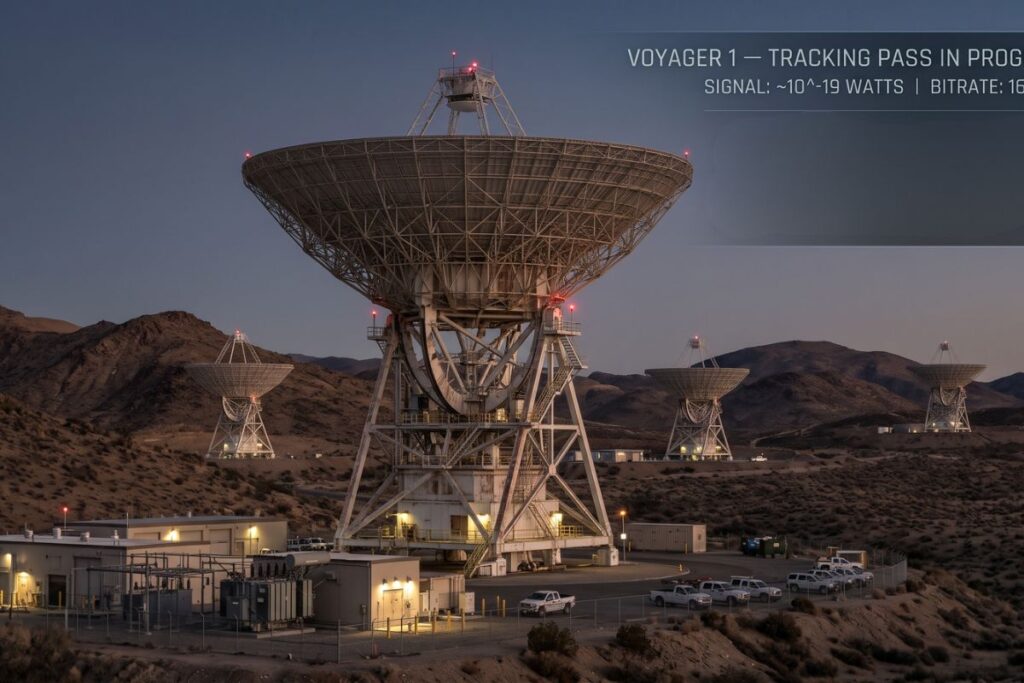
NASA hears Voyager 1 from one light-day away by pointing its largest 70-meter radio dishes, often linked with smaller 34-meter antennas, at the probe for hours at a time. Because the Voyager 1 Deep Space Network workload locks up overbooked ground stations, newer planetary and solar missions must accept lower download speeds, delayed science data, and tighter scheduling windows.
How Does NASA Receive Voyager 1’s Signal From One Light-Day Away?
NASA receives Voyager 1’s signal at 16.09 billion miles from Earth by combining the collecting power of its largest 70-meter antennas with multiple 34-meter dishes to catch a radio wave arriving at roughly 10-19 1 watt.
The Deep Space Network (DSN) is NASA’s international array of giant radio antennas, located in Goldstone, California; Madrid, Spain; and Canberra, Australia, that communicates with spacecraft beyond Earth orbit. Voyager 1 broadcasts with a 22-watt transmitter, roughly the power of a refrigerator light bulb, sending data at 160 bits per second.
Telemetry architecture documented in NASA’s Voyager Telecommunications design manual and live tracking feeds on NASA’s Deep Space Network Now show that a single 70-meter (230-foot) dish is frequently insufficient at that distance. During tracking passes, engineers rely on “arraying”, electronically linking a 70-meter antenna with two or more 34-meter dishes at the same complex to merge their signals into one stream.
Every multi-hour pass spent listening to Voyager 1 ties up that hardware. While those antennas track the 49-year-old probe, no other spacecraft in that region of sky can use them.
Which Space Missions Lose Tracking Time When Voyager 1 Talks?
Active planetary and astrophysics missions, including the Mars Reconnaissance Orbiter, Mars Perseverance rover, James Webb Space Telescope, and Psyche asteroid spacecraft, lose available antenna hours when Voyager 1 occupies a 70-meter dish.
NASA’s ground network already runs at a capacity deficit. According to an audit by the NASA Office of Inspector General (IG-23-016), demand for the Deep Space Network exceeds available antenna capacity by up to 40 percent during peak periods.
Over a five-year span reviewed by federal auditors in that report, NASA missions received between 8,500 and 15,000 fewer tracking hours than requested, restricting the volume of scientific data returned to Earth.
When Voyager 1 claims a multi-hour block on a 70-meter dish, the scheduling ripple spreads across roughly 60 active NASA and international missions. As the NASA OIG noted in its DSN revitalization summary, capacity bottlenecks have already forced missions such as Mars Odyssey and New Horizons to absorb shortfalls in requested tracking time.
Without a 70-meter pass, flight teams must compress science files, postpone playback of lower-priority instrument data, or route signals through smaller 34-meter dishes at reduced download speeds.
Why Can’t NASA Use Smaller Antennas for Voyager 1?
NASA cannot offload Voyager 1 onto standard 34-meter dishes or commercial ground stations because radio signal strength drops with the square of the distance, leaving only 70-meter apertures, or multi-dish arrays, sensitive enough to pull the probe’s carrier wave out of cosmic noise at one light-day.
Geography narrows NASA’s options even further. Voyager 1 travels north of the solar system’s orbital plane at a celestial declination of plus 12 degrees, keeping it within view of northern-hemisphere stations and placing heavy tracking demands on Goldstone’s 70-meter DSS-14 and Madrid’s 70-meter DSS-63.
Meanwhile, Voyager 2 heads south at minus 59 degrees declination. That southern trajectory leaves Canberra’s 70-meter dish, DSS-43, as the sole antenna on Earth capable of sending commands to Voyager 2, tethering all three of NASA’s largest dishes to the twin 1977 probes.
To ease the bottleneck, NASA is building six new 34-meter Beam Waveguide dishes under its Deep Space Network Aperture Enhancement Project (DAEP), a multi-year upgrade program designed to let four smaller dishes combine signals to match one 70-meter antenna. In August 2026, NASA brought its fifth new dish, Deep Space Station 23 (DSS-23), online at Goldstone, while the sixth dish, DSS-33 in Canberra, is scheduled to enter service in 2029.
How Does NASA Weigh Voyager 1’s Data Against Modern Missions?
Every week, schedulers inside NASA’s Space Communications and Navigation (SCaN) office allocate roughly 500 antenna activities across priority tiers that weigh urgent spacecraft health checks and critical maneuvers against routine science downloads, under NASA’s DSN scheduling framework.
The data-rate gap between Voyager 1 and modern spacecraft illustrates the trade-off. Based on Voyager 1’s 160-bits-per-second downlink rate, an eight-hour pass on a 70-meter dish yields roughly 4.6 megabits of data, less than one high-resolution smartphone photo, from the probe’s two remaining active sensors, its magnetometer and plasma wave instrument.
Point that same 70-meter dish at a modern planetary orbiter for eight hours, and ground stations capture tens of gigabits of science. According to JPL’s Mars Reconnaissance Orbiter Telecommunications design summary, MRO transmits at up to 6 megabits per second on a 70-meter antenna, returning roughly 37,500 times the data volume of an equivalent Voyager 1 pass.
Voyager’s defenders note that raw megabits miss the scientific value. As Voyager Project Manager Suzanne Dodd has explained in NASA’s DSN history archives, NASA expanded the 70-meter dishes from 64 meters in the 1980s specifically to support Voyager, and Voyager 1 remains the only functioning spacecraft sampling magnetic fields and plasma density inside interstellar space.
What Happens to the Deep Space Network Before Voyager 1 Goes Silent?
Before Voyager 1’s nuclear power supply runs out in the 2030s, the Voyager 1 Deep Space Network scheduling squeeze will tighten further as crewed Artemis lunar missions and commercial Moon landers enter service.
According to NASA SCaN’s DSN status briefings, agency capacity studies project total DSN demand to grow tenfold by the early 2030s, driven by Artemis flights, Commercial Lunar Payload Services (CLPS) landers, and high-rate planetary orbiters.
In June 2026, following a $4.1 million mishap on a 70-meter antenna caused by procedural and staffing strain, SCaN Deputy Associate Administrator Kevin Coggins acknowledged that operators had been stretched beyond their usual roles and pledged to rebuild core operational capacity across the network.
Voyager 1’s plutonium power supply loses roughly 4 watts each year. After executing a high-risk heater swap in September 2026 to extend instrument life, detailed in JPL’s October 2026 mission status update, engineers expect the probe to lose enough power to shut down its remaining science instruments within the next few years, before falling completely silent in the 2030s. When Voyager 1 goes dark, NASA’s scheduling office will regain hundreds of hours of 70-meter antenna time each year for waiting lunar and planetary missions.
Frequently Asked Questions
How does NASA still communicate with Voyager 1 from one light-day away?
NASA communicates with Voyager 1 at 16.09 billion miles by pointing its 70-meter dishes in Goldstone, California, and Madrid, Spain, at the probe, often electronically arrayed with two or more 34-meter antennas. This combined collecting area captures Voyager 1’s 22-watt radio signal, which arrives on Earth at roughly 10-19 watts and transmits data at 160 bits per second.
Does tracking Voyager 1 take antenna time away from newer NASA missions?
Yes, tracking Voyager 1 ties up overbooked 70-meter Deep Space Network antennas where demand already exceeds capacity by up to 40 percent during peak periods, according to the NASA Office of Inspector General. When Voyager 1 occupies a 70-meter dish for multi-hour passes, missions such as the Mars Reconnaissance Orbiter, Psyche, and New Horizons must compress data, delay playback, or use slower 34-meter antennas.
How much data does Voyager 1 send back compared to modern spacecraft?
During an eight-hour pass on a 70-meter antenna, Voyager 1 transmits roughly 4.6 megabits of data at 160 bits per second from its magnetometer and plasma wave instruments. By comparison, the Mars Reconnaissance Orbiter transmits at up to 6 megabits per second on the same 70-meter dish, returning roughly 37,500 times more data in an equal eight-hour window.
When will Voyager 1 stop using NASA’s Deep Space Network?
Voyager 1 loses about 4 watts of plutonium power each year and is projected to shut down its remaining science instruments within the next few years before falling completely silent in the 2030s. Once the spacecraft goes dark, NASA’s Space Communications and Navigation office will regain hundreds of hours of 70-meter dish capacity annually.

Praseetha K
Praseetha K is the Managing Editor of Clarity Times. She edits, verifies and publishes the newsroom's articles, and also writes analysis on policy, law, business and technology. Articles she writes are edited by the Editor-in-Chief before publication.