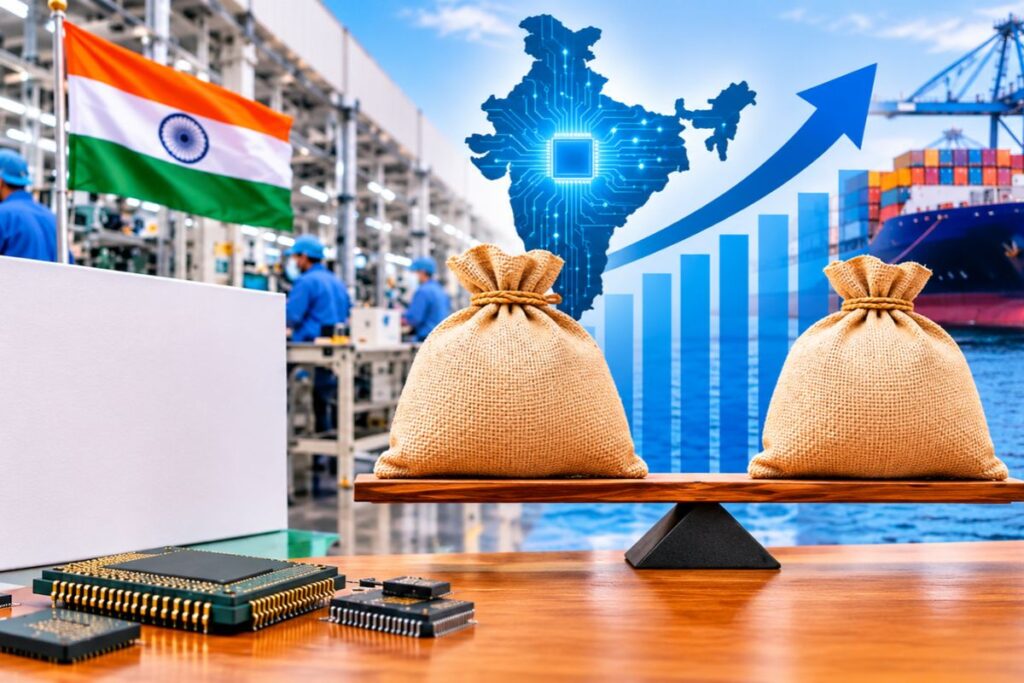
India’s Production-Linked Incentive (PLI) schemes have disbursed ₹35,354 crore across 14 sectors through March 2026 against ₹15.2 lakh crore in cumulative exports, yet NITI Aayog’s November 2026 mid-course evaluation reveals wide disparities in India’s PLI scheme tech exports, with telecom absorbing ₹2,756 crore, medical devices ₹267 crore, and IT hardware just ₹98 crore, while large corporations captured the bulk of payouts.
How Much Taxpayer Money Has India Spent Across Tech PLI Schemes?
According to a November 2026 mid-course evaluation by NITI Aayog and the Indian Institute of Management Ahmedabad (IIM Ahmedabad), the government disbursed ₹35,354 crore across 14 PLI sectors through March 2026, or 18.51% of the ₹1,91,049 crore total outlay, against ₹15.2 lakh crore in cumulative exports.
The Production-Linked Incentive (PLI) scheme is a federal industrial subsidy program that reimburses approved manufacturers a fixed percentage of incremental sales over a pre-subsidy base year. Across the entire program, cumulative production reached ₹22,66,412 crore through March 2026.
Within technology hardware, however, PLI scheme disbursements in India diverge sharply across ministries:
- Large Scale Electronics Manufacturing (LSEM) and IT Hardware: According to Business Today’s analysis of the NITI Aayog evaluation, electronics manufacturing, driven by mobile phone assembly, absorbed ₹19,091 crore, or 56% of its allocated budget. By contrast, IT Hardware 2.0 received ₹98 crore, representing 0.57% of its ₹17,000 crore outlay.
- Telecom and Networking Products: NITI Aayog’s assessment records ₹2,756 crore in cumulative disbursements through March 2026, even as telecom exports expanded at a 1.5% average annual growth rate between FY21 and FY25.
- Medical Devices: According to NITI Aayog and NIIR Project Consultancy Services data, the Department of Pharmaceuticals disbursed ₹267 crore against a ₹3,420 crore outlay alongside ₹5,869.36 crore in PLI-linked medical device exports, working out to roughly ₹0.045 (about 4.5 paise) in subsidy per rupee of PLI-tracked exports.
Four sectors, electronics, pharmaceuticals, telecom equipment, and food processing, together accounted for ₹31,220 crore, or 88% of all PLI cash disbursed nationwide.
Which Companies Captured the Largest PLI Scheme Payouts?
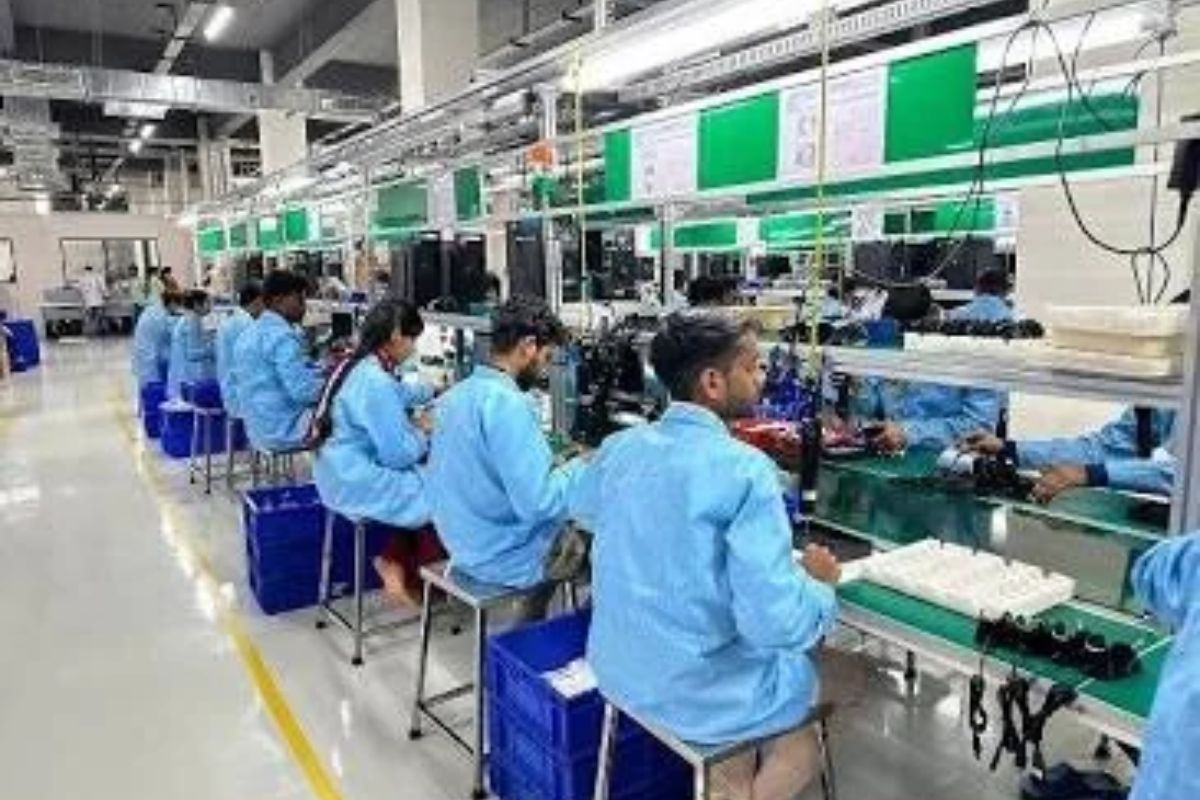
According to NITI Aayog’s November 2026 sector review and audited corporate filings, large corporations generated 61% of total PLI production and captured the majority of cash disbursements, while micro, small, and medium enterprises (MSMEs) faced steep capital and revenue eligibility thresholds.
In telecom hardware, Tejas Networks’ FY25 Annual Report records ₹312 crore in cumulative PLI incentives, comprising ₹123 crore for FY24 and ₹189 crore for H1 FY25, as net revenues rose 261% to ₹8,923 crore on domestic 4G and 5G radio deployments. In its FY26 Annual Report, Tejas Networks reported consolidated net revenues falling to ₹1,103 crore and a net loss of ₹909 crore as domestic telecom order execution slowed.
In electronics assembly, Dixon Technologies’ FY26 Integrated Annual Report shows consolidated revenues climbing from ₹38,880 crore in FY25 to ₹48,873 crore in FY26, with mobile phones generating 91% of its revenue mix through its PLI-enrolled subsidiary Padget Electronics. In medical devices, Poly Medicure’s FY26 management disclosures show standalone revenues rising 12.3% to ₹1,875.26 crore, with domestic sales growing 19.6% and international exports growing 9.3%, while NITI Aayog noted that the medical devices scheme introduced a lower-threshold “Category B” mid-stream after steep entry rules initially locked out smaller producers.
Why Do Headline Export Milestones Obscure Fiscal Return on Capital?
Headline PLI export figures obscure fiscal return on capital because reporting ₹15.2 lakh crore in cumulative exports without tracking taxpayer cost per incremental export dollar treats assembly of imported parts identically to domestic component manufacturing.
Official releases from the Press Information Bureau routinely highlight aggregate PLI milestones: ₹2.40 lakh crore in committed investment, ₹22.66 lakh crore in production, and ₹15.2 lakh crore in cumulative exports.
Those gross numbers do not isolate how much public money bought each additional dollar of foreign sales above a pre-subsidy baseline. In its November 2026 Impact Assessment of PLI Schemes, NITI Aayog reported that electronics growth remains concentrated in final assembly of imported displays, batteries, and circuit boards, while electronic component production under PLI peaked around 2022 and subsequently declined.
Examining scheme-level evaluations exposes where execution fell short of headline numbers.
Why Did IT Hardware 1.0 Stall While Telecom Export Growth Lagged?
According to NITI Aayog and IIM Ahmedabad, IT Hardware 1.0 stalled because low 2% average incentive rates and strict localization rules deterred global PC makers, while Telecom PLI recorded a 1.5% annual export growth rate between FY21 and FY25 as firms focused on domestic network rollouts.
In IT Hardware 1.0, the original subsidy program for laptops, tablets, and servers, with incentive rates of 1% to 4% (averaging 2%) failed to offset component import disadvantages, prompting the government to relaunch the program as IT Hardware 2.0 with a ₹17,000 crore outlay and 5% average incentives. Even after the relaunch, Hindustan Times reported that NITI Aayog flagged lost implementation time, falling production in FY26, and missing import data, noting that the Ministry of Electronics and Information Technology’s view of production as “market-driven” made it difficult to isolate how much output resulted from the subsidy.
Telecom and Networking Products PLI followed a domestic-first trajectory. Despite attracting ₹5,278 crore in investment, telecom exports grew at 1.5% annually between FY21 and FY25, even as telecom imports fell at an 18.5% annual rate due to domestic 4G and 5G network deployments. Separately, Telecom Regulatory Authority of India (TRAI) annual report disclosures note that financial compliance and incentive disbursements under the telecom PLI remain subject to inspection and Comptroller and Auditor General of India (CAG) audit reviews.
Defending the policy structure, NITI Aayog’s November 2026 release stated that PLI payouts are strictly outcome-based, released only after companies verify incremental investment and sales thresholds, and noted that across 14 sectors the program mobilized ₹2.40 lakh crore in capital expenditure and 8.49 lakh jobs.
Yet those investment figures raise a direct financial question as early PLI disbursement windows reach their statutory end dates.
What Happens to India PLI Scheme Tech Exports When Subsidies Expire?
When five-to-six-year PLI sunset clauses expire, starting with the original mobile phone PLI on March 31, 2026, low-margin electronics assemblers face sharp operating margin pressure unless local component sourcing lowers input costs.
All 14 PLI schemes operate with statutory sunset clauses, fixed expiration dates after which cash payouts terminate, to prevent permanent corporate reliance on state subsidies. The expiration of the original mobile phone PLI in March 2026 prompted the Union Cabinet in July 2026 to approve a ₹62,500 crore successor Mobile Phone Manufacturing Scheme through FY31 alongside the ₹40,000 crore Electronics Component Manufacturing Scheme (ECMS).
For non-smartphone tech manufacturers, closing subsidy windows directly tests unit economics. In electronics assembly, operating profit margins, measured by EBITDA (earnings before interest, taxes, depreciation, and amortization), typically run in the single digits, making a 4% to 6% PLI payout a primary driver of net profit. By contrast, higher-margin medical device producers such as Poly Medicure, which posted a 24.4% consolidated operating EBITDA margin in FY26 before other income, depend far less on direct PLI payouts to sustain export margins.
According to NITI Aayog’s evaluation, 58% of total PLI scheme-months had already elapsed by March 2026 while employment generation stood at 28% of full-tenure targets (8.49 lakh jobs against a 30.19 lakh target), leaving a narrow window to prove that non-smartphone export lines can compete against Vietnam and Mexico without ongoing taxpayer grants.
Frequently Asked Questions
How much taxpayer money has India disbursed under the PLI scheme through March 2026?
According to NITI Aayog’s November 2026 mid-course evaluation, the Indian government disbursed ₹35,354 crore across 14 PLI sectors through March 2026, or 18.51% of the ₹1,91,049 crore total budget, against ₹15.2 lakh crore in cumulative exports.
Which tech sectors received the most and least PLI funding?
Electronics manufacturing (dominated by mobile phone assembly) received ₹19,091 crore, telecom and networking products received ₹2,756 crore, medical devices received ₹267 crore, and IT Hardware 2.0 received ₹98 crore through March 2026.
Which companies captured the largest share of PLI payouts and production?
NITI Aayog reported that large corporations generated 61% of total PLI production and captured the bulk of payouts due to steep capital and revenue thresholds. In telecom, Tejas Networks booked ₹312 crore in cumulative PLI incentives across FY24 and H1 FY25, while in mobile assembly Dixon Technologies grew revenues to ₹48,873 crore in FY26 through its PLI-enrolled subsidiary Padget Electronics.
Why did IT Hardware 1.0 and Telecom PLI struggle to grow exports?
IT Hardware 1.0 stalled because low 2% average incentives and strict localization mandates deterred PC manufacturers, forcing a relaunch as IT Hardware 2.0, which still lost implementation time and saw falling production in FY26. Telecom PLI recorded a 1.5% average annual export growth rate between FY21 and FY25 because manufacturers focused primarily on domestic 4G and 5G network rollouts.

Praseetha K
Praseetha K is the Managing Editor of Clarity Times. She edits, verifies and publishes the newsroom's articles, and also writes analysis on policy, law, business and technology. Articles she writes are edited by the Editor-in-Chief before publication.