
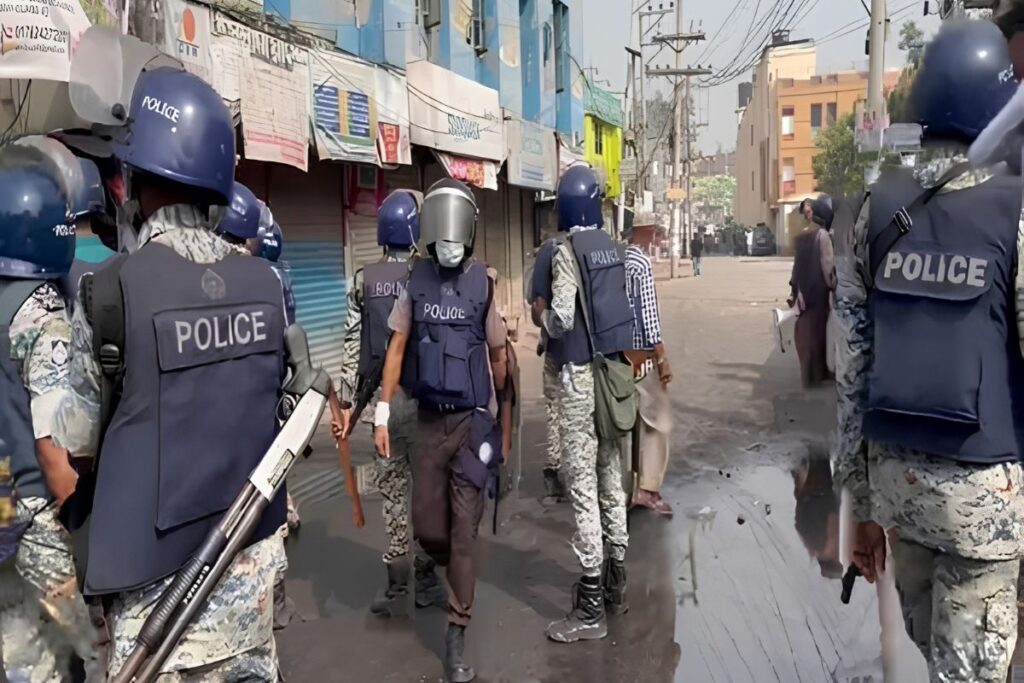
Bangladesh arson arrests 2026 are overwhelmingly targeting opposition-linked suspects while leaving retaliatory burnings of Awami League properties largely uncharged. Police First Information Reports (FIRs) and lower-court remand filings across Dhaka, Chattogram, and Gopalganj rely heavily on open-ended “unnamed accused” clauses under non-bailable sabotage laws, detaining suspects before individualized forensic or video evidence is presented.
According to Bangladesh police charging records and lower-court remand dockets from Dhaka, Chattogram, and Gopalganj, officers are booking hundreds of unnamed Awami League suspects under non-bailable sabotage statutes while opening few active prosecutions for burned Awami League homes and offices.
Who Is Actually Being Named in Bangladesh Police FIRs?
Bangladesh police FIRs from November 2026 name a small roster of local Awami League figures alongside hundreds of unidentified accused, whereas burnings of Awami League leaders’ homes have produced few immediate arrests. In a single 24-hour Dhaka sweep ahead of the November 19 shutdown, Dhaka Metropolitan Police (DMP) detained at least 71 Awami League, Chhatra League, and Jubo League activists, while Bangladesh Police Headquarters logged 63 arrests across 38 registered cases nationwide and Chattogram Range Police recorded 839 arrests in a 24-hour sweep.
In those registered First Information Reports (FIRs), the formal written police complaints that initiate a criminal investigation under Bangladeshi law, investigators pair named party members with open-ended lists of ogyatonama (“unnamed miscreants”). In Gopalganj district, police filed an Anti-Terrorism Act case over November 10 strike violence that named 153 Awami League leaders and activists alongside 300 to 400 unidentified accused, allowing officers to attach detainees from later sweeps to an existing docket.
By contrast, when properties belonging to former Awami League ministers burned during the same week, rapid arrests did not follow. On the night of November 18, within 30 minutes of each other, unidentified attackers torched the Chandpur residences of former Education Minister Dipu Moni and Awami League Organizing Secretary Sujit Roy Nandy, while separate fires hit former minister SM Rezaul Karim’s home in Pirojpur; Chandpur and Pirojpur police confirmed visiting the scenes without announcing immediate arrests or named suspect rosters.
How Do the Special Powers Act and Anti-Terrorism Act Block Pre-Trial Bail?
Invoking the Special Powers Act 1974 and the Anti-Terrorism Act 2009 shifts arson cases toward special tribunals and removes lower-court magistrates’ routine authority to grant bail at initial hearings. Rather than charging detainees solely under standard Bangladesh Penal Code arson sections, police forwarding reports routinely attach non-bailable sabotage provisions from both special statutes.
In Netrokona district, police confirmed that 13 Awami League leaders and activists arrested across six upazilas were booked under both the Anti-Terrorism Act and the Special Powers Act. Under the Special Powers Act 1974, a preventive detention and sabotage law enacted after Bangladesh’s independence, and the Anti-Terrorism Act 2009, a counterterrorism statute carrying strict bail restrictions, suspects remain in custody while investigators seek multi-day police remand.
Even after 2026 amendments to Bangladesh’s Code of Criminal Procedure (Act No. 11 of 2026) introduced arrest safeguards and capped police remand at 15 days, detainees face immediate custodial remand before forensic labs examine debris or verify digital records. Following the November 19 detention of former Education Minister Nurul Islam Nahid at his Dhaka residence and an earlier Dhaka Chief Metropolitan Magistrate (CMM) Court hearing over a Gulshan flash procession, a magistrate placed 25 alleged Awami League activists on 10-day remand each at initial production.
Why Is There a Retaliation Blind Spot When Both Sides’ Properties Burn?
While government ministers have pledged evidence-based prosecutions across party lines, police sweeps have concentrated on banned Awami League networks rather than suspected retaliatory arson against Awami League homes. The November 2026 unrest began after exiled former Prime Minister Sheikh Hasina announced plans to return from India in December 2026 and her banned Awami League called a shutdown marking the anniversary of her in-absentia death sentence, triggering fires across 28 districts at state buildings, over 35 Grameen Bank branches, and ruling-party sites alongside Awami League properties.
In districts where both sides suffered arson, including Gopalganj’s Tungipara, where attackers burned Tungipara Police Station and the home of Bangladesh Nationalist Party (BNP) lawmaker SM Zilany on November 17, and Chattogram, where arsonists set fire to an abandoned ground-floor room at former Chief Adviser Muhammad Yunus’s ancestral home, Home Minister Salahuddin Ahmed pledged to prosecute perpetrators using audio and video evidence, while Prime Minister Tarique Rahman urged BNP workers in parliament to remain active against sabotage.
Law enforcement officials argue that preventative sweeps under sabotage laws are warranted because the Awami League is a legally banned organization whose shutdown call led to civilian deaths, including a sleeping bus helper in Pirojpur, and attacks on Key Point Installations (KPIs), which are designated critical state facilities such as police stations. Human rights monitors counter that open-ended detentions repeat earlier patterns of one-sided policing; in August 2026, Human Rights Watch urged the Bangladeshi government to end indefinite pretrial detention of political opponents, documenting hundreds of Awami League members held in jail without formal trial proceedings.
What Happens to Bangladesh Arson Arrests 2026 After Mass Sweeps?
Most unnamed-accused sabotage cases in Bangladesh result in pre-trial detention rather than courtroom convictions because courts face massive case backlogs and lack individualized forensic evidence. By mid-2025, Bangladesh’s judicial backlog exceeded 4.65 million pending cases, including nearly 4 million cases stalled in lower courts, leaving special tribunals and magistrate courts heavily congested.
In Bangladesh’s criminal justice pipeline, sabotage FIRs built on hundreds of unidentified accused and custodial interrogation summaries rarely survive trial scrutiny once political tensions subside. Prosecutors face high acquittal rates and multi-year delays, meaning the immediate legal outcome of an unnamed-accused Special Powers Act filing is pre-trial custody rather than a final verdict.
Frequently Asked Questions
Who is being arrested in Bangladesh’s November 2026 arson crackdown?
Police charging records from November 2026 show that arrests have overwhelmingly targeted Awami League, Chhatra League, and Jubo League members, including 71 detained in a 24-hour Dhaka Metropolitan Police sweep and 839 in a Chattogram Range Police drive. By contrast, police have reported no immediate arrests following the November 18 arson attacks on the Chandpur homes of former Awami League ministers Dipu Moni and Sujit Roy Nandy.
How do police use “unnamed accused” clauses in Bangladesh FIRs?
In Bangladesh, police frequently register First Information Reports (FIRs) naming a core group of local opposition figures alongside hundreds of ogyatonama (“unnamed miscreants”), such as a Gopalganj Anti-Terrorism Act case naming 153 people and 300 to 400 unidentified suspects. That open-ended roster allows officers to arrest individuals during night sweeps and attach them to an existing arson docket before matching CCTV or forensic evidence.
Why is it difficult for detainees to get bail under the Special Powers Act and Anti-Terrorism Act?
Booking arson suspects under the Special Powers Act 1974 and Anti-Terrorism Act 2009 shifts jurisdiction toward special tribunals and strips lower-court magistrates of routine bail authority at initial hearings. Despite 2026 Code of Criminal Procedure amendments capping police remand at 15 days, magistrates continue granting immediate custodial remand, such as 10-day remands ordered for 25 detainees in a Dhaka Gulshan case.
Do mass sabotage arrests in Bangladesh usually lead to convictions?
No, historically, sabotage cases built on unnamed-accused rosters and custodial statements face high acquittal rates and multi-year delays in Bangladesh’s congested courts, where total pending cases surpassed 4.65 million by mid-2025. As a result, these filings primarily function as short-term pre-trial detention rather than producing trial convictions.

Praseetha K
Praseetha K is the Managing Editor of Clarity Times. She edits, verifies and publishes the newsroom's articles, and also writes analysis on policy, law, business and technology. Articles she writes are edited by the Editor-in-Chief before publication.