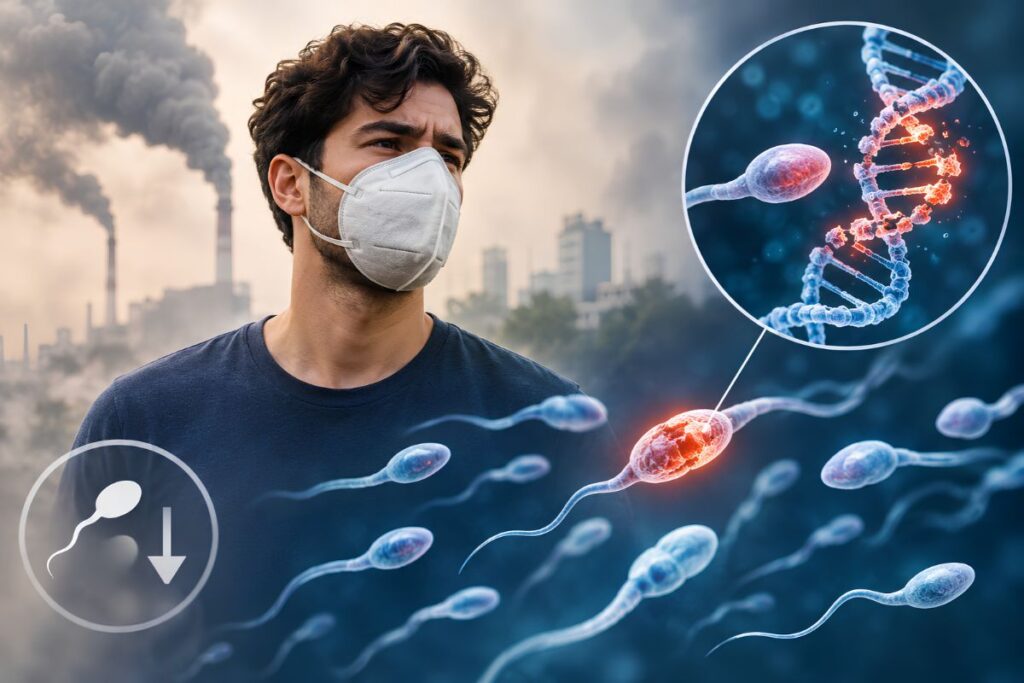
Sperm DNA fragmentation and poor motility can persist despite clean eating, regular exercise, and abstaining from tobacco because involuntary environmental exposures bypass individual wellness habits. Fine particulate air pollution, plasticizers called phthalates, and microplastics enter the body through breathing and food packaging, triggering oxidative stress that damages sperm DNA even in otherwise healthy men.
Why do fit, non-smoking men still have high sperm DNA fragmentation?
Physically active, non-smoking men frequently pass standard semen counts while failing specialized genetic integrity tests due to environmental oxidative stress. According to a comparative clinical study in the Journal of Clinical and Diagnostic Research, 32.3 percent of male partners from infertile couples with normal baseline sperm counts still recorded clinically elevated DNA damage.
Doctors at Indian fertility and research hospitals encounter this pattern regularly among younger urban patients. Men in their late twenties and early thirties who maintain normal body weights and avoid tobacco and alcohol still arrive at clinics with impaired reproductive potential.
A standard semen analysis measures basic ejaculate volume, total sperm count, and movement, often classifying these men as normozoospermic, meaning their baseline counts fall within normal clinical ranges. Yet when clinicians run a Sperm DNA Fragmentation Index (DFI) test, which measures the percentage of sperm carrying structural breaks in their genetic material, results frequently exceed the 25 percent clinical threshold.
Separate research led by reproductive geneticists at the All India Institute of Medical Sciences (AIIMS), published in the Indian Journal of Medical Research, documented mean seminal reactive oxygen species levels nearly nine times higher in male partners of couples experiencing unexplained recurrent pregnancy loss than in fertile controls: 55,096.4 relative light units per minute per 20 million sperm compared with 5,924.8.
This clinical disconnect challenges the standard advice issued every November around International Men’s Day. Most seasonal health coverage treats declining male fertility as a consequence of desk jobs, late nights, processed food, and smoking, implying that better personal discipline can reliably restore reproductive health.
What seasonal coverage blames, and what basic tests miss
Mainstream health reporting focuses on modifiable habits because their biological effects are well established. Obesity, heavy alcohol use, and tobacco consumption generate reactive oxygen species, unstable oxygen-containing molecules that damage cellular structures and DNA, while prolonged sitting raises scrotal temperatures and slows sperm production.
Preventive medicine specialists maintain that addressing these factors remains essential. Eliminating smoking or reducing excess body fat removes major metabolic stressors and can produce measurable improvements in basic semen parameters within three to six months.
However, a standard semen analysis measures only outward physical traits: how many sperm are present, how fast they swim, and whether their shapes appear normal under a microscope. It does not detect subcellular genetic breaks caused by chemical exposures, leaving men with clean medical histories without an explanation for delayed conception or recurrent early pregnancy loss.
How does air pollution damage sperm during the 90-day development cycle?
Fine particulate air pollution (PM2.5) crosses the blood-testis barrier and impairs sperm motility throughout the 70-to-90-day spermatogenesis cycle, the biological process by which stem cells mature into sperm. According to a large cohort study of fertile men published in Environmental Health, higher 90-day average PM2.5 exposure is associated with a 2.21 percent drop in total sperm motility.
Airborne pollutants represent one of the hardest exposures for urban residents to avoid. Because human spermatogenesis takes roughly three months, city residents face a continuous 90-day window of vulnerability before ejaculation.
Monthly ambient air quality tracking by the Centre for Research on Energy and Clean Air (CREA) shows that in October 2026, 261 of 267 monitored Indian cities exceeded the World Health Organization (WHO) 24-hour guideline for PM2.5 of 15 micrograms per cubic meter. Among India’s five largest megacities, Delhi recorded a monthly average of 69 micrograms per cubic meter and breached India’s looser national daily limit of 60 micrograms per cubic meter on 21 out of 31 days, while Mumbai averaged 46 micrograms per cubic meter and Kolkata 45 micrograms per cubic meter.
A broader systematic meta-analysis in Frontiers in Public Health confirmed that PM2.5 exposure during both the 10-to-14-day motility-development stage and the full 90-day cycle reduces total sperm count and progressive movement.
Reproductive toxicology reviews note that PM2.5 particles act as carriers for heavy metals such as lead and cadmium. Once inhaled into the bloodstream, these microscopic particles cross the blood-testis barrier, the protective cellular wall that normally shields developing germ cells, inducing localized oxidative stress and DNA strand breaks regardless of whether a man exercises indoors or eats a balanced diet.
How do phthalates and microplastics enter human testicular tissue?
Dietary and dermal contact with plastic packaging introduces phthalates and solid microplastics that accumulate inside human testicular tissue and degrade sperm motility. According to a study in Toxicological Sciences, researchers detected microplastics in all 23 human testis samples analyzed at a mean concentration of 328.44 micrograms per gram of tissue, nearly three times the 122.63 micrograms per gram found in canine testes.
Whole foods, dairy products, and drinking water routinely come into contact with synthetic polymers during processing, transport, and retail storage. Even men following strict whole-food diets ingest plasticizers through standard retail packaging.
A March 2026 systematic review by researchers at Kasturba Medical College in Manipal, published in Reproductive Biology and Endocrinology, synthesized findings across 38 studies examining phthalates, chemical plasticizers used to make plastics flexible and found in food packaging, personal care items, and thermal billing receipts. The review concluded that elevated urinary metabolites of phthalates such as di(2-ethylhexyl) phthalate (DEHP) and dibutyl phthalate (DBP) are consistently associated with reduced sperm concentration, abnormal morphology, and lower motility, driven by endocrine disruption and oxidative stress in testicular Leydig cells, the cells responsible for producing testosterone.
In the Toxicological Sciences tissue analysis, polyethylene (PE) and polyvinyl chloride (PVC) ranked among the dominant polymers found inside human testes. Separately, a 113-patient study published in eBioMedicine examining mixed microplastic exposure in semen and urine found a dose-response relationship between higher polymer loads and reduced sperm quality.
Toxicologists note an important methodological caveat: human tissue and cohort studies demonstrate strong statistical associations rather than single-factor causation, because free-living individuals encounter complex mixtures of airborne particulates, plasticizers, and dietary chemicals simultaneously.
Can antioxidant supplements reverse pollution-induced sperm damage?
Oral antioxidant supplements show very low clinical certainty for improving live birth rates and cannot fully counteract continuous daily exposure to airborne particulates and plasticizers. According to a systematic review by the Cochrane Library, excluding studies with a high risk of bias leaves no statistically significant evidence that oral antioxidants increase live birth rates in subfertile men.
When men with unexplained sperm DNA fragmentation seek treatment, clinics frequently prescribe high-dose oral supplements, such as vitamin C, vitamin E, zinc, or coenzyme Q10, to neutralize oxidative stress. The Cochrane review evaluated 12 small-to-medium randomized controlled trials and concluded that the overall certainty of evidence supporting live birth improvements remains very low.
Regulatory benchmarks show that packaging standards also lag behind updated toxicological thresholds. While the Food Safety and Standards Authority of India (FSSAI) amended its packaging regulations to cap specific migration of DEHP from food-contact plastics at 1.5 milligrams per kilogram, the European Union tightened its corresponding limit under Regulation (EU) 2023/1442 to 0.6 milligrams per kilogram, more than twice as strict.
For men planning fatherhood, the gap between clinical advice and environmental reality has practical consequences. Individual habits still control baseline metabolic health, but reducing exposure to high-pollution air and heated plastic food containers addresses risks that gym routines cannot reach, and leaves unresolved the broader regulatory question of how urban air quality and packaging standards shape reproductive health before a patient ever enters a clinic.
Frequently Asked Questions
Can a man have a normal sperm count and still have high sperm DNA fragmentation?
Yes. According to clinical research in the Journal of Clinical and Diagnostic Research, 32.3 percent of male partners from infertile couples with normal baseline sperm counts still recorded clinically elevated DNA fragmentation above 25 percent. Standard semen analyses measure sperm count, movement, and shape, but cannot detect structural DNA breaks inside the sperm head.
How long does air pollution affect sperm quality?
Air pollution affects sperm development across a 70-to-90-day window, which is the full time required for stem cells to mature into sperm. Cohort data published in Environmental Health show that higher 90-day average PM2.5 exposure reduces total sperm motility by 2.21 percent, with additional vulnerability during the 10-to-14-day motility-development stage.
Do over-the-counter fertility antioxidants fix DNA fragmentation caused by pollutants?
Clinical evidence does not confirm that oral supplements overcome ongoing environmental exposure. A Cochrane Library systematic review of 12 randomized controlled trials found very low certainty of evidence that oral antioxidants improve live birth rates, and no statistically significant benefit once studies with a high risk of bias were excluded.
How do microplastics and phthalates enter the male reproductive system?
Men ingest phthalates and microplastics primarily through food packaging, bottled water, dairy processing, and dermal contact with items like thermal receipts. A Toxicological Sciences study detected polyethylene and polyvinyl chloride microplastics in all 23 human testis samples tested at a mean concentration of 328.44 micrograms per gram, while a 2026 Kasturba Medical College review linked urinary phthalate metabolites to Leydig cell disruption and lower sperm motility.

Praseetha K
Praseetha K is the Managing Editor of Clarity Times. She edits, verifies and publishes the newsroom's articles, and also writes analysis on policy, law, business and technology. Articles she writes are edited by the Editor-in-Chief before publication.