Yes. Companion dogs routinely acquire multidrug-resistant bacteria, including Escherichia coli and Enterococcus, through raw-meat diets, antibiotic treatments, and household contact. Whole-genome sequencing of cohabiting owners and pets shows they frequently carry genetically matching resistant strains that transfer back and forth through daily routines like handling waste, feeding, and close indoor contact.
Do owners and dogs share identical antibiotic-resistant bacteria?
Genomic surveillance confirms that cohabiting owners and dogs frequently carry virtually identical multidrug-resistant gut bacteria, proving shared household carriage rather than coincidental outdoor exposure.
Mainstream pet coverage frames microbial sharing between humans and dogs as a benign quirk of bonding. When public health researchers use whole-genome sequencing, a laboratory method that maps an organism’s entire DNA code, to compare gut bacteria from matched owner-dog pairs, they find matching resistance profiles across both species.
In a One Health study presented at the European Society of Clinical Microbiology and Infectious Diseases (ESCMID) Global Congress, researchers analyzing households in Portugal and the United Kingdom documented genetically matching strains of extended-spectrum beta-lactamase (ESBL)-producing Enterobacterales, bacteria resistant to multiple frontline antibiotics, inside both pets and their cohabiting owners. Complementary whole-genome comparative research using a strict five single-nucleotide polymorphism (SNP) genetic threshold, meaning the bacterial DNA sequences differ by fewer than five single-letter mutations, confirmed cross-species E. coli co-occurrence inside the same home.
These bacteria carry resistance genes on plasmids: small, circular pieces of DNA that transfer between different bacterial species inside the canine gut microbiome. Because the strains match down to tiny genetic markers, epidemiologists classify the pattern as shared household carriage.
“Our findings underline the importance of including pet-owning households in national programmes that monitor levels of antibiotic resistance,” lead researcher Dr. Juliana Menezes of the University of Lisbon noted in an ESCMID briefing on the household transmission data.
How do raw-meat diets load the canine gut with resistance genes?
Dogs fed raw-meat-based diets carry and shed substantially higher rates of multidrug-resistant E. coli than dogs fed conventional heat-processed kibble.
Pet-wellness media frequently promotes uncooked diets as a way to boost a dog’s gut diversity. Comparative stool sequencing reveals a competing reality: in a University of Liverpool study published in Frontiers in Microbiology analyzing 432 canine fecal samples, antibiotic-resistant E. coli was isolated from 39.4% (76 of 193) of raw-fed dogs compared with 13.8% (33 of 239) of dogs fed non-raw diets. In that same cohort, 17% of raw-fed dogs shed multidrug-resistant ESBL-producing E. coli, versus 1% of conventionally fed dogs.
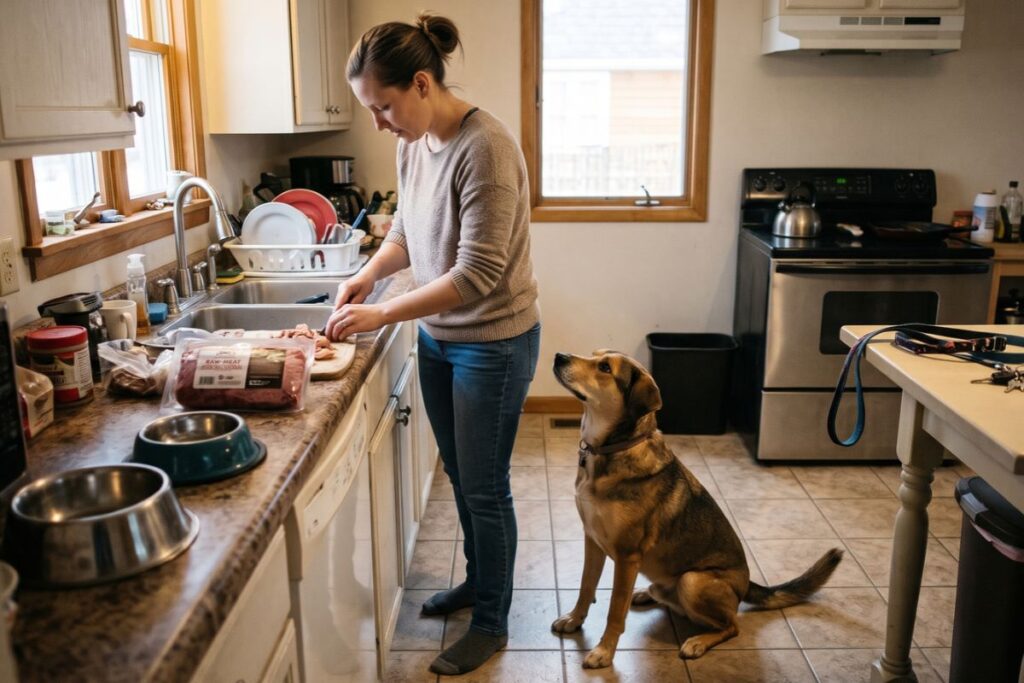
Uncooked poultry and livestock tissues often harbor bacteria producing extended-spectrum beta-lactamases (ESBLs), enzymes that disable common frontline antibiotics like penicillins and cephalosporins, as well as genes resisting colistin, a last-resort antibiotic in human medicine. Separate University of Bristol surveillance across 600 healthy pet dogs confirmed that raw feeding was the strongest risk factor for excreting E. coli resistant to ciprofloxacin, a critically important fluoroquinolone antibiotic. Regulatory sampling by the U.S. Food and Drug Administration’s Veterinary Laboratory Investigation and Response Network (Vet-LIRN) has also repeatedly flagged commercial raw pet-food products for bacterial contamination.
“Our research adds to the increasing evidence that not feeding raw meat to dogs may help in that objective,” University of Bristol molecular biology professor Matthew Avison said in a university research summary addressing how to curb the circulation of resistant E. coli.
Commercial raw-food manufacturers and holistic veterinarians note that high-pressure processing (HPP), a cold-pasteurization method that subjects sealed packages to extreme water pressure, reduces bacterial counts compared with untreated raw meat, and clinical illness in healthy adult owners remains statistically uncommon relative to total pet-owning households. A 2024 study in the Journal of Food Protection demonstrated that combining HPP with lactic acid fermentate achieved a 5-log (99.999%) reduction in Salmonella, Shiga toxin-producing E. coli, and Listeria monocytogenes in raw poultry pet food, though food-safety researchers note HPP efficacy varies by meat fat content and recipe formulation.
How do veterinary prescriptions and indoor habits spread resistant bacteria?
Empirical broad-spectrum antibiotic prescribing selects for resistant gut strains in dogs, while inconsistent handwashing after handling pets or food bowls moves those bacteria to human family members.
Dogs and humans share a basic microbiome overlap simply by living under the same roof. When either species takes a broad-spectrum antibiotic, the drug wipes out susceptible gut bacteria and allows resistant strains to multiply unchecked. According to a point-prevalence survey published in the Journal of the American Veterinary Medical Association covering 2,599 dogs and cats across 52 U.S. practices, 29.2% of animals received an antibiotic prescription, including third-generation cephalosporins (12.5% of systemic prescriptions), yet only 13.4% of animals treated for suspected infections underwent bacterial culture-and-susceptibility testing. In the United Kingdom, the 2025 Veterinary Antibiotic Resistance and Sales Surveillance (UK-VARSS) report recorded 195 tonnes of veterinary antibiotics sold across livestock and companion animals, including 0.83 tonnes of highest-priority critically important antibiotics.
General-practice veterinarians point out that empirical broad-spectrum prescribing, treating an infection before confirming the exact bacterial species, often happens because pet owners decline or cannot afford laboratory culture-and-sensitivity tests. In a veterinary antimicrobial prescribing survey indexed on PubMed, 24% of responding clinicians reported not ordering culture-and-sensitivity testing in practice, explicitly citing diagnostic cost to clients as a primary barrier.
Once resistant bacteria dominate a dog’s gut, everyday household habits determine whether those microbes cross species lines. In a Kansas State University behavioral and microbiological study examining fecal DNA fingerprints from dog-owner pairs, 10% of pairs shared identical E. coli strains. Researchers found no statistically significant increase in shared E. coli from bed-sharing or face-licking alone; instead, carriage of antibiotic-resistant E. coli was significantly linked to owners who did not wash their hands after petting their dogs or before preparing meals.
“We should use common sense and practice good general hygiene,” lead investigator Dr. Kate Stenske KuKanich of Kansas State University’s College of Veterinary Medicine stated in the study briefing. “We also need to make sure we are washing our hands often.”
Why does asymptomatic carriage hide the risk for months?
Healthy dogs carry and shed antibiotic-resistant gut bacteria in their stool for weeks or months without showing symptoms, creating a silent reservoir that can trigger difficult-to-treat human infections later.
Commensal bacteria, microbes that live peacefully in the digestive tract without causing immediate disease, can hold onto resistance plasmids while a dog appears healthy. In a longitudinal cohort study published in Antimicrobial Agents and Chemotherapy tracking 38 household dogs over six months, 84% (32 of 38) shed ESBL-producing E. coli in at least one stool sample without showing clinical illness, with nine dogs testing continuously positive across consecutive monthly and weekly checks.
The clinical risk surfaces when resistant E. coli from a shared household reservoir migrates to the human urinary tract or enters a surgical wound. One Health investigations have documented household clusters where identical multidrug-resistant E. coli strains, such as the pandemic ST131 lineage, circulated simultaneously in intestinal samples from human family members and the household dog alongside recurrent urinary tract infections, as detailed in clinical surveillance published via PubMed Central and European uropathogenic E. coli genotyping.
“Once a person swallows some E. coli, these bacteria can sit in their intestines for years before causing an infection,” University of Bristol’s Matthew Avison explained in the Bristol One Health briefing. “There are hundreds of thousands of urinary tract infections caused by E. coli in the UK every year, as well as thousands of bloodstream infections which frequently lead to life-threatening sepsis.”
How can dog owners contain resistant bacteria without giving up their pet?
Replacing uncooked meat diets with heat-processed food, requesting diagnostic bacterial cultures before antibiotic prescriptions, and washing hands after handling pet waste or bowls cut household transmission without relying on unproven probiotics.
Many owners reach for over-the-counter probiotics to restore gut balance after antibiotic treatment. However, peer-reviewed research published in Cell demonstrated that taking standard multi-strain probiotics immediately after antibiotics impaired and delayed the gut’s natural microbial reconstitution compared with spontaneous recovery, while reviews by the International Scientific Association for Probiotics and Prebiotics (ISAPP) confirm that routine probiotic supplementation lacks strong clinical evidence for restoring baseline microbiome diversity.
Veterinary stewardship bodies and public health agencies recommend three targeted adjustments to interrupt household transmission:
- Cook meat diets or choose heat-processed food: The U.S. Centers for Disease Control and Prevention (CDC) Healthy Pets guidance explicitly advises against feeding raw meat or raw treats to dogs, particularly in households with children under age five, adults 65 and older, pregnant women, or immunocompromised family members.
- Request diagnostic cultures before antibiotics: Under American Veterinary Medical Association (AVMA) antimicrobial stewardship guidelines, asking a veterinarian for a culture-and-sensitivity test during recurring skin, ear, or urinary infections, and using watchful waiting or topical antiseptics when appropriate, curbs unnecessary broad-spectrum drug exposure.
- Enforce kitchen and waste handwashing: Following CDC pet-food safety protocols, washing hands with soap and water immediately after picking up dog waste, handling pet food bowls, or petting animals before cooking interrupts the primary oral-fecal transfer route identified in household DNA-fingerprinting studies.
Frequently Asked Questions
Can my dog pass antibiotic-resistant E. coli to me even if my dog looks healthy?
Yes. In a six-month longitudinal study published in Antimicrobial Agents and Chemotherapy, 84% (32 of 38) of tracked household dogs shed extended-spectrum beta-lactamase (ESBL)-producing E. coli in their stool without showing any symptoms of illness. Whole-genome sequencing confirms that cohabiting humans and dogs frequently share genetically matching strains that can later cause human urinary tract infections.
Does feeding a raw-meat diet increase antibiotic-resistant bacteria in dogs?
Yes. According to a University of Liverpool study of 432 dogs published in Frontiers in Microbiology, 39.4% of raw-fed dogs carried antibiotic-resistant E. coli compared with 13.8% of dogs fed non-raw diets, and 17% of raw-fed dogs shed multidrug-resistant ESBL-producing E. coli versus 1% of conventionally fed dogs. Separate University of Bristol research across 600 dogs likewise identified raw feeding as the strongest risk factor for excreting ciprofloxacin-resistant E. coli.
Does letting my dog sleep in my bed or lick my face spread resistant bacteria?
A Kansas State University fecal DNA-fingerprinting study of dog-owner pairs found no statistically significant increase in shared E. coli strains from bed-sharing or face-licking alone. Instead, carriage of antibiotic-resistant E. coli was significantly associated with owners who did not wash their hands after petting their dogs or before preparing meals.
Do canine probiotics clear antibiotic-resistant bacteria after a course of antibiotics?
No. Peer-reviewed research in Cell found that taking standard multi-strain probiotics immediately after antibiotics delayed the gut’s natural microbial recovery compared with spontaneous recovery, and the International Scientific Association for Probiotics and Prebiotics (ISAPP) notes that routine probiotic supplements lack clinical proof for restoring baseline microbiome diversity.

Praseetha K
Praseetha K is the Managing Editor of Clarity Times. She edits, verifies and publishes the newsroom's articles, and also writes analysis on policy, law, business and technology. Articles she writes are edited by the Editor-in-Chief before publication.