At Clarity Times, we examine what mainstream narratives omit. This dispatch investigates institutional incentives, policy fine print, and multi-dimensional community impacts.
A UN Loss and Damage Fund payout cannot immediately reach Nepal following the August mountain collapse because the facility is not an emergency cash reserve. Operating as a competitive grant program with an 11-step vetting process, the fund is currently stalled by a $2.8 billion backlog of rival requests.
Why can’t the UN disburse disaster funds immediately?
The United Nations facility has no rapid-response mechanism for sudden disasters. Formally designated as the Fund for Responding to Loss and Damage (FRLD), this international body was established under the United Nations Framework Convention on Climate Change to help vulnerable nations recover from climate-driven devastation.
Under procedural rules adopted in April 2025, the fund operates through the provisional [“Barbados Implementation Modalities“](https://climatefundsupdate.org/the-funds/fund-for-responding-to-loss-and-damage/). The Barbados Implementation Modalities serve as the fund’s operating manual, setting guidelines for how projects are drafted, evaluated, and funded.
Those rules require recipient governments to submit technical project proposals through an 11-step approval procedure.
According to tracking by Climate Funds Update, individual projects under this framework are capped at $25 million. Nepal’s $20 million request reaches near the upper ceiling.
Vetting an application requires months of technical review. The system was engineered to evaluate long-term infrastructure adaptation, not to deploy emergency cash when mountain slopes collapse.
What are the odds of Nepal receiving its $20 million request?
Nepal faces steep mathematical odds of receiving its requested $20 million because the fund holds only $630.99 million in paid contributions against $2.8 billion in competing claims.
According to reporting by The Indian Express, donor nations had deposited $630.99 million into the FRLD account by March 2026. When the fund opened its initial project window in November 2025, 180 countries submitted applications requesting a combined $2.8 billion.
The Government of Nepal’s Ministry of Finance sent its $20 million request on September 1, after that initial proposal window had already closed. Facing a capital deficit, the FRLD Board voted in July 2026 to push all disbursement decisions on the pending $2.8 billion backlog to December 2026.
Nepal is not drawing down a dedicated account. It is bidding against dozens of disaster-hit countries for an oversubscribed pool of grant money.
How do World Bank rules prevent direct emergency relief?
Even if the board approves Nepal’s request, the money cannot bypass administrative red tape because the FRLD is hosted as a Financial Intermediary Fund under the World Bank Group.
A Financial Intermediary Fund is a multilateral trust arrangement where donor contributions are pooled and disbursed only through accredited third-party partner agencies, rather than transferred directly to recipient treasuries.
According to the World Bank’s operating framework, capital must be routed through accredited implementing entities, such as regional development banks or vetted international organizations.
Direct transfers to local town councils or ministry accounts are prohibited. The intermediary agencies must first conduct independent fiduciary vetting, a procedural requirement that routinely adds months between project approval and bank transfers.
Civil society coalitions argue this arrangement deprives mountain communities of aid when survival hangs in the balance. The World Bank and the FRLD Secretariat maintain that strict oversight prevents misallocation, satisfies donor audit standards, and ensures projects yield durable infrastructure instead of short-term fixes.
Where will Nepal get the money to rebuild?
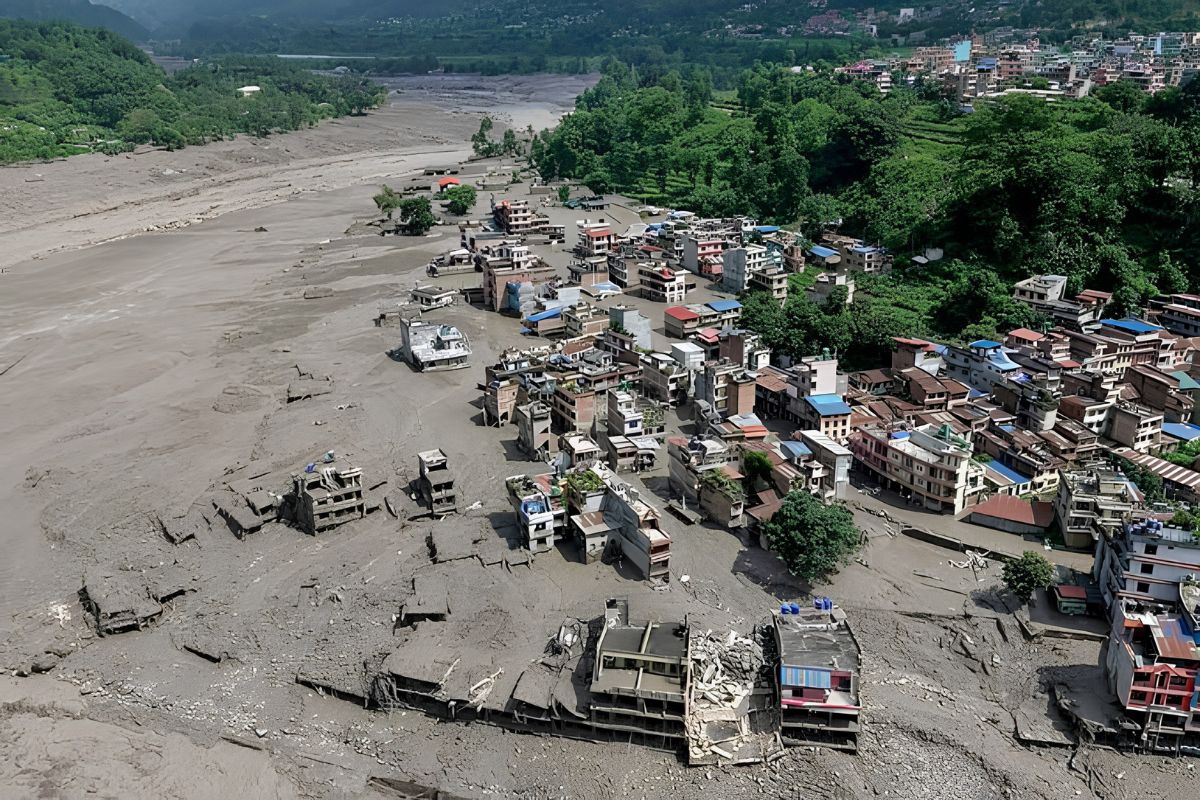
Downstream from the Langtang Lirung collapse, communities along the Trishuli River cannot wait for multilateral review boards. Disaster reports compiled by Matrix News confirm the debris flow killed over 1,350 people, while The Indian Express estimates direct physical damage at $2.5 billion.
Immediate humanitarian assistance will come through traditional emergency channels: local emergency budgets, United Nations humanitarian appeals, and bilateral emergency aid packages.
Long-term reconstruction tells a different fiscal story. To rebuild highways, power grids, and border terminals, Nepal will turn to sovereign borrowing, taking on development loans from lenders like the Asian Development Bank while its formal claim to the UN fund remains pending.
Frequently Asked Questions
Can Nepal immediately withdraw cash from the UN Loss and Damage Fund?
No. The Fund for Responding to Loss and Damage is not an emergency checking account or an insurance policy. It operates as a competitive grant program that requires governments to pass an 11-step technical vetting process before any funds can be released.
Why hasn’t the UN Loss and Damage Fund disbursed money to Nepal?
The fund’s board postponed all project decisions until December 2026 after receiving 180 applications totaling $2.8 billion against just $630.99 million in paid contributions. Nepal submitted its $20 million application on September 1, after the initial application window had already closed.
Why does the World Bank prevent direct payments to Nepal’s government?
Because the fund is structured as a World Bank Financial Intermediary Fund, money cannot be wired directly into a recipient government’s treasury. Capital must flow through accredited third-party development partners and undergo strict fiduciary auditing to satisfy international donor standards.
How will Nepal pay for reconstruction after the Langtang Lirung disaster?
Short-term relief relies on traditional United Nations humanitarian appeals and emergency state funds. Long-term reconstruction of bridges, roads, and hydropower assets will largely require Nepal to secure bilateral loans from multilateral development banks.
Editorial Independence & Corrections
Clarity Times is published by Beeps Venture Technologies LLP under strict editorial independence charters. We uphold rigorous sourcing and verification protocols. Noticed a factual omission or error? Review our Correction Protocols or contact our editorial desk at mail@claritytimes.org.

Praseetha K
Investigative journalist and research analyst contributing independent field reports and structural analysis for Clarity Times.