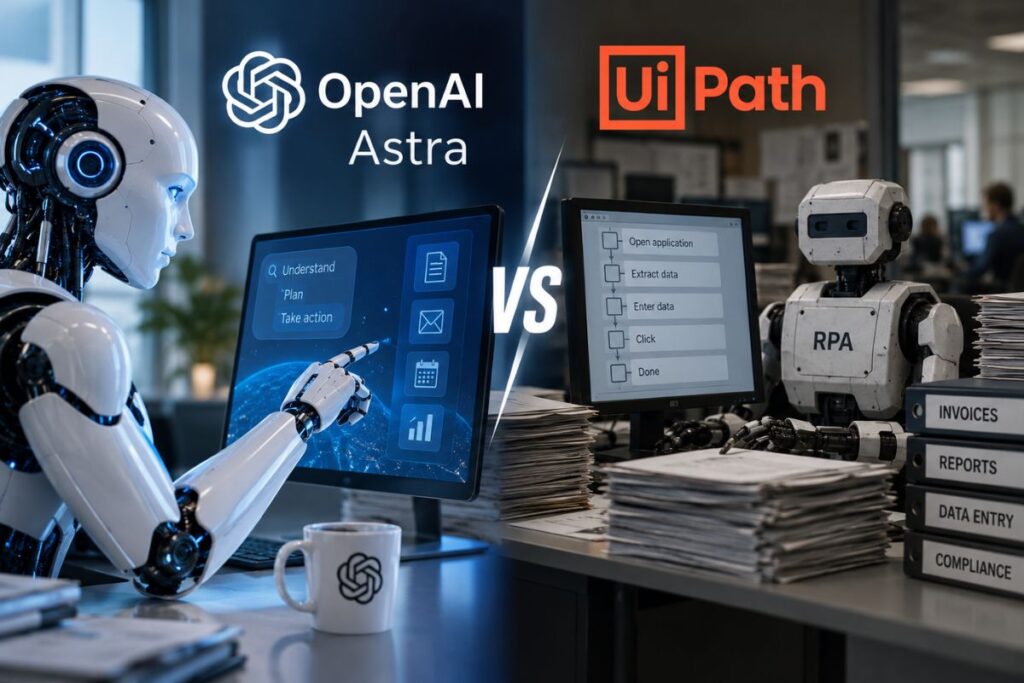
The competitive dynamics between OpenAI Astra and UiPath center on fundamentally different approaches to on-screen data targeting. Astra’s computer-use model abandons the brittle, code-based scripts that routinely drain corporate automation budgets, instead leveraging spatial visual reasoning. This architectural shift effectively eliminates the continuous maintenance cycles that have historically driven recurring revenue for legacy Robotic Process Automation (RPA) providers.
Legacy vendors will keep their regulated enterprise clients for now. AI agents cannot yet match the deterministic audit logs required for financial compliance.
Why do UI changes break legacy UiPath tools but not OpenAI Astra?
Legacy UiPath tools fail when a web interface changes because they rely on underlying code locators, while OpenAI Astra succeeds by using spatial visual reasoning to find moved elements on the screen. A controlled test comparing Astra against legacy tools demonstrates this architectural difference. Under OpenAI’s official computer-using agent benchmarks, Astra achieved a 92.7% success rate on ScreenSpot-Pro, an industry benchmark measuring autonomous interaction with complex graphical user interfaces.
When an enterprise resource planning interface undergoes a layout reflow, a standard RPA script fails instantly. It returns a selector timeout error. The workflow halts and waits for a human developer to rewrite the instructions.
Astra absorbs the same layout shift without interrupting the task. The model visually locates the moved “Submit” button on the screen and clicks it, rendering routine CSS and DOM modifications harmless to the automation pipeline.
Why does RPA script maintenance cost so much?
RPA script maintenance consumes between 40% and 50% of enterprise automation budgets because developers must manually rebuild code locators every time a third-party software interface updates. Corporate buyers purchase RPA as software, but they operate it as an ongoing consulting service. According to enterprise automation directors managing fleets of 100 or more active bots, these repairs dominate the operating cost.
| Capability | Legacy RPA (UiPath) | Visual AI (OpenAI Astra) |
|---|---|---|
| Navigation Method | DOM selectors & accessibility trees | Raw video frames & visual affordances |
| Resilience to UI Shifts | Fails instantly (requires manual repair) | Adapts dynamically via visual reasoning |
| Cost Structure | Fixed annual license + maintenance | Variable pay-as-you-go per token |
| Auditability | Deterministic, cryptographically signed logs | Probabilistic, higher variance risk |
Dynamic web pages break fixed automation scripts. Every time a vendor updates a software interface, the automation scripts tied to that interface break. IT departments pay developers hourly rates to rebuild the locators.
By bypassing the need for fixed selectors, Astra functionally targets this maintenance budget rather than the initial software license cost.
How does Astra’s visual processing differ from RPA DOM selectors?
Traditional RPA bots read the underlying code structure using Document Object Model (DOM) selectors—specific code tags that identify individual elements on a web page—whereas OpenAI Astra captures continuous screenshots and processes raw video frames to interact with the visual interface.
Traditional RPA operates beneath the graphical interface. Bots navigate applications by reading the accessibility tree, which is the underlying code structure that screen readers and bots use to navigate a user interface.
If a button’s underlying ID changes from btn-submit-01 to btn-submit-02, the RPA bot goes blind.
Astra looks at the application exactly as a human employee does. It takes continuous screenshots, processes the raw video frames through its 1.05-million-token context window, and reasons over visual affordances. It operates entirely on the rendered output.
Is Astra cheaper than an unattended RPA license?
OpenAI Astra is 60% to 75% cheaper annually than a dedicated legacy RPA license for workflows that execute fewer than 800 times per month. Running a dedicated unattended RPA bot requires fixed licensing fees. An enterprise pays thousands of dollars annually just for the right to let the bot sit on a server. According to UiPath’s enterprise licensing and Orchestrator tier structures, dedicated server licenses routinely exceed $20,000 annually per host.
Astra uses a pay-as-you-go model. In production deployments, enterprises pay metered rates per million input and output tokens consumed during the specific minutes the model spends watching the screen and executing actions. This model mirrors cost optimizations across back-office operations, such as domain-specialized AI models designed for high-throughput enterprise BPO environments.
Based on standard enterprise license rates and Astra API token costs, the breakeven threshold sits at 800 executions. For workflows running below that volume, Astra’s token architecture costs less than maintaining a dedicated legacy RPA license.
Why do enterprises still require legacy RPA audit logs?
Corporate accounting departments require the cryptographically signed audit logs provided by legacy RPA to meet zero-tolerance regulatory mandates, which probabilistic AI agents cannot currently guarantee. Large enterprises operate under strict regulatory frameworks that penalize probabilistic behavior.
Corporate accounting departments require complete determinism. A bot moving payroll data between two systems must execute the task identically every single time. Traditional RPA provides this guarantee. It also generates the logs required by the Sarbanes-Oxley Act (SOX) Section 404, a federal mandate requiring management to report on the adequacy of internal financial controls.
Agentic AI introduces variance. As documented in our investigation into the compliance risks and lack of chain-of-thought monitorability in GPT-6 Astra, models that reason visually cannot produce a guaranteed mathematical audit trail. For high-stakes financial and medical records, regulated institutions cannot absorb the uninsurable legal liability of a probabilistic worker. Similar workflow pressures are visible across frontline support teams, as explored in our coverage of chat support agents adapting to strict automation metrics.
How does integrating visual AI conflict with UiPath’s business model?
Integrating visual AI creates a business model conflict for UiPath because self-healing AI models eliminate the billable maintenance hours that systems integrators rely on for recurring revenue. Incumbent vendors are attempting to defend their territory by integrating visual foundation models directly into their existing orchestrators.
According to UiPath Investor Relations financial disclosures, the vendor continues to expand annual recurring revenue by deepening integration across enterprise IT stacks. However, this integration strategy faces friction from the broader IT consulting ecosystem.
Major systems integrators rely on billable hours dedicated to fixing broken RPA scripts. If legacy vendors successfully package models like Astra to self-heal broken workflows, they eliminate the maintenance cycles that drive recurring revenue for their integration partners. The visual reasoning that improves the software simultaneously cannibalizes the business model of the contractors paid to support it.
Related In-Depth Coverage

Clarity Times Science & Tech Bureau
The Clarity Times Science & Tech Bureau investigates artificial intelligence governance, semiconductor supply chains, biotechnology, and public health systems.