At Clarity Times, we examine what mainstream narratives omit. This dispatch investigates institutional incentives, policy fine print, and multi-dimensional community impacts.
At least nine of the 12 hydropower projects flooded in Nepal on August 26 operated without upstream water-level sensors or automated sirens. A review of post-disaster disclosures reveals that these missing Nepal hydropower early warning systems cost crews a vital 40-minute evacuation window, trapping hundreds of workers underground.
Was there enough time to evacuate the tunnels?
Yes, hydrological and timeline data indicate the flood surge took between 18 and 26 minutes to reach the tunnel portals, exceeding standard tunnel evacuation protocols.
The August Himalayan glacier flood on the Nepal-Tibet border is widely described as an instantaneous event. Timeline records contradict this. The flood struck a border crossing at approximately 8:32 am, but officials did not issue a public alert until 9:13 am – a 41-minute gap. Based on standard debris-flow velocity models, the surge took an estimated 18 to 26 minutes to reach the uppermost tunnel portals in the Trishuli and Chilime river corridors. Walking at a standard pace or utilizing site muck cars, 80 percent of underground personnel could have cleared the 1.5-kilometer to 4-kilometer access adits if an alert sounded the moment the river began to rise.
Why didn’t the Nepal hydropower early warning systems activate?
The alarms never sounded because the hardware did not exist at the majority of the affected dams.
Nepalese officials have acknowledged that while some basic river-gauging stations existed near the border, they were not actively monitored to detect failure. Across the dozen affected sites, none possessed automated siren cut-offs linked directly into the subterranean tunnel networks.
At the Upper Trishuli-3A site, where dozens remain trapped, survivor Raj Chhetri told reporters that workers received zero advance notice. “If we had received information beforehand, many lives and property could have been saved,” Chhetri stated, noting that a loud noise was their only warning before mud filled the shafts.
Did regulations require early warning sensors?
Yes, but post-disaster safety frameworks were treated as voluntary checklists rather than enforced operating constraints.
Nepal updated its infrastructure safety discourse after India’s 2021 Chamoli disaster, a precedent to this Nepal tunnel disaster, which similarly drowned tunnel crews following a glacier burst. Post-Chamoli studies published in Communications Earth & Environment called for the strict deployment of targeted ground monitoring and clear warning thresholds in Himalayan permafrost valleys.
In the push to build energy capacity, transboundary disaster resilience was sidelined. Without punitive enforcement from the Department of Electricity Development (DoED) – the government agency responsible for licensing and regulating power projects in Nepal – dam developers treated unmonitored catchment areas as a standard operational exposure.
How did underground communications fail during the flood?
Once portal staff fled the rising water, crews working inside the tunnels were entirely cut off from the surface.
Even if surface managers received regional flash flood warnings from national meteorological desks, they possessed no hardwired loops to broadcast them underground. Subterranean communications at the affected sites relied on portal-based intercoms or VHF walkie-talkies (handheld radios limited by physical obstacles).
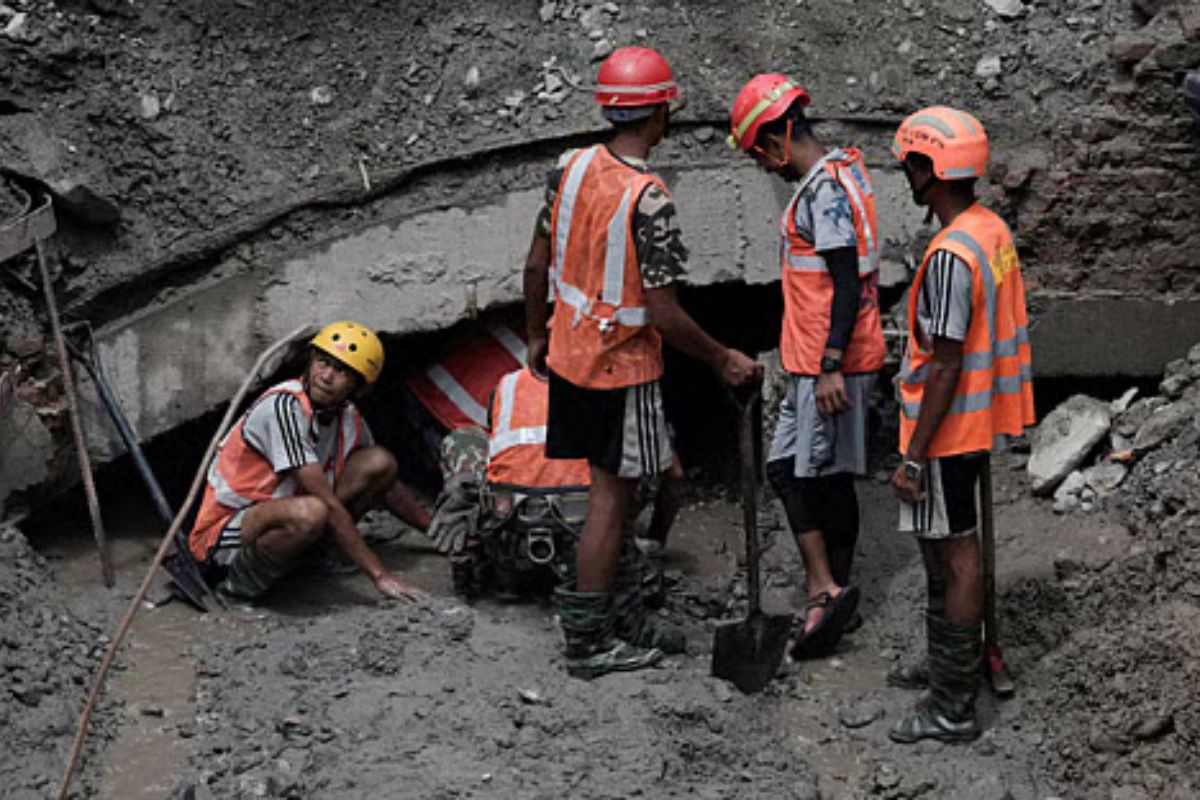
Sanjay Sah, a mechanical foreman rescued after nine days trapped during the Trishuli hydropower rescue, told the media he survived in the dark and communicated with other trapped colleagues solely by “shouting to each other from nearby.” The complete absence of leaky-feeder radio systems – specialized cables that allow radio signals to propagate through underground tunnels – left underground workers blind to the surface threat.
Are glacial early warning systems too expensive for dam developers?
No, a fully redundant, satellite-linked upstream sensor suite costs roughly $35,000, representing a microscopic fraction of a standard dam’s construction budget.
Dam developers often cite the physical realities of the Himalayas when explaining unmonitored catchments. Upstream alpine moraines above 4,500 meters are subject to rockfalls and permafrost degradation that can destroy physical nodes. Developers also note that the August 26 event originated across the border in Tibet, where private Nepalese operators hold no legal authority to install hardware.
The barrier is not capital. Following the disaster, Nepal is now preparing to install exactly this kind of VSAT-connected seismic sensor (a system using small satellite dishes for remote data transmission) and camera array to bypass mobile network failures.
Set against financial data filed with lenders, that safety package is a fraction of project capital. The Upper Trishuli-3A plant was financed by a $149.4 million concessional loan from the Export-Import Bank of China, while the neighboring Upper Trishuli-1 project is backed by lenders including the Asian Development Bank. According to these project finance sheets, the telemetry package capable of triggering an evacuation represents roughly 0.03 percent of a standard $150 million construction budget.
Frequently Asked Questions
Did the flooded Nepal hydropower dams have early warning systems? At least nine of the 12 hydropower projects flooded on August 26 did not have upstream water-level sensors or automated sirens. Nepalese officials confirmed that existing border river-gauging stations were not actively monitored for failures.
Could the hydropower workers have evacuated the tunnels in time? Yes. Hydrological data shows the flood surge took an estimated 18 to 26 minutes to reach the tunnel portals. If early warning sensors had been installed and activated, 80 percent of the workers could have walked out of the tunnels safely.
Why didn’t surface staff radio the underground tunnel crews? The hydropower sites lacked hardwired underground alarm loops or leaky-feeder radio systems. Communication relied on portal-based intercoms and walkie-talkies, which lost connection once the portal staff evacuated the entrance.
How much does an early warning sensor system cost for a dam? A satellite-linked upstream sensor suite with tunnel alarms costs between $35,000 and $50,000. For a standard $150 million hydropower project, this safety equipment makes up roughly 0.03 percent of the total construction budget.
Editorial Independence & Corrections
Clarity Times is published by Beeps Venture Technologies LLP under strict editorial independence charters. We uphold rigorous sourcing and verification protocols. Noticed a factual omission or error? Review our Correction Protocols or contact our editorial desk at mail@claritytimes.org.

Praseetha K
Investigative journalist and research analyst contributing independent field reports and structural analysis for Clarity Times.