
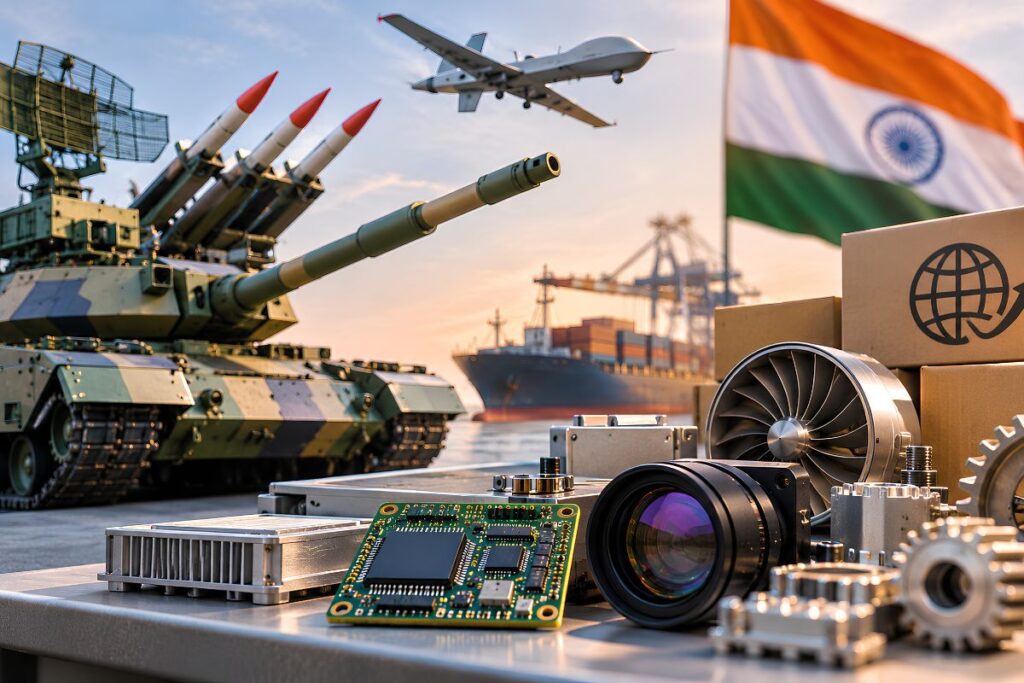
Between 35% and 45% of the value in India’s ₹21,083-crore defence export tally comes from foreign parts, raw materials, and assemblies shipped in from abroad. Evaluating India defence exports for real indigenous content shows that while headline shipments expanded thirty-fold over the past decade, net sovereign earnings remain substantially lower because domestic assembly plants depend heavily on imported high-tier components.
What Does Customs Data Reveal About India’s Defence Export Milestone?
Line-item customs data shows that net domestic value retention across India’s premier aerospace and electronic defence exports sits between 55% and 65%, with imported sub-assemblies accounting for the remainder.
When the Ministry of Defence announced that annual exports reached ₹21,083 crore in fiscal year 2023–24, official releases treated the milestone as a single consolidated measure of national industrial self-reliance.
The underlying shipment declarations tell a different story.
According to export records compiled by the Directorate General of Commercial Intelligence and Statistics, outward shipments under primary military codes, specifically Chapter 88 for aircraft and Chapter 93 for arms and ammunition, carry an estimated 35% to 45% imported content by value.
That gap stems directly from how manufacturers finance and clear incoming inputs. Under the Advance Authorisation scheme managed by the Directorate General of Foreign Trade, a policy mechanism allowing manufacturers to import production inputs duty-free provided the finished goods are exported, exporters bring in specialized alloys, sensor blocks, and hardware kits with zero import tariff.
In practice, a substantial portion of the recorded export value represents the pass-through expense of foreign kits routed through Indian factory floors rather than fresh domestic value addition.
How Do Indian Trade Rules Define an “Indigenous” Defence Export?
Indian trade policy assigns zero minimum domestic value addition threshold to defence exports, allowing assemblies composed entirely of foreign sub-systems to count fully toward national export milestones.
Under standard licensing rules enforced by the Department of Defence Production, an export clearance is granted once a product satisfies customs classifications and secures approvals under the Special Chemicals, Organisms, Materials, Equipment and Technologies (SCOMET) framework, a dual-use export control list regulating strategic goods.
If an Indian contractor imports a machined structural frame from abroad, wires internal power harnesses, completes quality tests, and ships the unit to a foreign buyer, customs logs the full outward invoice price as an Indian defence export.
This sets up a direct contradiction with domestic military purchases. Under the Defence Acquisition Procedure, the statutory handbook governing military procurement, weapons procured for the Indian Armed Forces must satisfy strict Indigenous Content rules, often 50% to 60%, calculated by stripping out foreign raw material costs, overseas royalties, and imported modules.
Commercial exports face no such check. Any military hardware assembled inside India qualifies for the national export scoreboard, regardless of where its critical internals were engineered.
Where Does Foreign Dependency Lie in the Defence Export Bill of Materials?
An audit of the defence export bill of materials across structural aerostructures, field artillery, and surveillance electronics confirms that foreign suppliers hold a near-complete monopoly over specialized raw materials and microprocessors.
Evaluating three primary categories reveals where domestic fabrication ends and overseas reliance takes over:
- Aerostructures and Cabin Assemblies: Joint ventures such as Tata Boeing Aerospace assemble fuselages for the AH-64 Apache and commercial passenger doors outside Hyderabad and Bengaluru. However, certified titanium fasteners, single-crystal alloys, and carbon-fiber prepregs, composite fabrics pre-impregnated with resin that provide structural rigidity, are 100% imported. Global aerospace contractors legally restrict production to qualified overseas vendors, meaning raw materials make up roughly 70% of structural costs, leaving local retention limited to machining labor and assembly fees.
- Artillery Systems and Munitions: Private and public manufacturers, including Kalyani Strategic Systems and Munitions India Limited, export 155mm field guns and artillery shells to customers across the Middle East and Southeast Asia. While local foundries forge the barrels, breeches, and mechanical chassis, critical high-energy propellants, electronic proximity fuses, and digital fire-control chips frequently come from foreign technical partners.
- Radar and Naval Avionics: State-owned Bharat Electronics Limited supplies coastal surveillance networks and optronic consoles to partner countries across the Indian Ocean. While the physical shelters, wiring, and console interfaces are designed and fabricated domestically, the active electronically scanned array (AESA) radar antennas depend on imported gallium nitride semiconductors, and signal processors run on foreign silicon.
Are Indian Assembly Plants Absorbing Real Technology or Operating as Contract Outposts?
Contractual clauses enforced by Western aerospace primes prevent Indian Tier-1 integrators from sourcing hardware from domestic small businesses, turning local factories into build-to-print assembly outposts.
Indian defence primes note that build-to-print work, manufacturing components strictly to blueprints supplied by an overseas client without owning the design rights, is a standard first phase in industrial development. Handling foreign assembly lines trains local technicians to meet rigorous AS9100 aerospace quality standards and helps build an industrial baseline.
The bottleneck appears down-tier. Tier-2 and Tier-3 precision toolmakers across machine-tool clusters in Coimbatore, Pune, and Belagavi report that foreign original equipment manufacturers bar primary contractors from replacing overseas bolts, bearings, and castings with locally certified equivalents.
The result is a rigid operational boundary: Indian firms absorb capital expenses for hangars and assembly labor, while foreign suppliers retain the high-margin, patent-protected sub-systems.
How Can India Transition from Gross Billings to Measuring Real Domestic Value Retention?
Tracking Advance Authorisation customs waivers and GST input-tax credits across export shipments would provide the Ministry of Commerce with an exact metric of net domestic value retention.
Independent monitoring organizations, including the Stockholm International Peace Research Institute, already evaluate the global arms trade by counting deliveries of major conventional weapons rather than headline invoice totals, eliminating distortions caused by component pass-throughs.
Domestically, establishing a mandatory domestic value addition baseline for export incentives would immediately separate sovereign industrial output from low-margin assembly logistics.
Until trade registries distinguish between sovereign manufacturing and foreign component pass-throughs, headline export growth will mask the defence industrial base’s continued dependence on foreign sub-tier suppliers.
Frequently Asked Questions
What percentage of India’s defence exports is actually made domestically?
Based on Directorate General of Commercial Intelligence and Statistics customs records across primary military classifications, imported content accounts for 35% to 45% of India’s headline export value. In advanced aerospace structures and radar electronics, net domestic value retention averages between 55% and 65%.
Why do reported Indian defence export numbers include foreign parts?
Indian export rules do not require minimum domestic content thresholds for commercial arms sales. Under the Advance Authorisation scheme, manufacturers import foreign sub-assemblies duty-free, assemble them into finished kits, and record the entire final invoice value as an Indian export.
What critical components in India’s defence export pipeline remain imported?
Major structural exports rely almost entirely on foreign-certified titanium fasteners, carbon-fiber prepregs, electronic proximity fuses, gallium nitride radar semiconductors, and fire-control microprocessors sourced from overseas manufacturers.

Praseetha K
Praseetha K is the Managing Editor of Clarity Times. She edits, verifies and publishes the newsroom's articles, and also writes analysis on policy, law, business and technology. Articles she writes are edited by the Editor-in-Chief before publication.