Editorial Disclosure: Clarity Times is published by Beeps Venture Technologies LLP, the corporate parent entity that developed Beeps Card. Consistent with our newsroom conflict of interest rules, this article was reported and edited under standard primary documentation protocols without commercial pre-screening.
A business card exchange usually takes only a few seconds. Someone hands over a card, the other person glances at it, and both move on. Sometimes it leads to a useful connection. Quite often, the card ends up in a drawer or gets thrown away.
Beeps Card is built around a simple question: what if that small piece of cardboard could do a little more?
The NFC-enabled digital business card platform officially launched on 5 September 2026. Developed by Beeps Venture Technologies LLP in Kerala, it combines a physical card with an online profile where users can share contact details, showcase their work, and give potential customers an easier way to get in touch.
The idea is not entirely new. Digital business cards and NFC-enabled products already exist. What matters is how the technology is used and whether it makes a difference to the person handing over the card and the person receiving it.
A Business Card That Can Change After It Is Printed
One of the familiar frustrations with paper visiting cards is that they become outdated surprisingly quickly.
A phone number changes. Someone starts offering a new service. A business moves to another address. The cards already distributed remain exactly as they were printed, and replacing them costs money.
There is another limitation: space. A small card can carry a name, designation, phone number, and perhaps a website. It cannot comfortably accommodate a portfolio, product catalogue, service descriptions, booking links, and everything else a business might want a prospective customer to see.
A digital profile offers more room and can be updated without printing a fresh batch of cards. That is the basic appeal behind products such as Beeps Card.
Of course, paper cards still have their place. They are straightforward, require no subscription, and work without a phone or internet connection. For someone who rarely exchanges business cards, switching to an NFC product may offer little practical benefit.
For freelancers, consultants, sales professionals, and business owners who regularly meet potential customers, the calculation can be different.
How Beeps Card Works
The technology behind the card is called Near Field Communication, or NFC. It is the same broad technology category used in contactless interactions between compatible devices.
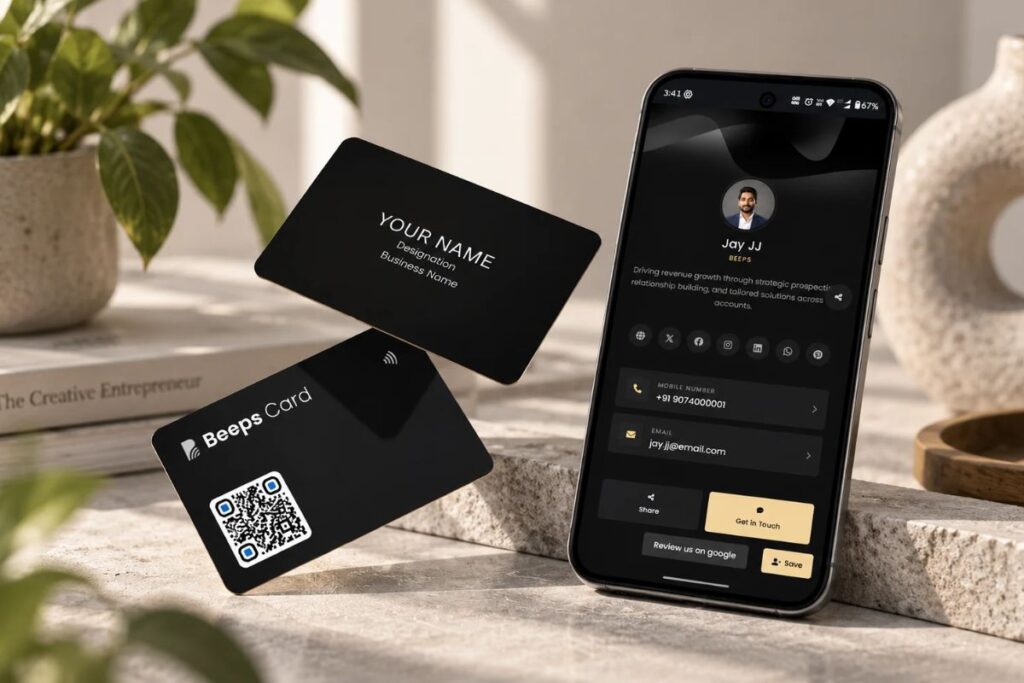
A small NFC chip embedded in the Beeps Card stores a web address. When someone brings a compatible smartphone close to the card, the phone can open the linked digital profile in its browser. People can also access the profile through a QR code.
There is no need to install a dedicated app simply to view the profile.
What happens next depends on the information the cardholder has added. A visitor might find contact details, social media links, photographs, products, services, or a way to submit an inquiry. Some plans also offer features such as appointment booking and payment options.
The NFC Forum provides further information about how NFC works and where the technology is used.
The important distinction is that the chip itself does very little beyond opening the relevant destination. The usefulness comes from the profile behind it.
What Happens After Someone Taps the Card?
Consider a consultant meeting a prospective client at a business event.
With a conventional visiting card, the client might save the telephone number and later search online for the consultant’s services. With a digital business card, the same introduction could lead directly to a profile containing the consultant’s contact details, services, and enquiry form.
A retailer could use a similar profile to display products. A photographer might share a portfolio, while a service provider could make appointment information easier to find.
Beeps Card offers features intended to support these uses, including contact sharing, product and service listings, enquiry forms, media galleries, and catalogue sharing. Additional options, depending on the subscription plan, include profile customization, analytics, and payment-related functionality.
Not everyone will need all of these features. A simple contact-sharing profile may be enough for one person, while another might want a more complete business page.
That distinction matters when evaluating digital business cards. A longer feature list does not necessarily make a product better. What counts is whether the available tools solve a problem the user actually has.
NFC Is Not New. The Experience Around It Is What Counts.
Beeps Card enters an established market. NFC business cards, QR-based profiles, and digital visiting cards are already available from various providers in India and elsewhere.
The technology itself is therefore not the main point of difference. The more useful comparison is between the services built around it.
Some products focus on the physical card and basic contact sharing. Others provide editable profiles, custom designs, analytics, or specialized features. Beeps Card takes a broader approach by bringing contact sharing together with tools for presenting products and services, receiving inquiries, and supporting other business interactions.
Whether that combination is worth paying for depends on the user. Someone who only wants to share a phone number may not need a subscription-based platform. A business that wants to present its offerings in one place may find the additional features more useful.
There is also a cost question worth considering. The physical card and the digital service are not necessarily the same purchase. With Beeps Card, prospective customers should check which features are included in each subscription plan and what happens to their profile if the subscription expires.
These details are less exciting than the idea of tapping a card to share information, but they are important when deciding whether the product makes financial sense.
The Thinking Behind Beeps Card
Jithu Jayaraj, the founder of Beeps Card, sees the product as a way to make the exchange of professional information more useful.
The thinking is straightforward: giving someone your contact details is only the beginning. If that person wants to understand your work, explore your services, or contact you later, the information should be easy to find.
The product brings those details together in a profile that can be accessed through a physical card.
As Jayaraj puts it:
“A business card should do more than share someone’s name and phone number. When you meet a potential customer, you want them to understand what you do, see your services, and know how to reach you. We wanted to bring those things together in one place, while keeping the experience of sharing a physical card simple.”
That is the thinking behind the product, although the technology alone cannot guarantee better networking. A well-organized profile may make follow-up easier, but it cannot replace a useful conversation, a good service, or a genuine business relationship.
Is a Digital Business Card Worth It?
The answer depends on how often someone networks and what they need their card to accomplish.
For a professional who simply wants to share a name and telephone number, a paper card or a basic digital contact page may be perfectly adequate. Paying for a more elaborate platform could be unnecessary.
For someone who regularly meets prospective customers, manages multiple services or wants to present a portfolio, an editable digital profile can be more practical. It offers a single place to keep information current and gives recipients more options than a printed card can provide.
There are trade-offs, too. The profile depends on the provider’s online service, some features require a subscription, and users need to keep their information accurate. A digital card is only as useful as the experience it offers when someone opens it.
These are sensible considerations for anyone comparing products in this category, including Beeps Card.
What the Launch Means
Beeps Card officially launched on 5 September 2026, adding another option to India’s digital business card market.
Its approach is easy to understand: retain the familiarity of handing someone a physical card, but use that interaction to open a profile that can contain far more information than the printed version.
That may be useful for professionals who want to make their work easier to discover and for businesses that need a convenient way to present their offerings. It will be less compelling for people whose networking needs are already met by a simple card.
The broader shift is not really about replacing paper with technology for its own sake. It is about making the information exchanged during a meeting easier to access and maintain.
Whether that makes a meaningful difference depends on the person using it.
Readers interested in the product can find its features and subscription options on the official Beeps Card website.
About Beeps Card
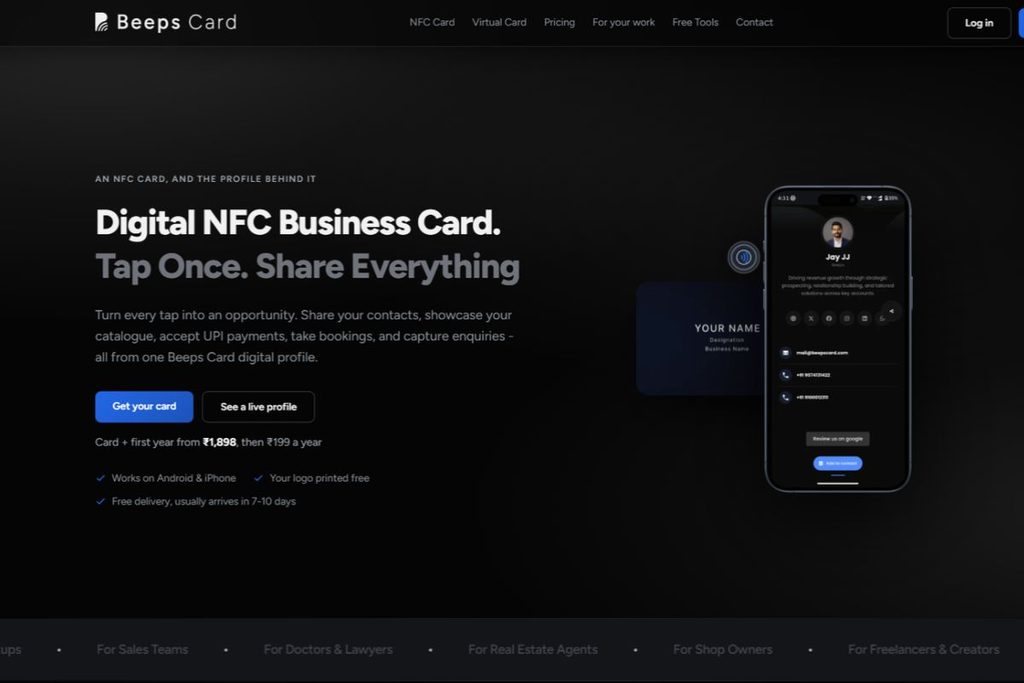
Beeps Card is an NFC-enabled digital business card platform developed by Beeps Venture Technologies LLP in Kerala, India. It combines a physical NFC card with an online profile for sharing contact details and presenting business information.
Related In-Depth Coverage

Clarity Times Markets & Economy Desk
The Clarity Times Markets & Economy Desk tracks corporate balance sheets, Reserve Bank of India monetary policy, trade flows, and industrial infrastructure.