At Clarity Times, we examine what mainstream narratives omit. This dispatch investigates institutional incentives, policy fine print, and multi-dimensional community impacts.
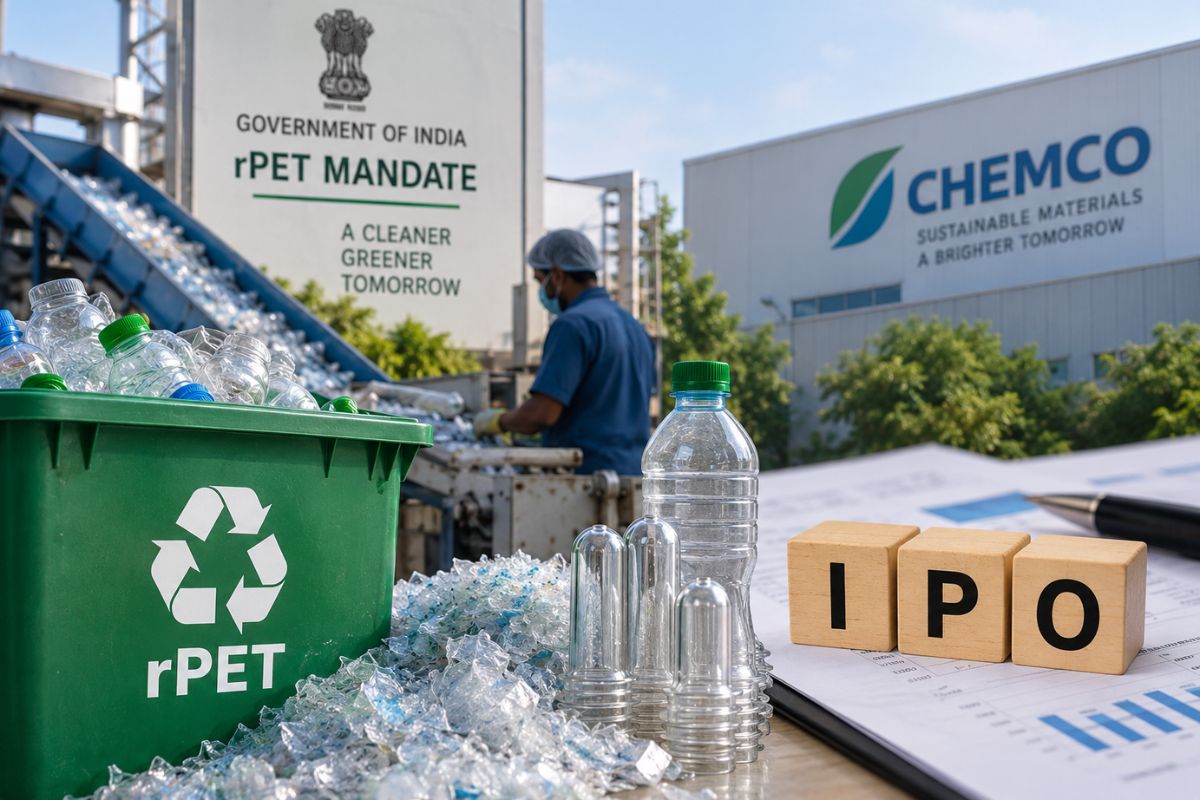
New plastic recycling rules threaten the profitability of packaging suppliers by forcing expensive factory upgrades. The ₹1,500-crore Chemco IPO valuation rests on 1.25 lakh tons of virgin plastic capacity. To serve clients under the India rPET mandate, the company must fund unbudgeted factory retooling or risk stranded assets by 2027.
What does the India rPET mandate require?
The Ministry of Environment, Forest and Climate Change (MoEFCC) requires fast-moving consumer goods companies to use at least 40 percent recycled content in food-grade packaging starting April 2026. This target climbs to 60 percent by the 2028-29 financial year.
An analysis by Clarity Times reveals that Chemco’s massive virgin plastic infrastructure faces immediate stranded-asset risk because these federal recycling mandates require unbudgeted factory retooling.
This rule sits under the Extended Producer Responsibility (EPR) framework. EPR is a policy approach that holds manufacturers legally and financially accountable for the end-of-life disposal and recycling of their products.
Chemco processes 1.25 lakh tons of plastic polymers annually. According to the company’s corporate metrics, this capacity leans heavily toward virgin polymer processing.
Chemco supplies multinational beverage companies. These clients must hit federal recycling targets. That leaves Chemco’s current manufacturing footprint misaligned with client needs over the next two years.
Why does virgin plastic processing require new capex?
Transitioning a packaging plant from virgin plastic to recycled material requires expensive machinery modifications because recycled plastic melts and flows differently. Suppliers cannot simply feed recycled pellets into unmodified extrusion and injection molding machines without compromising bottle strength.
rPET (recycled polyethylene terephthalate) is plastic recovered from previously used PET bottles and reprocessed into new packaging. Building facilities capable of processing food-grade rPET to international standards takes immense capital.
According to industry data published by Packaging World Insights, setting up 3 lakh metric tonnes of advanced rPET capacity requires investments between ₹9,000 crore and ₹10,000 crore.
Early reports on Chemco’s IPO filings show the primary proceeds target general capital expenditure and debt reduction. They show no explicit allocation for EPR compliance retooling. If the funds ignore this shift, the technical costs of compliance act as an unpriced future liability.
What is the baseline Chemco IPO valuation?
Chemco Plastic Industries is seeking a ₹1,500-crore valuation through an initial public offering to fund standard capital expenditure and debt reduction. The issue includes a fresh share sale and an offer for sale by promoters.
According to financial data from Crisil Ratings, the company reported an operating income of ₹939 crore and a profit after tax of ₹61.9 crore for the 2025 financial year.
Market analysts pitch the offering as a stability play. They point to historical operating margins and long-term contracts with Coca-Cola and PepsiCo.
Is there enough food-grade rPET in India?
India currently lacks the food-grade rPET production capacity required to meet the incoming demand from FMCG majors. Retooling factories solves only the mechanical side of the transition. The downstream challenge remains raw material procurement.
MoEFCC regulations dictate that food and beverage packaging must use certified food-grade recycled plastic.
According to the Food Safety and Standards Authority of India (FSSAI), the country currently has 17 authorized recycled PET manufacturing plants. This provides a combined national capacity of roughly 3 lakh tonnes.
This restricted capacity creates a hard supply-demand mismatch. Food-grade recycled raw materials will cost more. Suppliers without secured supply chains for food-grade rPET face severe production bottlenecks.
Will the Chemco IPO fund the rPET transition?
Chemco’s current Draft Red Herring Prospectus (DRHP) earmarks IPO proceeds for general corporate purposes and debt reduction, rather than the specific factory retooling required for rPET compliance. If the company fails to retrofit its 23 manufacturing locations, its virgin processing units risk becoming stranded assets as clients move orders to compliant suppliers.
The syndicate of investment banks managing the deal-Equirus, Axis Capital, and 360ONE-frame the offering around historical performance. They omit the transition strategy.
Chemco could argue existing contracts allow them to pass capital expenditure and raw material premiums directly to FMCG clients. The company could leverage its massive scale to absorb transition costs better than smaller, unlisted competitors.
Whether those 16 percent operating margins hold depends entirely on how much of the green premium beverage giants agree to pay.
Frequently Asked Questions
When does India’s rPET mandate start?
The MoEFCC mandate takes effect on April 1, 2026. It requires FMCG companies to use 40 percent recycled content in food-grade PET packaging, a target that scales up to 60 percent by 2028-29.
Can standard plastic factories process rPET?
No. Recycled plastic melts and flows differently than virgin plastic. Factories must upgrade their extrusion and injection molding machines to handle rPET, otherwise the structural integrity of the final bottles is compromised.
Does India produce enough food-grade rPET?
Not currently. The FSSAI has authorized 17 recycling plants to produce food-grade rPET, establishing a national capacity of about 3 lakh tonnes. This falls short of the incoming demand from major beverage brands, creating a supply bottleneck.
Editorial Independence & Corrections
Clarity Times is published by Beeps Venture Technologies LLP under strict editorial independence charters. We uphold rigorous sourcing and verification protocols. Noticed a factual omission or error? Review our Correction Protocols or contact our editorial desk at mail@claritytimes.org.

Praseetha K
Investigative journalist and research analyst contributing independent field reports and structural analysis for Clarity Times.