
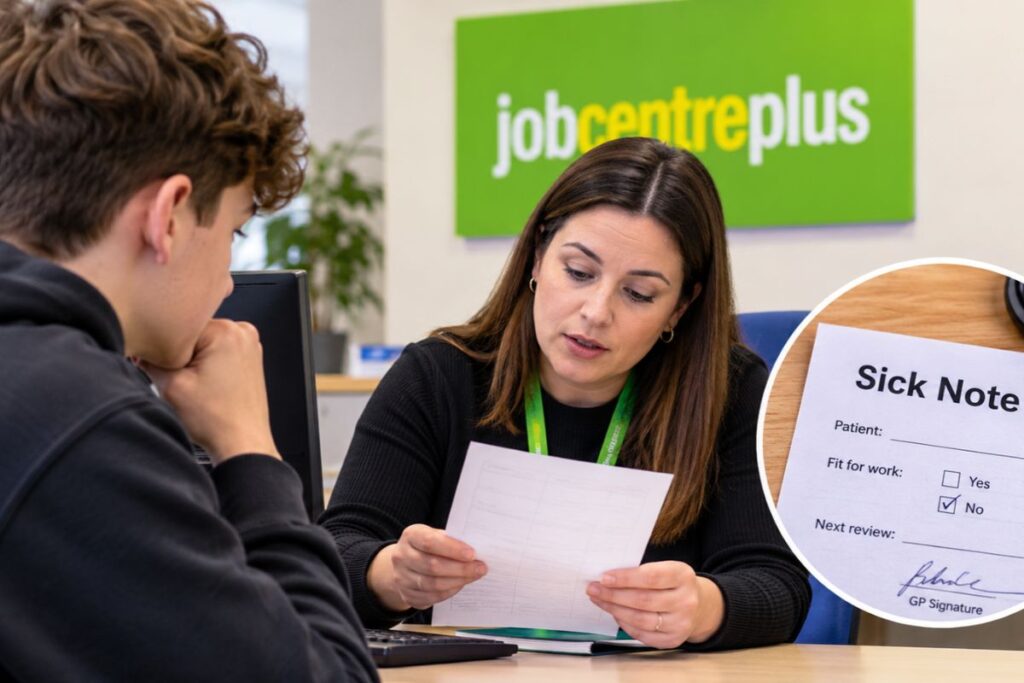
When a 20-year-old on Universal Credit uploads a medical sick note, frontline Jobcentre Work Coaches, often managing 100 or more claimants in 10-minute slots, typically park them in light-touch deferral. Internal rules, local mental health waitlists, and stretched Disability Employment Advisers leave coaches with few workable paths to move sick young claimants toward jobs before their health assessment occurs.
What Happens at the Jobcentre When a Young Claimant Uploads a Fit Note?
Frontline Jobcentre Work Coaches record the fit note in the claimant’s digital journal, suspend mandatory job-search rules during an initial easement period, and rarely have enough time in a 10-minute appointment to build a health-focused job plan. The moment an 18-to-24-year-old uploads a Statement of Fitness for Work, commonly called a fit note, into their online Universal Credit journal, an administrative triage begins.
Inside Department for Work and Pensions (DWP) Jobcentres, standard claimant appointments frequently run for 10 minutes while coaches carry caseloads exceeding 100 people, according to evidence submitted to the House of Commons Work and Pensions Committee’s Get Britain Working: Reforming Jobcentres inquiry.
Under DWP Intensive Work Search operational guidance governing claimants who report a health condition, submitting valid medical evidence triggers an initial easement period in which mandatory work-search requirements can be switched off while the claimant awaits a Work Capability Assessment (WCA), the medical evaluation used to decide whether an illness limits a person’s ability to work.
Under DWP’s Additional Work Coach Time: Health instructions, claimants who are pre-WCA with a valid fit note can be booked for 30-minute fortnightly health-support interventions, though those sessions depend on local coach availability and suitability assessments.
In practice, frontline staff must verify the dates on the fit note, update the digital claimant commitment, the agreement outlining what a claimant must do in exchange for benefit payments, and decide whether to book follow-up contact before a standard 10-minute slot ends. Policy analysis by the think tank Re:State (No Job for the Centre, September 2026) found that compliance monitoring across Jobcentre Plus consumes £350 million and 13 million work coach hours each year, leaving minimal diagnostic time to address complex health barriers during routine appointments.
What Does the DWP Youth Guarantee Deliver on the Ground?
While government programs aim to connect unemployed youth with local services, frontline delivery has historically prioritized job-ready young people over those with complex health barriers. Figures from the Office for National Statistics (ONS) August 2026 NEET bulletin show an estimated 981,000 people aged 16 to 24 in the UK, 13.0% of that age group, were not in education, employment, or training (NEET) between April and June 2026, up by 30,000 from the same period a year earlier.
To bring that figure down, ministers rolled out the DWP Youth Guarantee Journey, which replaced the earlier Youth Offer in June 2026, combining Youth Hubs and specialist Youth Employability Coaches alongside tougher rules requiring claimants to engage with job preparation. Youth Hubs are community-based centers co-located with local councils and charities to provide employment and skills advice outside traditional Jobcentre offices.
As Alan Milburn’s 2026 Young People and Work interim report noted, government plans rely on expanding 360 Youth Hubs to join up Jobcentres with local services, yet earlier Youth Offer delivery focused overwhelmingly on job-ready unemployed youth rather than economically inactive young people with health conditions.
How Do Work Coaches Decide Between Deferral, Work Preparation, and Sanctions?
Once an initial fit-note exemption ends, Work Coaches use individual discretion to decide whether to suspend job-search rules, set light work-preparation tasks, or enforce full job-hunting requirements backed by financial sanctions. Under DWP Youth Offer operational rules, young claimants awaiting a Work Capability Assessment without a fit note are invited onto youth employment programs on a strictly voluntary basis, whereas those with ongoing fit notes rely on individual coach discretion to tailor or suspend mandatory tasks.
A benefit sanction reduces a claimant’s Universal Credit standard allowance, costing a single claimant under 25 £11.10 per day at the 100% rate out of a £338.58 monthly standard allowance, when a Work Coach records a missed appointment or uncompleted task without good reason. Research by the Youth Futures Foundation (The Youth Guarantee and the benefits system) shows how young claimants are segmented across Universal Credit conditionality regimes, from “Intensive Work Search” to “Preparing for Work” (6%) and “No Work Requirements”, with coaches deciding whether health restrictions justify moving a claimant out of active job-hunting penalties.
Without clinical training or access to medical records beyond the brief summary written by a GP on the fit note, coaches must judge whether a missed appointment reflects disengagement or a health flare-up. Many resolve that safeguarding risk by keeping sick under-25s in low-contact deferral until an external health assessor reviews the case.
Why Do Jobcentre Referrals for Sick Young Claimants Stall?
Referrals from the Jobcentre desk stall because Disability Employment Advisers are spread thinly across offices, NHS mental health waiting lists exceed a year in many areas, and Work Capability Assessments take roughly five months. Inside Jobcentre Plus, Disability Employment Advisers (DEAs), specialist staff who advise Work Coaches and claimants on health-related workplace adjustments, frequently cover multiple sites, with parliamentary workforce figures documenting a ratio of roughly one full-time adviser for every 28 Work Coaches.
External clinical support carries longer queues. According to House of Commons Library mental health statistics and June 2026 parliamentary answers on NHS waiting lists, 239,785 children and young people’s mental health referral spells were waiting for a first contact as of March 2026, up from 227,985 in July 2024, while waits for secondary mental health therapy routinely exceed 12 months in many areas.
At the same time, the health assessment queue itself has lengthened. DWP statistical releases cited in 2026 Work Capability Assessment backlog analysis show that 350,000 Universal Credit health claimants, 10% of the 3.6 million UC health caseload, had submitted acceptable medical evidence by June 2026 and were still waiting for a WCA decision, with initial assessments taking a median of 112 weekdays (roughly 22 working weeks) from claim to decision.
During those five months or more between uploading a first fit note and receiving an assessment outcome, a young claimant can remain parked in an administrative holding pattern, registered on a Jobcentre caseload, yet unable to access clinical treatment or supported job placements.
What Do Civil Servants and Ministers Say Needs to Change?
Frontline civil servants call for longer appointments and lower caseloads to replace compliance checks, while ministers argue that regular coach contact prevents young claimants from drifting away from the labor market. In its written evidence to the Work and Pensions Committee’s Reforming Jobcentres inquiry, the Public and Commercial Services (PCS) union, representing 46,000 DWP staff, stated that Jobcentres have become centers for monitoring benefit compliance rather than providing tailored support, warning that staff shortages and conditionality pressures undermine one-to-one coaching.
Frontline staff and parliamentary committee proposals center on structural changes inside Jobcentres: extending health-related appointments beyond 10 minutes, capping Youth Employability Coach caseloads (set at a maximum of 100 claimants in DWP guidance), and co-locating NHS employment advisers inside local services so referrals happen immediately rather than across separate waiting lists.
In June 2026 parliamentary statements on disability employment, the Department for Work and Pensions maintained that combining Work Coach and Disability Employment Adviser contact with programs such as Employment Advisors in NHS Talking Therapies, WorkWell, and Connect to Work keeps young claimants connected to support rather than drifting into permanent inactivity.
Whether ministers pair their upcoming youth employment reforms with lower Jobcentre caseloads and faster health assessments, or continue relying on 10-minute appointments to manage complex health barriers, will decide if frontline coaches can move sick under-25s off deferral and into work.
Frequently Asked Questions
What happens immediately after a young Universal Credit claimant submits a fit note?
According to Department for Work and Pensions operational guidance, submitting a valid fit note triggers an initial easement period during which mandatory job-search requirements can be switched off while the claimant waits for a Work Capability Assessment. Work Coaches must log the fit note dates, update the claimant commitment within a standard 10-minute appointment slot, and determine whether the claimant qualifies for optional 30-minute fortnightly health-support sessions.
How long do young Universal Credit claimants wait for a Work Capability Assessment?
DWP statistical releases cited in 2026 backlog analysis show that initial Work Capability Assessments take a median of 112 weekdays, roughly 22 working weeks, from claim to decision. As of June 2026, 350,000 Universal Credit health claimants had submitted valid medical evidence and were still waiting for an assessment outcome.
Can a young person with a sick note still be sanctioned on Universal Credit?
Yes, once the initial fit-note easement ends, Work Coaches decide whether to keep work-search rules switched off or impose tailored work-preparation tasks. If a single claimant under 25 misses a mandatory appointment or task without good reason, a 100% benefit sanction deducts £11.10 per day from their £338.58 monthly standard allowance.
Why are Jobcentre Disability Employment Advisers unable to see every sick young claimant?
Parliamentary workforce figures show a ratio of roughly one full-time Disability Employment Adviser for every 28 Work Coaches, requiring individual advisers to cover multiple Jobcentre offices and staff teams. Because of that ratio and external NHS mental health waiting lists, coaches often keep sick under-25s in light-touch deferral rather than making immediate specialist placements.

Praseetha K
Praseetha K is the Managing Editor of Clarity Times. She edits, verifies and publishes the newsroom's articles, and also writes analysis on policy, law, business and technology. Articles she writes are edited by the Editor-in-Chief before publication.