
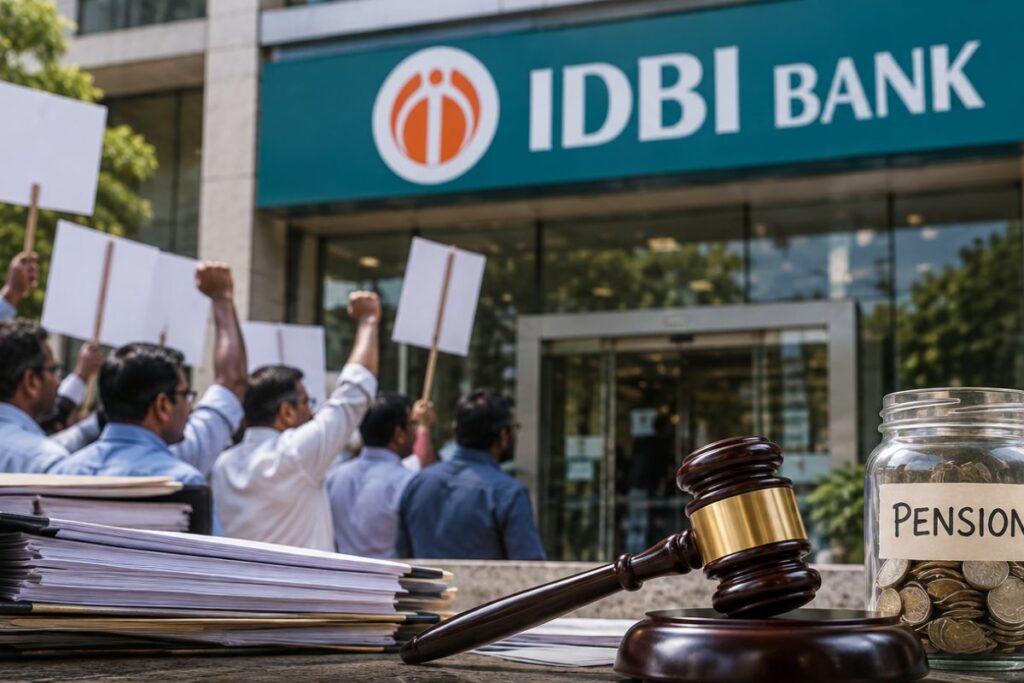
As the Union Ministry of Finance attempts to conclude India’s most closely watched banking privatization, the joint divestment of a 60.72 percent controlling stake in IDBI Bank by the Government of India and the Life Insurance Corporation of India (LIC) has encountered a formidable legal and operational barrier. While transaction advisers at the Department of Investment and Public Asset Management (DIPAM) project a multi-thousand-crore fiscal windfall, employee unions have mounted a coordinated multi-front legal offensive centered on statutory wage protections, bipartite industry negotiations, and sovereign guarantees for a massive legacy pension corpus.
Unlike standard public sector undertaking (PSU) sales, IDBI Bank occupies a unique constitutional and statutory niche. Established as a statutory development financial institution under the Industrial Development Bank of India Act, 1964, and subsequently corporatized under the IDBI Bank (Transfer of Undertaking and Repeal) Act, 2003, the lender carries legacy statutory covenants that legally bind successors. As prospective multinational bidders—led by Canada-based Fairfax Financial Holdings—seek to restructure the bank’s operational cost base, impending High Court writ petitions challenging the dilution of these protected employment terms threaten to freeze transaction milestones into protracted judicial paralysis.
The 60.72% Strategic Divestment Framework: DIPAM Timeline vs. Employee Resistance
The financial architecture of the IDBI Bank transaction represents a historic departure for the Indian banking sector. Together, the Government of India (holding 45.48 percent) and state-owned insurer LIC (holding 49.24 percent) control 94.72 percent of the lender’s equity capital. Under the strategic disinvestment mandate approved by the Cabinet Committee on Economic Affairs (CCEA), the government is offloading 30.48 percent and LIC is offloading 30.24 percent, transferring management control alongside an aggregate 60.72 percent equity stake to an incoming private promoter.
However, the United Forum of IDBI Officers and Employees—representing the All India IDBI Officers’ Association (AIIDIOA) and the IDBI Bank Employees Association (IBEA)—has submitted an uncompromising charter of demands to the Department of Financial Services (DFS). The union charter demands statutory guarantees that any incoming private owner must maintain parity with public sector Indian Banks’ Association (IBA) bipartite wage settlements, guarantee lifetime employment continuity without forced golden handshakes, and preserve defined-benefit pension indexation.
This institutional friction over long-term liabilities mirrors the legal bottlenecks examined in Clarity Times’ investigation into how protracted corporate litigation traps thousands of crores in disputed trade receivables, showing how legacy balance sheet disputes routinely disrupt statutory execution timelines.
The IDBI Bank (Repeal) Act, 2003: The Statutory Clash Over Protected Service Conditions
The primary legal battleground centers on the statutory guarantees embedded in the IDBI (Transfer of Undertaking and Repeal) Act of 2003. When Parliament transitioned IDBI from a specialized statutory development bank into a commercial banking company under the Companies Act, employees mounted fierce resistance.
To quell workforce unrest, Parliament enacted Section 5(1) of the Repeal Act, which explicitly mandated that every officer and employee transferred to the corporatized entity would continue to hold office on the exact same terms, remuneration, and tenure of service. Crucially, the statute affirmed that employees’ service conditions could not be altered to their detriment without statutory legislative sanction.
Labor law litigators representing the employee unions argue that selling majority control to a private conglomerate violates these foundational parliamentary commitments. If a private buyer seeks to rationalize branch networks, introduce hire-and-fire performance contracts, or replace standardized IBA pay scales with discretionary incentive structures, union attorneys are prepared to argue before the High Courts that such changes constitute an illegal ultra vires breach of statutory service covenants.
Shareholding and Transaction Architecture: GoI and LIC Joint Divestment Metrics
The table below summarizes the equity distribution, planned divestment tranches, and residual state holdings governing the IDBI Bank privatization framework:
| Shareholder Entity | Pre-Transaction Equity Holding | Divestment Tranche | Post-Transaction Residual Holding | Regulatory Strategic Role |
|---|---|---|---|---|
| Government of India (GoI) | 45.48% | 30.48% | 15.00% | Retains passive minority holding; loses board veto control |
| Life Insurance Corporation (LIC) | 49.24% | 30.24% | 19.00% | Reduces stake to meet RBI non-promoter cap; retains bancassurance tie-up |
| Total Sovereign / State Pool | 94.72% | 60.72% (Controlling) | 34.00% | Combined residual state stake of 34% prevents hostile third-party hostile takeovers |
| Public / Retail Shareholders | 5.28% | 0.00% | 5.28% | Subject to mandatory SEBI open-offer triggers by incoming acquirer |
The Unfunded Pension Corpus Dispute: Sovereign Guarantee Demands vs. Private Buyer Liabilities
While equity valuation captures investment banking headlines, the most contentious financial roadblock is the bank’s legacy defined-benefit pension scheme. Unlike modern private sector lenders whose employees participate in defined-contribution National Pension System (NPS) structures, IDBI Bank carries thousands of legacy retirees and senior officers enrolled in a defined-benefit pension trust fund.
Actuarial disclosures in IDBI Bank’s annual reports indicate that maintaining this defined-benefit fund requires regular supplementary cash injections to bridge yield shortfalls caused by fluctuating interest rates and increasing life expectancy. Employee associations contend that transferring majority ownership to a private entity without a sovereign counter-guarantee from the Ministry of Finance exposes thousands of retirees to potential fund default if the private management experiences commercial stress.
Conversely, prospective private bidders view an open-ended, under-funded defined-benefit pension liability as a commercial deal-breaker. Private equity models require predictable liability boundaries; absorbing an indexed defined-benefit scheme with unlimited actuarial deficit exposure severely depresses the valuation multiple bidders are willing to offer DIPAM.
This tension reflects broader labor market restructuring trends examined in Clarity Times’ report on how modern enterprise balance sheets aggressively minimize long-term pension liabilities, showing how corporate buyers seek to insulate earnings from permanent workforce overhead.
The High Court Writ Arsenal: Precedents of Judicial Stays on Banking Privatization
To halt the transaction before share-purchase agreements are executed, employee associations have readied writ petitions for filing before the Bombay and Delhi High Courts under Article 226 of the Constitution of India. The legal strategy draws direct inspiration from historical judicial interventions in public asset sales.
In prior disinvestment disputes—such as the legal challenges surrounding Bharat Petroleum Corporation Limited (BPCL) and the corporatization of public defense production units—interim judicial scrutiny forced the government to issue detailed affidavits addressing job security, pension portability, and reservation quotas for marginalized communities. If a High Court division bench admits the IDBI writ petition and issues an interim order directing maintenance of status quo pending statutory clarification, the disinvestment timeline will immediately slip past projected fiscal-year targets.
Regulatory Hurdles: RBI Fit-and-Proper Clearances and the 26% Promoter Voting Cap
Beyond judicial and labor resistance, the transaction faces a complex regulatory clearance gauntlet from the Reserve Bank of India (RBI). Under statutory banking ownership regulations, the RBI enforces strict “fit-and-proper” criteria for any entity acquiring more than 5 percent of a commercial bank.
Furthermore, under the Master Directions on Ownership in Private Sector Banks, promoter shareholding is capped at 26 percent of paid-up voting equity after an initial 15-year glide path. If Fairfax Financial or an overseas consortium acquires 60.72 percent, the RBI must grant special statutory exemptions permitting foreign non-banking entities to exercise majority control without immediate dilution. Navigating these regulatory concessions while simultaneously defending against union litigation leaves DIPAM walking an extraordinarily narrow operational tightrope.
Related In-Depth Investigations
- Examine our balance sheet report on the complex corporate litigation and regulatory hurdles delaying trade receivables conversion.
- Read our analysis on how corporate balance sheets re-engineer permanent labor liabilities into variable third-party contracts.
- Explore our financial dispatch on how commercial banking treasuries navigate cross-border regulatory arbitrage and swap windows.

Clarity Times Markets & Economy Desk
The Clarity Times Markets & Economy Desk tracks corporate balance sheets, Reserve Bank of India monetary policy, trade flows, and industrial infrastructure.