At Clarity Times, we examine what mainstream narratives omit. This dispatch investigates institutional incentives, policy fine print, and multi-dimensional community impacts.
Getting Alzheimer’s disease is rarely the direct result of failing to eat right or do puzzles. While daily habits offer a small cognitive buffer, new data shows environmental causes of dementia, specifically localized particulate air pollution and prohibitive hearing aid costs, frequently override individual lifestyle choices.
Does a “Brain Health” Lifestyle Prevent Dementia?
A “brain health” lifestyle provides marginal cognitive benefits, but public health messaging often overstates its power, leading to misplaced guilt when patients eventually develop dementia.
Major initiatives, such as the Alzheimer’s Association’s “(re)think your brain” campaign, urge the public to build new habits to protect their cognitive health. This hyper-individualized focus produces a documented psychological side effect.
Caregiver support organizations, like Bridges by Epoch, note that guilt is one of the most corrosive emotions families face. Relatives constantly wonder if they could have done more to prevent a loved one’s decline. If dementia is presented as preventable through diet, a diagnosis suggests the patient simply did not try hard enough.
What Environmental Causes of Dementia Override Lifestyle?
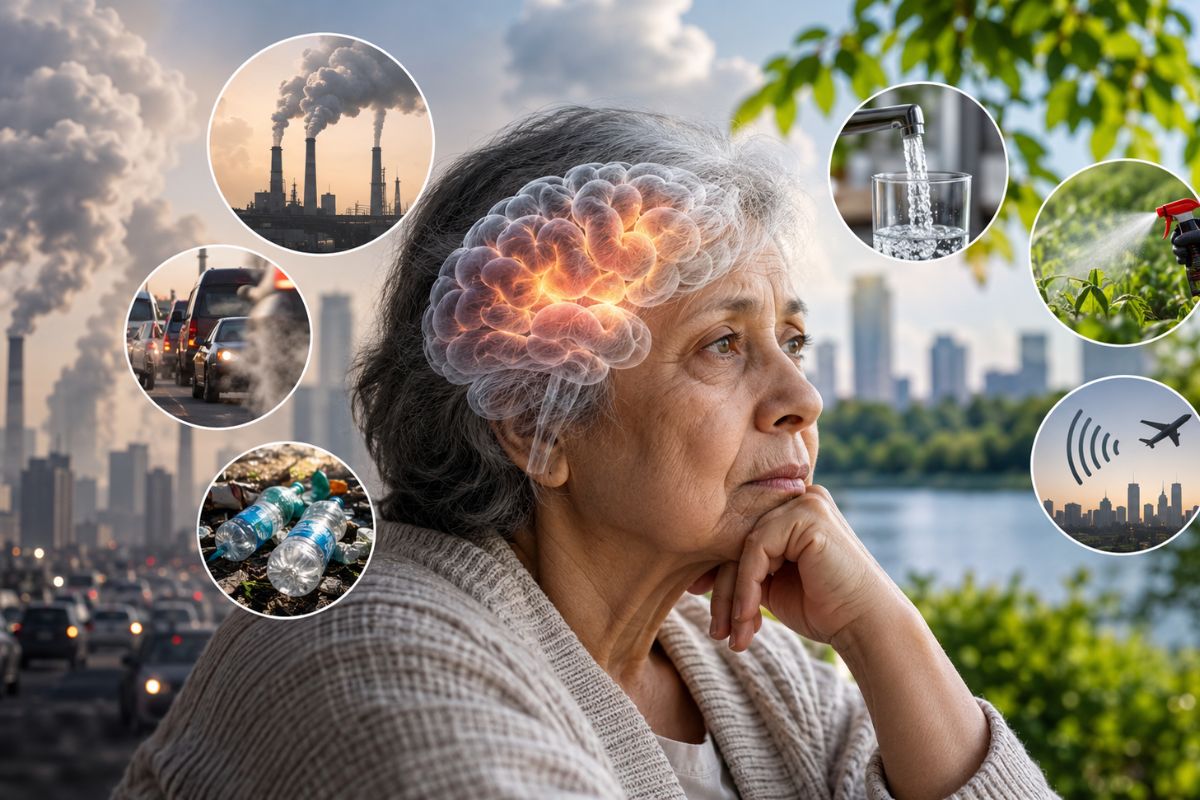
Geographic data shows that systemic environmental factors, such as high levels of PM2.5 air pollution, drive dementia clusters at higher rates than poor individual dietary habits.
A long-term study analyzing Medicare beneficiaries over 15 years found that a 10 percent increase in average PM2.5 exposure, fine, inhalable particles from vehicle exhaust and industrial emissions, boosts the probability of developing dementia by 8 percent. According to the Stanford Institute for Economic Policy Research, this environmental risk is roughly twice as large as the increased risk associated with hypertension.
Residents in highly polluted zip codes develop dementia at higher rates than those in clean-air regions, regardless of how well they eat or exercise.
The biological mechanism is direct. Research published in the journal Frontiers in Molecular Neuroscience shows that PM2.5 particles bypass pulmonary defenses and enter brain tissue directly via the olfactory nerve. Once inside, the particles activate the brain’s resident immune cells, triggering severe neuroinflammation.
How Does the Cost of Hearing Aids Affect Dementia Risk?
Untreated hearing loss is a primary driver of cognitive decline, but the high out-of-pocket cost of hearing aids prevents low-income populations from accessing this critical protection.
The 2024 Lancet Commission identifies untreated hearing loss as a primary risk factor for dementia. Yet, the barrier to treating it is economic rather than behavioral.
According to HearingLife, the average retail cost of hearing aids in 2024 ranges between $3,000 and $8,700 per pair. Because Medicare Part B historically excludes routine audiology care, paying out-of-pocket is impossible for many retirees.
A 2024 review by the Canadian Journal of Health Technologies noted that positioning hearing restoration as a dementia prevention strategy while requiring high out-of-pocket costs exacerbates systemic health inequities for low-income populations.
Are 45% of Dementia Cases Actually Preventable?
The claim that 45% of dementia cases are preventable is based on a global population model, not an individual guarantee that healthy choices will stop the disease.
The current focus on personal lifestyle stems from a widely cited metric from the Lancet Commission. The media frequently reports their finding that up to 45% of dementia cases are preventable.
That figure is a mathematical model called a Population Attributable Fraction, which estimates the proportion of disease cases that would never occur if a specific risk factor were completely eliminated across the entire globe.
This is a population-level measurement. According to researchers at the University of Chile, the absolute risk reduction for an individual modifying a single behavior in a clinical trial is vastly smaller, often registering at a fraction of a percent.
How Should Public Health Address Cognitive Decline?
A medically accurate public health approach to dementia requires tackling systemic infrastructure issues, like enforcing clean air regulations, rather than focusing solely on individual behavioral changes.
Major public health organizations maintain that behavioral messaging remains necessary. The Alzheimer’s Association argues that multidomain lifestyle interventions offer a statistically significant cognitive buffer. Their representatives emphasize that structured programs empower communities and give the public actionable daily steps.
Dementia advocates argue this approach fails without structural intervention. Treating dementia as a systemic issue yields massive results. According to the Stanford Institute for Economic Policy Research, enforcing existing Environmental Protection Agency (EPA) regulations on PM2.5 prevented 182,000 cases of dementia in a single year.
This shift requires moving the primary focus from the grocery store aisle to the city planning office.
Frequently Asked Questions
Can a healthy lifestyle guarantee I won’t get Alzheimer’s? No. While diet and exercise provide a small cognitive buffer, they cannot guarantee prevention. Systemic factors like air pollution exposure and untreated hearing loss frequently override personal habits.
How does air pollution cause dementia? Fine particulate matter (PM2.5) from vehicle exhaust and industrial emissions can travel directly into brain tissue through the olfactory nerve. Once there, these particles trigger severe neuroinflammation that accelerates cognitive decline.
Why is hearing loss linked to Alzheimer’s disease risk? Untreated hearing loss is a major risk factor for dementia, but preventing it is often blocked by economics. High out-of-pocket costs for hearing aids and the lack of Medicare Part B coverage mean many older adults cannot access this necessary sensory care.
Editorial Independence & Corrections
Clarity Times is published by Beeps Venture Technologies LLP under strict editorial independence charters. We uphold rigorous sourcing and verification protocols. Noticed a factual omission or error? Review our Correction Protocols or contact our editorial desk at mail@claritytimes.org.

Praseetha K
Investigative journalist and research analyst contributing independent field reports and structural analysis for Clarity Times.