
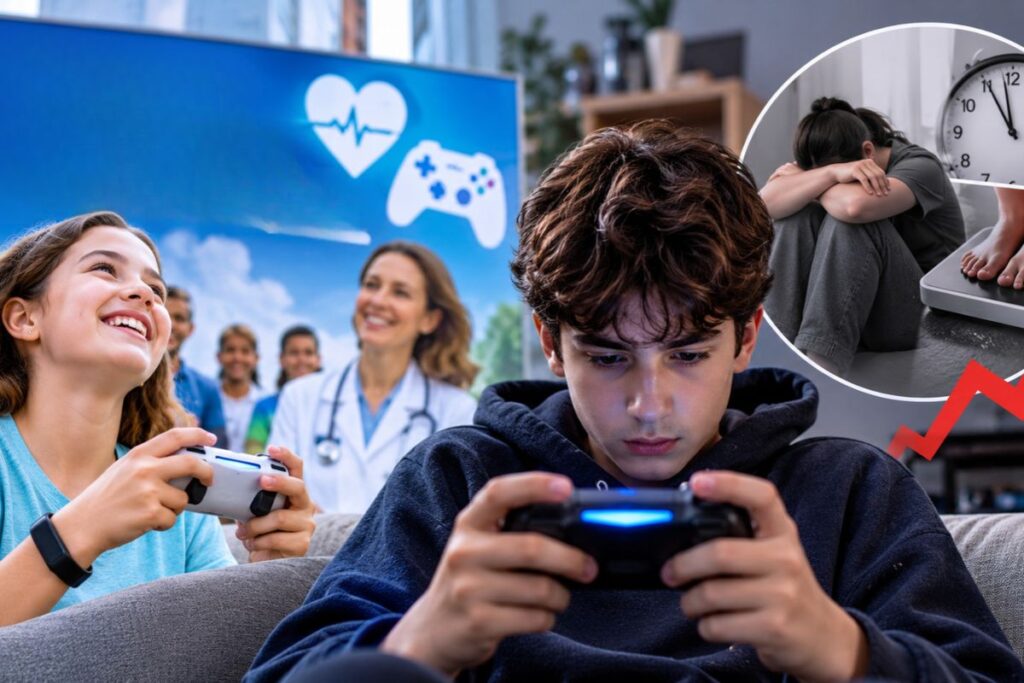
Educational and therapeutic health video games rarely hold users long-term once initial novelty, supervision, and grant funding expire. Evidence from the 2006–2016 school “exergaming” boom and first-wave prescription digital therapeutics shows sharp engagement drops after eight to 16 weeks, followed by insurer reimbursement denials and broken school hardware that districts cannot afford to maintain.
What Happened to First-Wave Prescription and School Health Video Games?
First-generation prescription health video games and statewide school exergaming programs ended in Chapter 11 bankruptcies, distressed corporate sales, and abandoned classroom hardware between 2006 and 2024. Public health researchers and technology firms had already poured hundreds of millions of dollars in venture capital, federal grants, and state education funds into testing whether game mechanics produce lasting behavioral change.
Prescription digital therapeutics are software-based treatments evaluated in randomized clinical trials and prescribed by licensed clinicians like medication. Akili Interactive won U.S. Food and Drug Administration (FDA) De Novo clearance in June 2020 for EndeavorRx, an action video game designed to improve attention function in children ages 8 to 12 with attention-deficit/hyperactivity disorder (ADHD).
Despite regulatory clearance and a 2022 public debut valuing the firm near $1 billion, commercial adoption stalled. According to Akili Interactive’s 2023 full-year financial disclosures, annual revenue reached $1.68 million against a GAAP net loss of $59.5 million.
After eliminating 40% of its workforce in September 2023 to abandon the prescription model and cutting another 46% of remaining staff in May 2024, Akili accepted an all-cash acquisition by Virtual Therapeutics at $0.4340 per share, roughly $34 million, per its Securities and Exchange Commission (SEC) Schedule 14D-9 filing.
Pear Therapeutics, which commercialized the first three FDA-authorized prescription behavioral software programs, followed a parallel collapse. In its 2022 Form 10-K filing, Pear warned of going-concern risks after recording a $75.5 million net loss and pausing pipeline development.
On April 7, 2023, Pear Therapeutics filed for Chapter 11 bankruptcy in Delaware with $30 million in funded debt, laid off more than 90% of its workforce, and sold its assets at bankruptcy auction for $6.05 million across four buyers, a fraction of the more than $400 million invested in the company.
Public school rollouts of exergames, video games that require physical body movement to play, followed the same trajectory a decade earlier. In January 2006, Konami Digital Entertainment and the West Virginia Public Employees Insurance Agency launched a three-year statewide partnership to install Dance Dance Revolution (DDR) systems across all 765 West Virginia public schools to combat childhood obesity.
While state health plans promoted the rollout across elementary schools and senior centers, a 2016 Journal of Pediatrics systematic review later concluded that evidence supporting sustained school-day health improvements was insufficient. Once initial seed grants and corporate partnerships ended, districts faced ongoing replacement costs for worn dance pads and consoles out of baseline budgets, leaving hardware unused in storage closets.
How Does Today’s “Breakthrough” Coverage Compare to Yesterday’s Press Releases?
Current media coverage of serious health games repeats the exact promotional framing used during the 2006–2012 school exergaming rollout and the 2020 launch of prescription video games. Serious health games are digital games designed specifically to teach health behaviors or deliver clinical therapy rather than pure entertainment.
A new wave of virtual reality (VR) and serious health games, highlighted in coverage of Yale University’s XRPeds Lab and University of New Haven public health showcases, is drawing institutional attention by embedding behavioral science into interactive reward loops.
In 2006, West Virginia state officials described Dance Dance Revolution as a unique way to turn screen time into active time; in 2022, Pear Therapeutics executives framed software as a transformational category of medicine. Both waves rely on controlled pilot studies showing short-term gains in health knowledge or task performance while participants are actively supervised.
What Does Longitudinal Data Show About Long-Term User Retention?
Longitudinal studies tracking voluntary usage outside short trial windows show that player engagement drops sharply after eight to 16 weeks once external reminders stop. Researchers call this drop-off “novelty decay”, the rapid decline in user participation after the initial excitement of a new game wears off.
In a peer-reviewed study of school dance-mat exergaming systems published via the National Library of Medicine, teachers reported strong initial student interest followed by a steep drop in engagement after a few weeks. Subsequent systematic reviews of active video games and VR cognitive-motor exergaming trials confirm that retention of gains beyond eight weeks is limited without continuous external prompting.
Even in adolescent and young adult cohorts tracked over longer windows, sustained participation erodes. According to a longitudinal investigation of adolescent exergaming, 56.5% of teen players (105 of 186 tracked exergamers) stopped exergaming between Grade 9 and Grade 11.
A separate longitudinal cohort study in JMIR Serious Games tracking 681 young adults found that more than twice as many participants quit exergaming (134) as started it (56). Among those who sustained play, median moderate-to-vigorous physical activity fell from 180 minutes to 66 minutes per week.
Why Do Insurers and School Systems Reject Health Games After Trials End?
Health video games stall after clinical trials because commercial health insurers refuse reimbursement without multi-year cost savings, and public schools lack budgets for ongoing hardware maintenance.
In healthcare, FDA clearance did not guarantee insurance payment. A qualitative study of U.S. health insurance medical and pharmacy directors found that payers routinely denied coverage for FDA-cleared digital therapeutics, demanding multi-year proof of reduced overall medical spending rather than short-term clinical test scores. In its 2021 operating disclosures, Pear Therapeutics reported that only 51% of prescriptions written for its three commercial products were ever fulfilled due to coverage gaps and out-of-pocket costs.
In public schools, the bottleneck is operational upkeep. The 2016 Journal of Pediatrics systematic review of 22 school active-video-game reports noted that classroom hardware deployments struggled to extend activity beyond narrow physical-education blocks. Dedicated gaming consoles, floor sensors, and VR headsets require recurring IT troubleshooting, device sanitization between 30-minute class periods, and replacement budgets that one-time pilot grants do not fund.
What Must Change for the 2026 Wave of Health Video Games to Survive?
To avoid repeating the 2006–2016 collapse, federal grantmakers and school districts must pair initial game development funds with multi-year maintenance budgets and mandatory 12-month retention tracking.
Current developers of serious health games argue that modern educational tools avoid several structural flaws that undercut earlier waves. Rather than relying on proprietary consoles or prescription-only insurance billing, projects such as Yale XRPeds Lab’s vaping-prevention simulation Invite Only VR run on existing hardware and target specific skill rehearsal, such as practicing peer-pressure refusal, rather than daily physical exertion.
Proponents also note that distributing educational games through free public-health portals or direct school-curriculum licensing bypasses the payer reimbursement bottleneck that bankrupted Pear Therapeutics and forced Akili Interactive to abandon prescriptions.
Federal research funding structures, however, still reward the same short-term study designs that masked retention failures a decade ago. An analysis of National Institutes of Health (NIH)-funded mobile and gamified health intervention grants found that federal awards heavily favor early-stage development and short pilot evaluations. Similarly, systematic reviews of serious games in health education show that most trials measure outcomes immediately post-intervention rather than tracking 12-month real-world survival.
Until funders require multi-year software upkeep and long-term usage audits, the current wave of public health video games faces the same commercial and classroom cliff as its predecessors.
Frequently Asked Questions
Do educational and therapeutic health video games work long-term?
Health video games frequently produce short-term gains in knowledge or attention during supervised clinical trials, but voluntary engagement drops sharply after eight to 16 weeks. In a longitudinal study of 186 teen exergamers, 56.5% stopped playing between Grade 9 and Grade 11 once structured school or study prompts ended.
Why did FDA-cleared prescription video game companies like Akili Interactive and Pear Therapeutics fail commercially?
Both companies failed because commercial health insurers refused to reimburse prescription software without multi-year proof of lower medical spending, leaving patients with high out-of-pocket costs. Pear Therapeutics filed for Chapter 11 bankruptcy in April 2023 with $30 million in debt after only 51% of prescriptions were fulfilled, while Akili Interactive sold for roughly $34 million in 2024 after annual revenue reached just $1.68 million against a $59.5 million loss.
What happened to the statewide school exergaming programs launched in the 2000s?
Programs like West Virginia’s 2006 rollout of Dance Dance Revolution across 765 public schools stalled once initial state and corporate seed grants expired. School districts lacked baseline operating funds to replace worn dance pads, repair consoles, and maintain hardware, leading to widespread decommissioning.
How does the 2026 wave of VR and serious health games differ from earlier exergames?
Newer serious health games, such as Yale XRPeds Lab’s Invite Only VR, focus on targeted behavioral skill rehearsal like vaping refusal rather than daily physical exertion, and many avoid prescription insurance billing by distributing directly to schools or public-health portals. However, NIH grant analyses show federal funding still prioritizes short pilot endpoints over 12-month retention tracking and post-grant IT maintenance.

Praseetha K
Praseetha K is the Managing Editor of Clarity Times. She edits, verifies and publishes the newsroom's articles, and also writes analysis on policy, law, business and technology. Articles she writes are edited by the Editor-in-Chief before publication.