
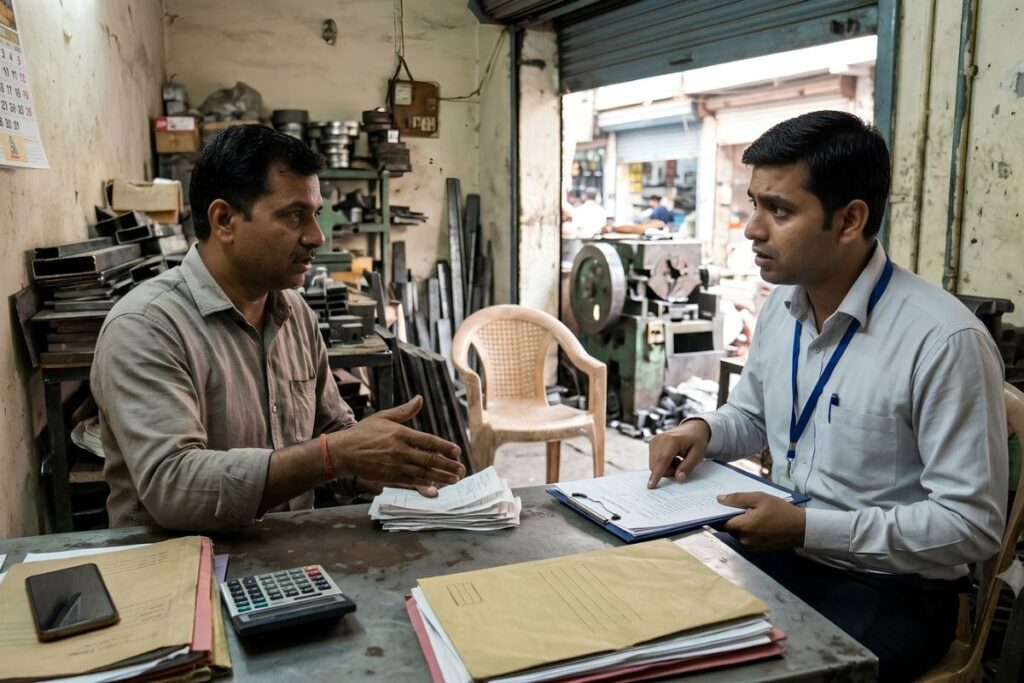
Indian banks turn away profitable small business owners with 730-plus personal CIBIL scores because enterprise loan underwriting in India demands multi-year Goods and Services Tax (GST) returns, audited entity balance sheets, and formal business registration, criteria a personal credit score cannot replace, pushing borrowers back toward costlier individual loans.
Why Does an Enterprise Loan Rejection Happen Despite a 730+ CIBIL Score?
An enterprise loan rejection in India occurs because bank credit committees evaluate business entity solvency rather than the owner’s personal consumer repayment history. A high personal credit score opens the door at a retail loan counter, yet commercial underwriting stalls within minutes when an applicant lacks audited company books.
Because many sole proprietors borrow on an individual Permanent Account Number (PAN), a ten-character tax identifier issued to individuals or entities by the Indian Income Tax Department, branches cannot process their files under commercial credit rules. According to Bank of Baroda’s business loan documentation requirements, formal enterprise facilities require entity registration proof, six to 12 months of business bank statements, one to three years of Income Tax Returns (ITR), and audited balance sheets and profit-and-loss statements.
What Do the TransUnion CIBIL and NSIC Numbers Actually Hide?
The headline figures show 39 lakh small business owners enquiring about enterprise credit without converting, but they omit how commercial credit scoring disqualifies borrowers who only hold personal loan histories.
According to a November 27, 2026 joint study released by TransUnion CIBIL and the National Small Industries Corporation (NSIC), 3.9 crore out of 4.1 crore individual business borrowers in India, 95 percent, have never borrowed in an enterprise capacity. Of those 3.9 crore borrowers, 63 percent hold a personal CIBIL score of 730 or higher, and 54 percent carry more than two years of business-credit experience. Total micro-business credit reached ₹29.6 lakh crore by June 2026, expanding at a 21 percent three-year compound annual rate for individual entrepreneurs compared to 12 percent for formal enterprises.
Consumer CIBIL scores measure individual repayment discipline on a 300-to-900 scale, whereas commercial lenders rely on the CIBIL MSME Rank (CMR) framework. CMR is a 1-to-10 commercial risk score generated by TransUnion CIBIL only after a business holds an established commercial bureau credit file and entity-level reporting. According to TransUnion CIBIL’s Micro Business Entrepreneurs report, 75 percent of unsecured business loan balances held by individual entrepreneurs sit on consumer credit files rather than commercial entity accounts.
How Do Bank Underwriting Rules Separate Consumer Scores From Commercial Files?
Public and private lenders apply two separate credit rulebooks: individual business loans rely on personal tax IDs and bank statements, whereas enterprise working-capital facilities demand audited entity financials and multi-year GST filings.
- Individual business-purpose loans: Underwritten against the owner’s personal PAN, personal CIBIL score, and recent bank-statement cash flows, allowing fast approvals without multi-year entity audits.
- Enterprise working-capital facilities: Underwritten against an entity PAN, Udyam registration, the Indian government’s official classification certificate for Micro, Small, and Medium Enterprises, audited profit-and-loss statements, and multi-year tax filings. Under the State Bank of India (SBI) MSME document checklist, enterprise applicants must submit three years of audited financials with tax audit reports, three years of acknowledged ITRs, and two years of GST or VAT returns. Similarly, HDFC Bank’s business loan documentation rules require Chartered Accountant-certified balance sheets and profit-and-loss accounts for the previous two years alongside proof of business continuity.
Commercial lenders state that this documentary divide reflects prudential risk control rather than arbitrary gatekeeping. Under the Reserve Bank of India (RBI) Master Direction on Lending to the MSME Sector (Amendment) Directions, 2026, effective April 1, 2026, banks are mandated not to accept collateral security on loans up to ₹20 lakh extended to Micro and Small Enterprises (MSEs). Because banks cannot fall back on property collateral below ₹20 lakh, credit committees rely strictly on verified tax returns and audited cash flows that a personal consumer credit score does not capture.
How Much Extra Do Borrowers Pay After Walking Away From Enterprise Loans?
Entrepreneurs who fall back on individual unsecured business loans pay roughly 3 to 13 percentage points more in annual interest than borrowers who qualify for benchmark-linked enterprise MSME facilities.
Walking away from an enterprise application does not stop an entrepreneur from borrowing; it redirects them toward individual unsecured business loans, loans against property, and gold loans. According to the Central Bank of India’s MSME interest rate schedule, general MSME and GST-backed enterprise loans linked to its 8.25 percent Repo-Based Lending Rate are priced between 7.75 percent and 9.20 percent per annum. By contrast, HDFC Bank’s unsecured business loan rate schedule ranges from 10.75 percent to 22.50 percent per annum.
For a micro-enterprise operating on thin trading margins, that rate spread compounds every quarter. Borrowers retain immediate liquidity without hiring a chartered accountant or formalizing multi-year tax filings, but they absorb a recurring interest penalty over formal enterprise cash-credit lines.
Why Haven’t Collateral-Free Guarantee Schemes Solved the Documentation Gap?
Government guarantee schemes remove property collateral requirements, yet banks still require Udyam registration, pass annual guarantee fees to borrowers, and face an 18-month claim lock-in that discourages branch officers from approving thin-file enterprise loans.
Policy architects point to consent-based digital data rails as the bridge across this divide. As detailed in the Small Industries Development Bank of India (SIDBI) Account Aggregator framework guide and its GST Sahay invoice-financing platform, lenders are deploying digital underwriting using Goods and Services Tax Network (GSTN) data and bank statements so thin-file businesses can prove revenue without physical paperwork.
At the branch level, however, guarantee schemes do not eliminate compliance friction or borrower costs. Under the Credit Guarantee Fund Trust for Micro and Small Enterprises (CGTMSE) 2026 fee and coverage structure, eligible collateral-free MSE loans up to ₹10 crore carry 75 percent to 90 percent default cover, and a valid Udyam Registration Number is mandatory. Lenders pay an annual guarantee fee starting at 0.37 percent for loans up to ₹10 lakh and 0.55 percent for loans between ₹10 lakh and ₹50 lakh, plus 18 percent GST, which banks routinely recover from the borrower. CGTMSE covers the bank only after an 18-month lock-in period (nine months for loans up to ₹10 lakh) and formal recovery proceedings, leaving branch officers exposed to early-default scrutiny if they sanction thin-file enterprise accounts without audited books.
Until commercial underwriting accepts real-time digital cash flows in place of multi-year audited balance sheets, a high personal CIBIL score will remain a ticket to retail credit, not an enterprise loan.
Frequently Asked Questions
Why do Indian banks reject enterprise loan applications from business owners with a 730+ CIBIL score?
A personal CIBIL score tracks individual consumer repayment history on a 300-to-900 scale, whereas commercial bank credit committees require entity-level solvency proof. According to State Bank of India and HDFC Bank MSME checklists, enterprise facilities require Udyam registration, two to three years of audited profit-and-loss statements, and multi-year GST returns that sole proprietors borrowing on personal PANs often lack.
How many creditworthy individual business borrowers in India have never accessed enterprise credit?
According to a November 27, 2026 joint study by TransUnion CIBIL and the National Small Industries Corporation (NSIC), 3.9 crore out of 4.1 crore individual business borrowers in India, 95 percent, have never borrowed in an enterprise capacity. Roughly 63 percent of those 3.9 crore borrowers have a personal CIBIL score of 730 or higher, and 39 lakh actively enquired about enterprise credit but did not convert.
What is the interest rate difference between an enterprise MSME loan and an individual unsecured business loan?
Benchmark-linked public-sector MSME loans carry single-digit rates, such as Central Bank of India’s 7.75 percent to 9.20 percent per annum range for general and GST-backed MSME facilities. By comparison, individual unsecured business loans, such as HDFC Bank’s unsecured business loan schedule ranging from 10.75 percent to 22.50 percent per annum, cost roughly 3 to 13 percentage points more.
Do collateral-free CGTMSE loans allow small businesses to borrow without audited financials or GST registration?
No. Under the 2026 Credit Guarantee Fund Trust for Micro and Small Enterprises (CGTMSE) guidelines, a valid Udyam Registration Number is mandatory, and banks pass on annual guarantee fees starting at 0.37 percent to 0.55 percent plus 18 percent GST to the borrower. Because CGTMSE enforces an 18-month claim lock-in period (nine months for loans up to ₹10 lakh), branch officers still require verified tax and financial records before approving enterprise limits.

Praseetha K
Praseetha K is the Managing Editor of Clarity Times. She edits, verifies and publishes the newsroom's articles, and also writes analysis on policy, law, business and technology. Articles she writes are edited by the Editor-in-Chief before publication.