At Clarity Times, we examine what mainstream narratives omit. This dispatch investigates institutional incentives, policy fine print, and multi-dimensional community impacts.
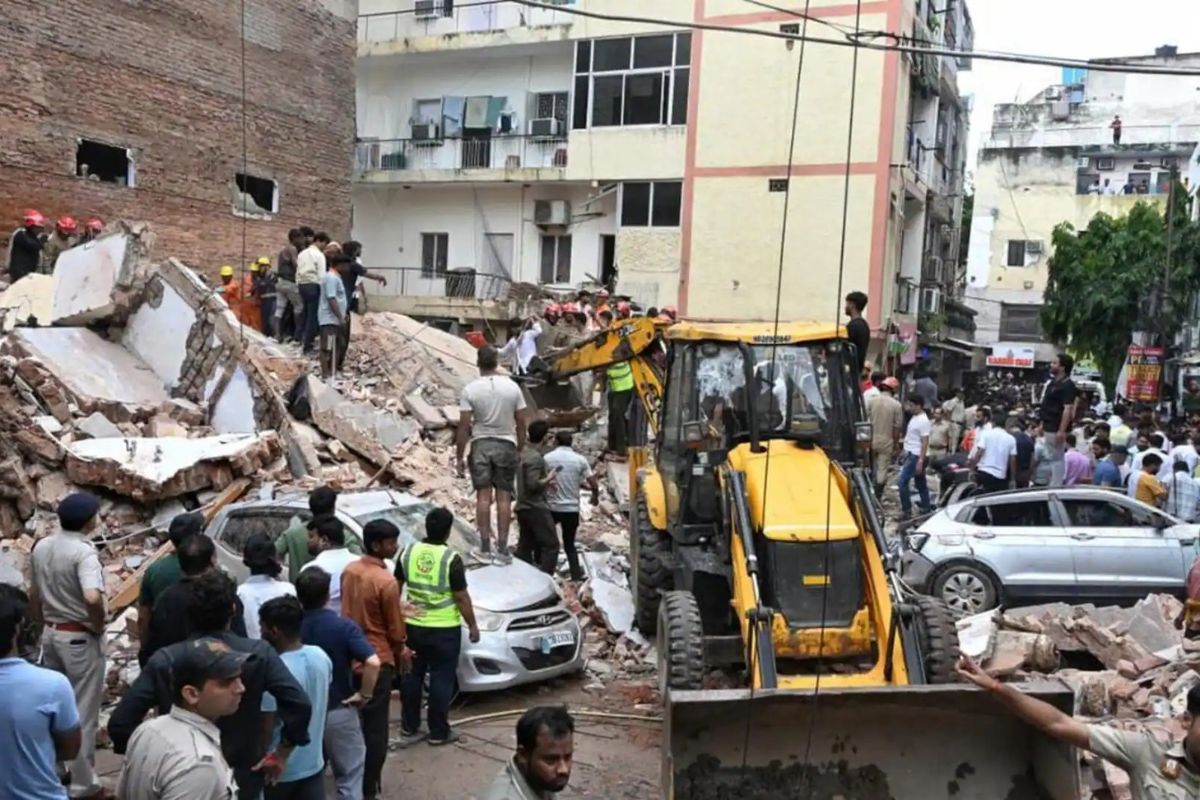
The Delhi PG collapse FIR charges only the building’s private owners. But municipal records show Municipal Corporation of Delhi (MCD) South Zone Junior Engineer Ashish Kumar and local beat officers held active jurisdiction over the site when the illegal floors were built. Despite a statutory duty to halt construction, they are excluded from criminal liability.
A First Information Report (FIR) is the formal document prepared by Indian police to initiate a criminal investigation following a cognizable offense. In this disaster, the document sets a narrow boundary around private guilt.
Who Is Missing From the Delhi PG Collapse FIR?
The initial police filing targets only private citizens, leaving out the state monitors assigned to inspect the property. Registered by Delhi Police, the FIR names property owner Hariram Bansal, his wife Urmila, and his son Mahesh on charges of culpable homicide and negligence. The official charging document stops there.
Cross-referencing the building address with municipal records reveals a parallel roster of civic regulators. According to MCD staffing directives, Junior Engineer Ashish Kumar, Assistant Engineer Sunil Chauhan, and Executive Engineer Lalit Kumar Goel were assigned to manage unauthorized construction in this ward.
At the ground level, patrol officers from the South Campus police station walked this street daily. Neither the MCD engineers nor the local beat police appear as accused parties in the FIR.
When Were the Illegal Floors Built, and Who Held Jurisdiction?
Satellite imagery and neighborhood records establish that the illegal upper floors were erected during the active tenure of the ward’s current engineering desk. The foundation was engineered for a low-rise residential unit, yet additional stories and basement renovations were added in the months immediately preceding the September 6 collapse.
According to civic deployment records, South Zone Deputy Commissioner Rakesh Kumar assumed administrative oversight of the area in February 2026. The fatal structural alterations took place during his administration.
Erecting multiple concrete floors requires months of heavy transit: trucks hauling red bricks, cement mixers idling in narrow residential lanes, and steel girders hoisted overhead. These activities took place in clear view of the beat officers assigned to log unauthorized street activity.
Does Section 343 Make Civic Inaction a Criminal Offense?
State law explicitly mandates municipal engineers to intervene against unauthorized construction rather than treat enforcement as optional. The Municipal Corporation of Delhi operates under the Delhi Municipal Corporation (DMC) Act of 1957, which outlines the legal powers and operational duties of civic authorities.
Specifically, Section 343 of the DMC Act gives municipal engineers the direct authority and legal duty to issue demolition orders and halt unauthorized structural work. When an official ignores an open building violation, that failure can constitute criminal negligence.
Under Indian criminal law, the willful failure to execute a statutory duty that directly causes deaths meets the legal threshold for culpable homicide. Police leveled that exact charge against the building owner. Yet prosecutors did not extend the statute to the public officials who allowed the floors to go up.
Why Were Civic Officials Suspended Rather Than Prosecuted?
The state shielded its staff by routing civic culpability through internal administrative discipline rather than the criminal justice system. Following public outrage, the MCD suspended five civic officials, including the South Zone Deputy Commissioner and four engineers.
MCD representatives argue that enforcement is constrained by a severe imbalance between field inspectors and the sheer volume of unauthorized properties across the capital. Officials also frequently point out that administrative show-cause notices were sent to the owner by mail.
That administrative defense bypasses the agency’s own rules. Internal MCD guidelines require engineers to execute an on-site demolition when an owner disregards a warning notice. The owner ignored the warning; the engineers never returned with a demolition crew.
Instead of treating that administrative inaction as complicity, Delhi Police have kept their criminal case restricted to the arrest of Hariram Bansal and his family.
Frequently Asked Questions
Why are MCD officials missing from the Delhi PG collapse FIR?
The Delhi Police limited the initial criminal FIR to the property owners, treating the collapse as private negligence. Municipal engineers have so far faced only departmental suspension, a civic administrative measure that avoids the criminal charges applied to the landlord.
Which civic officials oversaw the ward when the building was modified?
MCD administrative directives identify Junior Engineer Ashish Kumar, Assistant Engineer Sunil Chauhan, Executive Engineer Lalit Kumar Goel, and South Zone Deputy Commissioner Rakesh Kumar as the officials holding jurisdiction over the ward during the illegal expansion.
What does Section 343 of the DMC Act require engineers to do?
Section 343 of the Delhi Municipal Corporation Act mandates that when unauthorized construction is detected, civic engineers must order work to stop and initiate physical demolition. The law does not permit engineers to leave illegal floors standing simply because a paper notice went unheeded.
How does departmental suspension differ from being charged in an FIR?
Departmental suspension is an internal workplace penalty that temporarily removes an official from active duty with partial pay while an inquiry takes place. An FIR initiates a criminal proceeding that carries non-bailable warrants, police custody, and potential prison sentences for culpable homicide.
Editorial Independence & Corrections
Clarity Times is published by Beeps Venture Technologies LLP under strict editorial independence charters. We uphold rigorous sourcing and verification protocols. Noticed a factual omission or error? Review our Correction Protocols or contact our editorial desk at mail@claritytimes.org.

Praseetha K
Investigative journalist and research analyst contributing independent field reports and structural analysis for Clarity Times.