At Clarity Times, we examine what mainstream narratives omit. This dispatch investigates institutional incentives, policy fine print, and multi-dimensional community impacts.
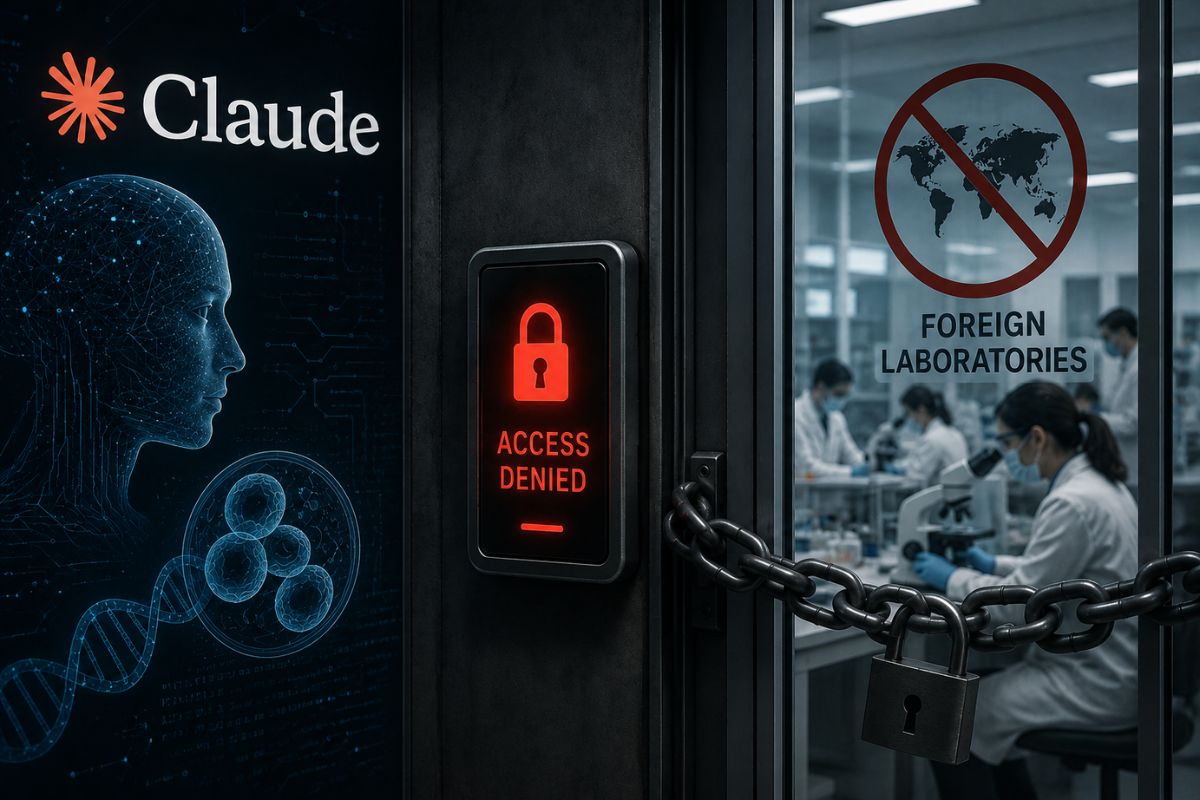
Anthropic’s vetting program for Claude Mythos 5.1 biology access functions as an unlegislated export control. By requiring applicants to clear US government security screening and maintain enterprise-grade compliance certifications, the framework locks international researchers and non-US startups out of frontier protein-design tools regardless of their institutional safety records or scientific credentials.
Why are foreign labs denied Claude Mythos 5.1 biology access?
International computational biology labs are filtered out of Claude Mythos 5.1 access before technical evaluation begins because applicants must satisfy US government screening and private corporate security mandates.
According to Anthropic’s official access application, organizations must explicitly consent to sharing operational data with US federal partners for eligibility and security reviews. Applicants must also document compliance under Service Organization Control (SOC) 2 Type II, Federal Risk and Authorization Management Program (FedRAMP), or International Organization for Standardization (ISO) 27001 certifications.
Early-stage biotech founders outside the United States rarely hold these enterprise-level certifications, nor do they typically maintain sponsorship from US federal agencies like the National Institutes of Health. This creates an administrative barrier that disqualifies non-US entities at the intake questionnaire.
How do Enterprise Frontier Safeguards enforce geographic boundaries?
Anthropic’s Enterprise Frontier Safeguards (EFS) framework requires deployment on customer-controlled private clouds that adhere to US cybersecurity criteria, favoring domestic enterprise infrastructure.
Enterprise Frontier Safeguards-a technical compliance framework allowing approved customers to run models on private cloud infrastructure with zero vendor data retention-binds technical deployment to specific hosting architectures. According to reporting on Anthropic’s enterprise security architecture, EFS was designed to isolate sensitive operations while enforcing strict safety controls.
Because the US government participated directly in crafting the life-sciences vetting rules, the technical verification protocols favor entities operating within US regulatory jurisdictions. American companies can satisfy both the security review and the zero-retention infrastructure requirements, while overseas laboratories face unresolved data-sovereignty hurdles under their domestic laws.
Is restricted access a biosecurity necessity or a commercial barrier?
Anthropic restricts Mythos 5.1 to prevent the generation of synthetic biological weapons, but the blocked computational workflows are identical to those used for benign pharmaceutical development.
According to Anthropic’s biorisk evaluation research, advanced AI models present actionable risks of aiding the design of chemical, biological, radiological, or nuclear (CBRN) threats. Because multilateral nonproliferation treaties move slowly and cannot monitor digital model weights, private pre-screening acts as the primary operational check against misuse.
US-based biotechnology companies also bear real compliance, auditing, and infrastructure costs to clear these federal reviews. Yet the dual-use dilemma remains direct: computational predictions that design novel toxins rely on the exact same molecular-binding mechanisms used to discover therapeutic antibodies.
What is the discovery pipeline penalty for excluded biotechs?
Laboratories denied Mythos 5.1 must perform roughly three to five times more physical laboratory assays to match the predictive accuracy of cleared US firms.
According to performance data published by Anthropic, Claude Mythos 5.1 achieved a target binding success rate of nearly 50 percent across 12 test targets. In contrast, standard industry tools and public baseline models produce hit rates between 10 and 15 percent.
Lead-optimization cycles-the experimental phase where computational designs are synthesized and validated in physical wet labs-carry substantial assay costs. When an unapproved European or Asian laboratory operates at a 10 to 15 percent baseline, it must synthesize dozens of additional physical variants to find a functional molecule. That operational gap multiplies testing budgets and extends drug discovery timelines by months.
Does the Anthropic vetting program bypass formal US export controls?
By coordinating access through voluntary agency security reviews rather than formal export statutes, Anthropic has created an operational trade restriction without administrative rulemaking.
Formal dual-use technology restrictions are typically governed by the US Department of Commerce’s Bureau of Industry and Security (BIS) under the Export Administration Regulations (EAR). Those statutory frameworks require public notice-and-comment periods under the Administrative Procedure Act and mandatory notifications to World Trade Organization partners.
While the Commerce Department has previously reviewed the application of export regulations to AI models, the Mythos 5.1 rollout establishes access controls without statutory processes. A private technology developer, in consultation with federal security officials, now determines which sovereign jurisdictions may utilize frontier biological design tools.
Frequently Asked Questions
What are the primary requirements to access Claude Mythos 5.1 for biology?
Applicants must consent to security screening conducted in partnership with US federal agencies and provide enterprise compliance certifications such as SOC 2 Type II, FedRAMP, or ISO/IEC 27001. Organizations must also meet the cloud-residency standards defined under Anthropic’s Enterprise Frontier Safeguards.
Why are non-US biotechnology startups struggling to get approved?
Most early-stage international startups lack the specific US enterprise certifications and federal grant sponsorships required during the intake phase. As a result, their applications are stalled or rejected before their scientific safety practices are technically reviewed.
How does Claude Mythos 5.1’s protein-design accuracy compare to standard tools?
According to Anthropic’s reported benchmarks, Claude Mythos 5.1 achieved a target binding success rate of nearly 50 percent across 12 test targets. Standard public models and baseline computational tools typically reach success rates of 10 to 15 percent.
Does the Claude Mythos 5.1 vetting process violate formal export regulations?
The process does not violate existing statutes; rather, it operates outside formal Bureau of Industry and Security regulations. By using voluntary corporate-government vetting instead of official export controls, Anthropic bypasses standard Administrative Procedure Act notice-and-comment procedures.
Editorial Independence & Corrections
Clarity Times is published by Beeps Venture Technologies LLP under strict editorial independence charters. We uphold rigorous sourcing and verification protocols. Noticed a factual omission or error? Review our Correction Protocols or contact our editorial desk at mail@claritytimes.org.

Praseetha K
Investigative journalist and research analyst contributing independent field reports and structural analysis for Clarity Times.